By Mathew Mattam
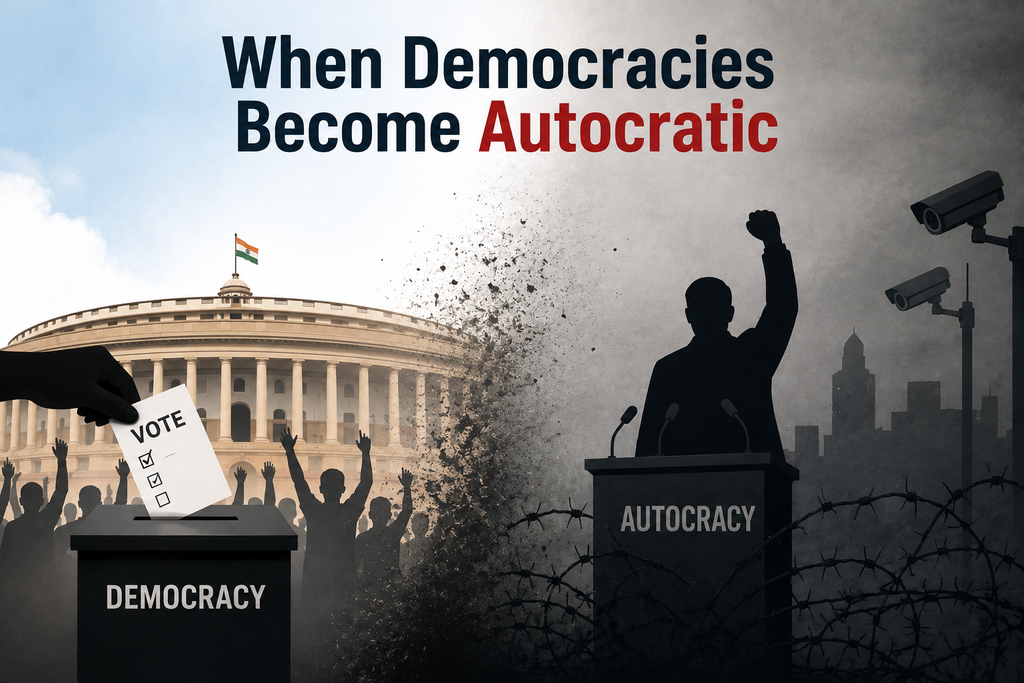
In the twenty-first century, democracy rarely disappears through a single military takeover. More often, it is weakened gradually by elected governments. Constitutions remain in place, elections are held, parliaments meet and courts continue to function, but the contest for power becomes increasingly unequal. Ruling parties capture public institutions, influence the media, restrict civil society and use investigative agencies, security laws or regulatory powers selectively against opponents. Political scientists describe such systems as “illiberal democracies,” “competitive authoritarian regimes” or “electoral autocracies.” Whatever terminology is used, the central contradiction is the same: electoral legitimacy is retained while democratic accountability is steadily removed.
Freedom House’s Freedom in the World 2026 report captures the scale of this danger. Assessing developments during 2025, it found that global freedom declined for the twentieth consecutive year. Political rights and civil liberties deteriorated in 54 countries, while only 35 recorded improvements. The report measures more than elections. It examines political pluralism, government accountability, freedom of expression and association, the rule of law, personal autonomy and whether rights can be exercised in practice. Its findings therefore ask a deeper question: not merely whether people vote, but whether they can organise, criticise, seek justice and replace those in power.
The most severe declines occurred in Guinea-Bissau, where a coup disrupted the electoral process, and Tanzania, where opposition exclusion, disappearances, media restrictions and violence surrounded the election. Burkina Faso, Madagascar and El Salvador followed. Georgia and Togo also suffered major setbacks. Bulgaria, Côte d’Ivoire, Mali, Myanmar, Nepal, Niger, Serbia and the United States each lost three points. Burundi, Guinea, Haiti, Italy, Kenya, Maldives and Tunisia lost two.
The remaining one-point declines occurred in Australia, Azerbaijan, Bangladesh, Belgium, Belize, Cambodia, Colombia, Comoros, Cuba, Cyprus, the Dominican Republic, Ecuador, Honduras, India, Iran, Kuwait, Kyrgyzstan, Mauritania, Mexico, Montenegro, Panama, Peru, Slovakia, Solomon Islands, South Sudan, Sudan, Taiwan, Thailand, Tonga, Turkey, Uganda and Zimbabwe. These countries differ greatly in history, wealth and political system. Their presence in the same list demonstrates that democratic erosion is neither confined to poor states nor limited to openly authoritarian regimes.
Some cases illustrate how elected authority can be converted into concentrated power. Hungary remains a leading example. Under Viktor Orbán and Fidesz, constitutional amendments, judicial appointments, media concentration and electoral-rule changes have tilted the political field towards the government. Turkey’s shift from parliamentary government to an executive presidency under Recep Tayyip Erdoğan has been accompanied by extensive pressure on journalists, judges, academics, civil-society activists and opposition politicians. Tunisia, once the strongest democratic hope to emerge from the Arab Spring, moved towards presidential dominance after Kaïs Saïed suspended and dissolved Parliament and secured a constitution that weakened institutional checks.
Serbia displays a slower form of institutional capture: elections and opposition parties survive, but media dominance, state resources and pressure on critics undermine genuine competition. Georgia’s restrictive legislation, pressure on civic organisations and disproportionate policing of protests have accelerated its decline. Thailand still holds civilian elections, yet military influence, court interventions and restrictive monarchy-related laws limit democratic choice. In the Philippines, the legacy of Rodrigo Duterte’s violent “war on drugs,” attacks on journalists and impunity continues to burden democratic accountability, even though the country’s aggregate score did not decline in the 2026 edition.
El Salvador demonstrates why popularity cannot substitute for constitutional restraint. President Nayib Bukele’s campaign against gangs has attracted substantial public support, but prolonged emergency rule, mass detention, weakened due process, attacks on independent media and judicial restructuring have concentrated power. In 2025, the legislature abolished presidential term limits, opening the way to indefinite reelection. A government may deliver security and still damage democracy when courts, legislatures and civil liberties can no longer constrain it.
India presents a more contested picture. It conducts elections on an extraordinary scale; turnout remains strong, opposition parties govern some states, courts sometimes restrain the executive, and the 2024 general election denied the Bharatiya Janata Party an outright majority. These are genuine sources of resilience. Nevertheless, Freedom House reduced India’s score from 63 to 62 and continued to classify it as “Partly Free.” Concerns include pressure on independent journalism, internet shutdowns, restrictions on protest, criminal or national-security cases against dissenters, tighter control of foreign funding for civil-society organisations and the alleged selective use of tax and investigative agencies.
The government rejects many international assessments as biased or methodologically flawed and argues that its actions protect national security, transparency and legal compliance. That response deserves acknowledgement, but it does not remove the need for scrutiny. Democracy depends on equal political opportunity, minority protection, independent institutions and the ability to challenge authority without fear. India has not ceased to be democratic; rather, its democratic institutions are engaged in a serious struggle between centralisation and resistance.
The United States shows that established democracies are not immune. It remained “Free,” but lost three points because of increasing executive dominance, legislative dysfunction, pressure on expression and weakened anti-corruption safeguards. Election denial, the January 6 attack and extreme polarisation had already exposed institutional vulnerabilities. Australia, Belgium, Cyprus and Italy also recorded declines, while Bulgaria’s three-point fall was among the sharpest within the “Free” category. Europe still contains many resilient democracies, but setbacks in Georgia, Serbia, Slovakia and Montenegro show that geography and formal membership in democratic institutions offer no automatic protection.
Across the Middle East, authoritarian rule remains widespread. Iran continues to be classified “Not Free,” with severe restrictions on meaningful elections, dissent, independent media, women’s rights and civil society. Kuwait and Turkey declined, while Israel’s score remained unchanged but its democracy continued to face pressures arising from war, polarisation and disputes over judicial and executive power. Syria, by contrast, gained five points following the collapse of Bashar al-Assad’s regime and the release of political prisoners, although its score remained extremely low and its transition uncertain. Progress after repression must be judged by whether new authorities build accountable institutions rather than simply replace one concentration of power with another.
The report also contains reasons for guarded hope. Improvements were recorded in Afghanistan, Albania, Austria, Bhutan, Bolivia, Bosnia and Herzegovina, Brazil, Fiji, Gabon, Ireland, Jamaica, Kosovo, Lebanon, Lesotho, Liberia, Lithuania, Malawi, Malta, Mauritius, Mozambique, Romania, Senegal, Seychelles, Sierra Leone, Slovenia, South Korea, Spain, Sri Lanka, Suriname, Syria, The Gambia, Timor-Leste, Trinidad and Tobago and Uruguay. Bolivia, Fiji and Malawi moved from “Partly Free” to “Free.” Sri Lanka and Syria achieved the largest gains, while competitive elections, stronger courts, peaceful transfers of power and institutional reforms supported progress elsewhere.
Brazil and Poland demonstrate that backsliding can be resisted. Brazil endured attacks on institutions and election denial under Jair Bolsonaro, but constitutional transfer after the 2022 election and accountability for the January 2023 assault helped restore safeguards. Poland’s government, elected in 2023 after years of judicial and media politicisation under Law and Justice, began rebuilding institutional independence. Recovery is difficult because democratic repair must itself respect law; a reforming government cannot defend institutions by adopting the shortcuts of its predecessor.
Events after the Freedom House assessment period underline the continuing risk. On 24 August 2026, Zambia’s Supreme Court premises, which also accommodate the Constitutional Court, were closed for stated security reasons on the effective final day for challenging the disputed presidential result. Opposition leader Brian Mundubile was seeking to contest President Hakainde Hichilema’s reelection amid observer concerns and arrests of opposition associates. The government denied directing the closure. Yet the incident illustrates a fundamental principle: a constitutional remedy is meaningless if citizens cannot reach the court before the deadline. Democracy depends on access, not promises written on paper.
Across these countries, five warning signs recur: executives accumulate powers belonging to legislatures, courts and regulators; independent media are captured or intimidated; civil society, universities and unions face funding restrictions or punitive laws; elections continue on an unequal field; and minorities, migrants, independent journalists or opposition parties are portrayed as enemies of the nation. Each step may be defended as legal, temporary or necessary. Together, they transform government from an accountable public trust into an instrument of partisan control.
The decisive test of democracy is not whether a government can win an election, but whether it can lose one—and whether its opponents have a fair opportunity to defeat it. Democratic recovery remains possible, as developments in Brazil, Poland, Bolivia, Fiji, Malawi, Sri Lanka and South Korea demonstrate. But improvement is fragile unless it is secured through independent courts, free media, credible elections, protected minorities and active civic institutions. Democracy survives not through elections alone, but through a political culture in which power accepts limits, citizens can question authority and the Constitution serves the people rather than the ruling party.
Sources: Freedom House, Freedom in the World 2026: The Growing Shadow of Autocracy; Freedom House country assessments; Reuters reporting on Zambia, 24 August 2026.
