
Mathew Mattam
The crisis of our age is not religion itself. It is what human beings have done with it. When politicians turn faith into an instrument of power, religion loses its spiritual purpose, society loses its unity, and ordinary people pay the highest price.
Faith Is Personal, Not Political Property
Religion should bring peace to the human heart, not fear into society. Faith is a personal relationship between an individual and God, shaped by conscience, experience, culture and spiritual understanding. Some find God in temples, churches, mosques or other places of worship. Others discover the sacred through service, compassion, nature or silence. Some choose not to believe at all. Every individual deserves the freedom to follow their conscience.
No politician, religious leader or institution can claim ownership over God. No one has the right to decide how another person should pray, worship or believe. Yet, across the world, religion is increasingly drawn into political struggles. Political leaders sometimes use religious identity to mobilise supporters, consolidate authority and divide communities. What should be a source of personal strength becomes a public test of loyalty.
The danger begins when politicians stop asking what they can do for people and start telling people whom they should fear in the name of religion.
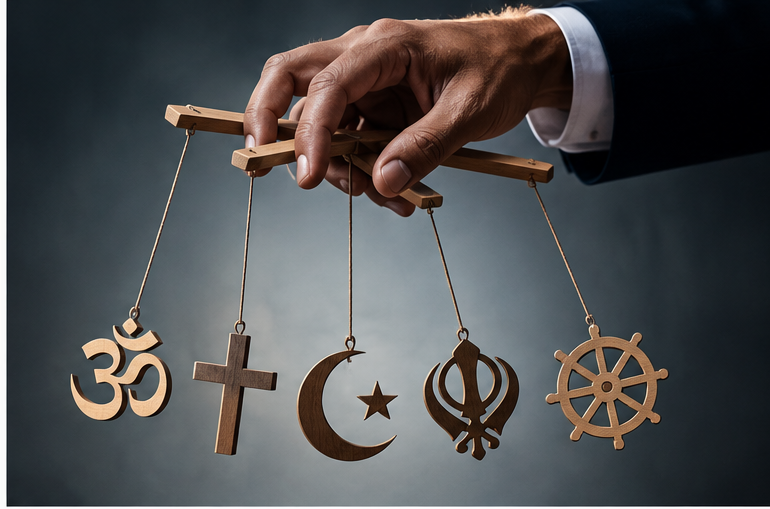
When God Becomes an Election Strategy
Imagine two neighbours who have lived peacefully for thirty years. They celebrate festivals together, share food, help each other during illness and support one another in difficult times. Their religions may be different, but their everyday struggles are the same.
Then comes an election. Suddenly, they are told that their religions cannot coexist, that their identities are under threat, and that their neighbour belongs to an opposing community.
Nothing has changed in their daily lives. Their incomes remain uncertain. Their children’s education remains expensive. Their hospitals remain overcrowded. Their employment opportunities remain limited.
What has changed is the political narrative. Religion becomes an emotional shortcut to political mobilisation. Instead of discussing unemployment, inflation, education, healthcare and inequality, public attention is redirected towards religious identity, historical grievances and imagined collective threats.
This does not mean every politician who speaks about religion is exploiting it. Faith can legitimately inspire public service, justice and compassion. The problem arises when religious identity is used to demand unquestioning loyalty, justify discrimination or silence disagreement.
Ordinary People Pay the Price
When religion becomes a political weapon, it is rarely the powerful who suffer first. It is the daily wage worker who loses employment during communal violence. It is the small shopkeeper whose business is destroyed. It is the mother who fears sending her child to school. It is the family forced to leave its neighbourhood. It is the young person who grows up believing that someone of another faith is an enemy. Trust disappears. Neighbours begin to suspect one another. Friendships break. Families become divided.
Democracy weakens. People are encouraged to judge leaders by religious identity rather than honesty, performance and accountability.
Humanity suffers. Compassion becomes selective. The suffering of one community is treated as less important than the suffering of another. And perhaps most dangerously, children inherit prejudices they never created. the conflict that begins as political mobilisation can become a wound carried across generations.
The Contradiction of Our Age
Humanity has achieved extraordinary scientific and technological progress. We can explore space, develop artificial intelligence, perform complex surgeries and communicate instantly across continents. Yet we continue to struggle with a simple human responsibility: respecting another person’s right to be different.
Today, social media can spread a religious rumour to millions within minutes. An edited video, a provocative speech or a misleading message can transform suspicion into anger before facts are established.
The troubling question is whether our extraordinary knowledge of human behaviour is increasingly being used not to build understanding but to manipulate fear, resentment and identity. When people repeatedly hear that their religion is in danger, they may begin to see aggression as protection and intolerance as courage.
When Religion Justifies War
History offers painful examples of religious language being used to legitimise struggles over territory, political authority, identity and power. Contemporary conflicts also demonstrate how religious narratives can intensify already complex disputes.
In Gaza, civilians have endured devastating suffering amid a conflict involving territorial, historical, national, security and religious dimensions. In tensions involving Iran and the wider Middle East, religious rhetoric can reinforce political and military narratives.
Nevertheless, when any side presents its political objectives as unquestionable divine commands, compromise becomes harder and the humanity of opponents becomes easier to ignore. The moral test is not whether victims belong to our religion, nationality or community. The test is whether we recognise their humanity.
Who Benefits from Division?
There is a simple question ordinary citizens should ask whenever religious emotions are stirred for political purposes: Who benefits from our anger?
Does the farmer receive a better price for crops? Does the unemployed young person find work? Does the worker earn a decent wage? Does the small entrepreneur gain access to affordable credit? Does the family receive better healthcare? If none of these conditions improves, citizens have every reason to question whether religious mobilisation is distracting attention from their real needs.
People who would otherwise demand answers about public services may instead be encouraged to defend political personalities as protectors of their faith. A society must remain free to question its leaders, regardless of their religious identity.
Religion Must Return to Its Moral Purpose
Every major religious tradition contains teachings that encourage compassion, generosity, self-discipline and concern for others. Religious institutions have also contributed enormously to education, healthcare, charity, peacebuilding and social reform. Their positive role must not be forgotten. The answer, therefore, is not to remove religion from society. It is to protect freedom of religion while preventing its exploitation as an instrument of domination.
A temple should inspire compassion. A mosque should encourage peace. A church should teach love. Every place of worship should be a space where human dignity is respected. Religious leaders have a particular responsibility to challenge hatred, including when it comes from within their own communities.
What Can Ordinary Citizens Do?
We cannot always control what political leaders say, but we can decide how we respond. We can refuse to forward messages that spread hatred. We can question provocative claims before accepting them as truth. We can maintain friendships across religious boundaries. We can teach children to respect different traditions. A citizen can be deeply religious and equally committed to democracy, pluralism and the freedom of others.
When Faith Becomes a Weapon, Everyone Loses
When religion becomes an instrument of political hostility, nobody truly wins. Religion should make us more human, not less. It should teach us to recognise suffering, not celebrate it. It should help us overcome hatred, not organise it.
God does not need political protection. Human beings need protection from hatred, violence, injustice and manipulation. The final question is not whose God is greater. It is whether our faith has made us better human beings.
