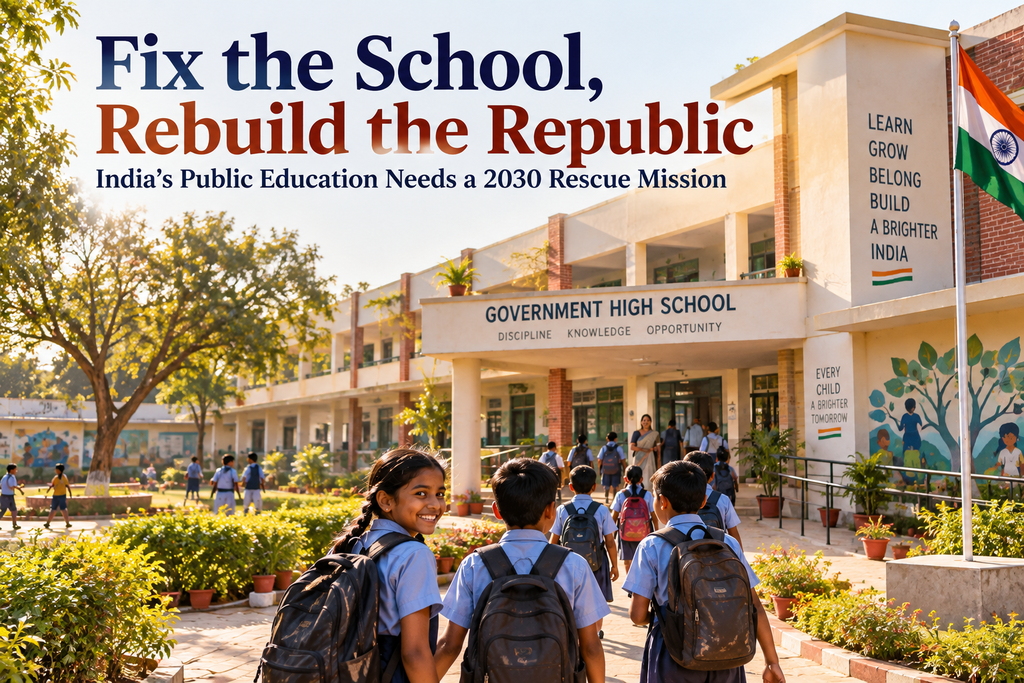
India’s Public Education Needs a 2030 Rescue Mission
Prof. Ujjwal K Chowdhury
A nation cannot build an innovation economy on children who cannot read. Nor can it invoke a demographic dividend while allowing the neighbourhood school to lose its teachers, its credibility and sometimes its roof. India’s public-school crisis is a failure to convert access into dependable learning. Its deepest injury falls on children whose parents cannot purchase an alternative.
94,000 Fewer Schools: Get the Headline Right
NITI Aayog’s May 2026 report, School Education System in India, records a decline in government schools from 11.07 lakh in 2014–15 to 10.13 lakh in 2024–25: approximately 94,000 fewer. The report explicitly links this decline to consolidation and rationalisation. Counting institutions alone cannot establish how many communities lost practical access.
Merging small schools can improve staffing and facilities. But a merger that lengthens an unsafe journey transfers administrative savings onto children. For a tribal settlement, mountain hamlet or Sundarban island, distance includes forests, rivers, weather and parental fear.
Every consolidation therefore needs a public access assessment. The relevant question is whether children reach a better school regularly and safely.
Enrolled, Yet Left Behind
ASER 2024, a rural household survey, found 98.1% of children aged 6–14 enrolled. Yet only 23.4% of government-school Class III children could read a Class II text. That improved from 16.3% in 2022, demonstrating recovery, while exposing the enormous unfinished task.
The latest UDISE+ figures, for 2025–26, record 1,00,843 single-teacher schools across the system, despite a national teaching workforce exceeding one crore. Favourable national pupil–teacher averages conceal distribution failures.
A teacher managing several grades, meal supervision and administrative demands cannot give every beginner sustained attention. When early comprehension fails, later lessons become exercises in copying. Schooling continues on paper while education recedes.
Why Meals, Free Education and Qualifications Fall Short
Midday meals, now under PM POSHAN, and free elementary education remain essential protections. Their contribution should be strengthened. But a nutritious lunch cannot supply a missing teacher, and removing fees cannot eliminate transport costs, household work or income pressures.
The Right to Education Act’s central entitlement covers ages 6–14. It does not itself guarantee free education throughout ages 3–18. The transition into adolescence therefore requires additional support.
Formal oversight also has limits. A UDISE code identifies a school; the Ministry’s own disclaimer says listing does not confer recognition. Registration, legal recognition and classroom quality are distinct.
Likewise, minimum teacher qualifications provide an entry standard. Effective teaching also requires preparation, mentoring, materials and protected time. Certificates cannot compensate for chronic vacancies or instruction in a language a beginner barely understands.
The crisis can also reinforce itself. Poor provision drives families towards fee-charging alternatives; falling public enrolment then becomes a reason to withdraw staff or merge schools. Breaking that cycle requires restoring confidence before shrinking provision. Private choice cannot discharge the state’s obligation to children left behind.
The institutional weakness is fragmented responsibility: one authority recruits, another repairs, another releases funds, while the headteacher answers for everything. Political attention rewards announcements more readily than maintenance. Families experience the accumulated failure as an unreliable public service.
The Better States Offer Lessons, Not Alibis
ASER found Class V government-school reading performance substantially stronger in Punjab and Mizoram: 66% and 65.9%, respectively, could read a Class II text. Kerala recorded a substantial Class III reading recovery; Sikkim showed improvement in Class VIII reading. These are specific strengths, rather than blanket certificates of excellence.
Kerala’s KITE programme offers an institutional lesson: infrastructure comes with teacher training, educational content and maintenance support. Equipment becomes useful when somebody is responsible for making it work.
These examples show that public provision can improve. They also warn against treating high literacy, examination results or impressive buildings as interchangeable measures of quality.
When Citizens Turn the Camera Around
The Cockroach Janata Party’s School Theek Karo campaign, launched on August 15, 2026, under Abhijeet Dipke, turned ordinary school facilities into a public accountability issue. Beginning in Maharashtra, its citizen audits spread across states including Rajasthan, Uttar Pradesh, Gujarat, Bihar, Uttarakhand, Madhya Pradesh and Tamil Nadu.
Videos of broken toilets, damaged classrooms and poor meal hygiene made neglect visible beyond departmental files. The campaign’s force lies in asking a question every parent understands: would officials accept these conditions for their own children?
There have been concrete administrative responses. Haryana released ₹130 crore for roughly 2,800 identified development works; Uttar Pradesh issued a 14-point infrastructure and cleanliness checklist. These actions occurred amid the campaign and wider public pressure; timing alone cannot establish exclusive causation.
At Rampura Kanwarpura near Jaipur, ₹18 lakh was approved for a replacement school building, and demolition of the unsafe structure began in September. However, part of the funding had been approved before the confrontation, and Rajasthan’s larger repair commitments also predated the campaign.
The defensible achievement is greater visibility and pressure for action. Nationwide improvements in learning remain to be demonstrated. The next test is completed work, functioning facilities and better attendance.
Authorities must protect children’s privacy and classroom time while enabling structured scrutiny. Transparency needs clear procedures and published findings.
Higher Enrolment Needs a Reason to Stay
NEP 2020 targets 100% gross enrolment from preschool through secondary education by 2030. UDISE+ 2025–26 reports a secondary GER of 71.7%, covering Classes IX–XII under the NEP structure. The distance remains considerable.
GER compares total enrolment at a stage, regardless of age, with the population of its official age group. It can exceed 100%; it does not prove universal attendance or learning.
Government policy already identifies the essentials. NEP calls for accessible schools, trained teachers, transport or hostels and tracking children who leave. NITI’s 2026 roadmap adds early warnings, transition tracking, bridge courses and timely scholarships.
The policy challenge is delivery: identify each missing child, understand the obstacle and fund the response. Another admission drive without follow-up will produce another reassuring register.
Public School Education Vision 2030: Ten Commitments
- Protect neighbourhood access.
By 2027, states should publish the destination school, journey, transport arrangements and consultation record for every proposed merger. Retain small schools wherever geography makes consolidation exclusionary. Evaluate access after implementation, with an obligation to correct failures. - End dependence on a lone teacher.
Publish school-level vacancies and fund recruitment against actual classroom needs. By 2028, eliminate avoidable single-teacher dependence through appointments, fair deployment and dependable substitutes. Remote postings need housing, incentives and professional support. - Make foundational learning the daily priority.
Provide protected reading and numeracy time, regular individual assessment and small-group support. NIPUN Bharat’s existing 2026–27 target demands urgent acceleration. Publish independently checked progress annually through 2030, without humiliating children or encouraging score manipulation. - Begin before Class I.
Provide trained preschool educators and play-based learning through coordinated Anganwadi–school plans. Use children’s home languages to build understanding, with deliberate bridges into additional languages. Avoid turning preschool into premature textbook drilling. - Guarantee facilities that function.
Complete independent structural, water, sanitation, electricity and accessibility audits by 2027. Publish repair deadlines and responsible officers. Ring-fence annual maintenance funds so a toilet remains usable and a repaired roof remains safe. Include heat, flood and cyclone resilience. - Make attendance affordable.
Strengthen meal quality, health checks and timely entitlements. Expand breakfast where need is greatest. Cover transport and essential learning costs for vulnerable adolescents, with benefits reaching families before expenditure forces withdrawal. Provide special educators, assistive devices and accessible transport where needed. - Follow children across transitions.
Assign a named worker to investigate persistent absence and failed transitions into Classes VI, IX and XI. Coordinate across states for migrant children. Offer bridge learning and supported re-entry without unnecessary documentation barriers. - Support teachers to teach.
Strengthen district teacher-education institutions and classroom coaching. Provide clerical and technical support, fair transfers and adequate teaching materials. Evaluate professional growth through classroom practice and student progress, taking starting conditions into account. Train teachers to use offline digital resources and protect children’s data. - Give communities enforceable oversight.
Equip school management committees to examine budgets, facilities and learning support. Establish termly public hearings and complaints with deadlines for resolution. Institutionalise citizen audits with child-protection safeguards and apply the same standards across political jurisdictions. - Finance the guarantee and verify results.
Adopt a Centre–state financing schedule towards NEP’s 6%-of-GDP goal for education overall. Allocate additional school funding for deprivation and difficult geography. Publish spending, staffing, learning and completion outcomes, with independent reviews in 2028 and 2030.
A Classroom Is a Promise
The task is achievable because India already has functioning public institutions, committed teachers and evidence of recovery. The strongest response to despair is to make those strengths dependable in every locality.
A village school is where the Republic becomes tangible: in a teacher who arrives, a meal served with dignity, a book understood and a question welcomed.
By 2030, every child should be able to enter that classroom with confidence that somebody will help them learn. That is a promise worthy of national ambition.
The author has been the Pro Vice Chancellor of Adamas and Techno India Universities, Vice President of Washington University of Science & Technology, and the Dean of Amity and Symbiosis Universities earlier.
