
Jinu Sam Jacob, Development Practitioner
The modern Indian metropolis presents a glittering facade of glass skyscrapers, digital public infrastructure, and automated services. Yet, beneath this veneer of rapid modernization lies an ancient, stubborn reality because India remains a deeply caste-bound, structured social community. While the manifestations of caste have evolved over centuries, its foundational logic of exclusion and subjugation remains robust.
In the contemporary era, the age-old conventional practices of untouchability, inaccessibility and enforced social distancing have not withered away. Instead, they have metamorphosed by adapting with alarming fluidity to the structures of our neo-digital society. This digital-age adaptation has reassured the historic oppressor, allowing them to sustain their position of dominance within a modernized hierarchy while continuing systemic oppressions under sophisticated new guises.
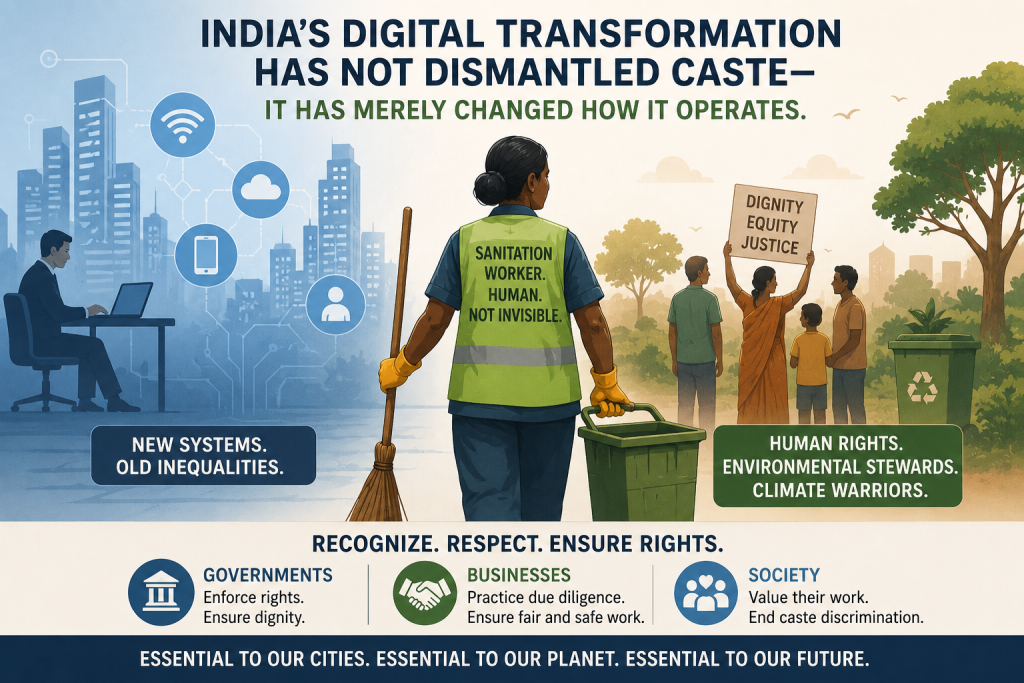
The Semantic Shift and Rebranding the Marginalized
Perhaps the most insidious feature of this evolution is linguistic. The lesser humans who were historically forced by birth into the degrading practice of manual scavenging have been handed a new nomenclature in the digital era. Today, they are politely termed sanitation workers. Yet, this change in title has done little to alter the underlying nature of their labor or the social stigma attached to it.
Their daily responsibilities remain intimately tied to the waste of others, which includes desludging toxic septage, navigating and maintaining choked drainage systems, handling municipal solid waste and managing community or public toilets. The language has been sanitized, but the systemic violence of the work remains completely intact. The digital society uses these updated vocabularies to alleviate its own collective guilt, masking structural caste exploitation behind the professionalized rhetoric of civic governance.
The mainstream urban community fails to see them, yet they know exactly when they are there. When the garbage truck passes by, the immediate response of the urban dweller is instinctive because a hand flies up to cover the nose and a head turns away to escape the filthy smell. Sometimes, there is a visceral wave of nausea, an impulse to puke and even an urge to spit on the road. The urban senses are fully functional, but the eyes fail.
The eyes of the urban mainstream systematically fail to see the human being behind the wheel of that truck or the individuals hanging precariously onto the rear bumper, completely exposed to the flying debris and toxic fumes of the city’s refuse. This selective blindness is a modern iteration of unseeability. The citizen consumes the service but erases the server, maintaining a sterile social distance while remaining entirely dependent on marginalized labor to keep their neighborhoods livable.
The Corporate Shift and the Mask of Subcontracting
Historically, municipal corporations and government departments were the primary employers of sanitation labor, providing at least a nominal layer of institutional accountability. In today’s landscape, however, avenues of employment have shifted dramatically. Gig economies, private residential townships and sprawling mega-malls have emerged as major hubs for cleaning operations.
The cleaning and maintenance of public spaces, corporate complexes and transit hubs are now routinely outsourced to private third-party agencies. On the surface, this transition mimics professional business operations because workers are outfitted in standardized fluorescent uniforms, equipped with branded gloves and issued digital identity badges.
Yet, if one scrapes beneath these visible identities, the fundamental truth becomes clear that the individuals involved in this work and their underlying socio-economic backgrounds remain entirely unchanged. The private agencies recruit from the exact same oppressed caste settlements. By hiding structural caste exploitation behind third-party subcontracts and branded uniforms, corporate entities insulate themselves from financial risk while actively sustaining caste-based forced labor under the guise of formalized corporate procurement.
Human Rights Due Diligence as a Non-Negotiable Standard
This structural camouflage directly violates the core tenets of Ethical Business and Human Rights Due Diligence as outlined by the International Labour Organization and the United Nations Guiding Principles. Traditional corporate due diligence processes are insufficient because they typically protect companies from financial or reputational legal liabilities rather than addressing the actual harms inflicted on human beings.
True Human Rights Due Diligence requires businesses to proactively identify, prevent, mitigate and account for how they address adverse human rights impacts across their entire supply chains and business relationships. In the context of urban sanitation, this framework demands that companies look past superficial supply contracts and actively audit the caste-based discrimination, structural hazards and wage theft experienced by the personnel cleaning their facilities.
Mechanization Without Liberation
It is frequently argued by technocrats and policymakers that increasing mechanization has eradicated manual scavenging and liberated the oppressed castes from direct contact with human waste. However, direct field experiences and empirical facts tell a radically different story. While mechanization has undoubtedly eased the brutal physical toll of manual labor, it has completely failed to transform the workers’ socio-economic status.
The introduction of high-powered vacuum loaders, jetting machines and automated suction units has altered the tools of the trade, but it has not changed the relations of the trade. The economic yields of mechanization rarely trickle down to the community. Instead, tech-driven upgrades often justify stagnating wages or contract structures that capture the surplus value generated by faster turnaround times, leaving the sanitation worker trapped in the same generational cycle of poverty and social immobility. The caste system has simply integrated the machine into its apparatus of control.
Unrecognized Contributions of the First Climate Warriors
Crucially, the mainstream narrative completely erases the historical and environmental value of this labor. Long before the modern vocabulary of sustainability, circular economy, or waste management existed, these marginalized communities were historically the first climate warriors. Through sheer survival, they produced an intricate, generational body of knowledge to adapt, navigate, and handle the ecological metabolic waste of expanding human habitats.
Despite this, they are still fundamentally unrecognized for their immense efforts and contributions to keeping your environment clean. The urban elite lives in an ecologically sterile bubble precisely because these workers absorb the environmental toxicity of the city. Yet, their labor is viewed through the lens of impurity rather than ecological stewardship. They are compensated with pittance and indignity, structurally denied the foundational right to intergenerational equity. The ecological debts owed to them, which include health, clean air, land, and economic security for their children, are systematically defaulted upon by the state and corporate actors alike.
The Intersectional Burden and Gendering the Margins
When the lens of analysis is sharpened to look at gender, the true cruelty of modern sanitation structures is laid bare. Approximately 50% of urban sanitation workers are women. These female workers face a double jeopardy because they are oppressed by both entrenched patriarchal norms and structural caste hierarchies. Typically belonging to the most marginalized communities, they are disproportionately relegated to the absolute bottom of the sanitation hierarchy, working predominantly as school toilet cleaners and manual drain clearers.
As modernization and mechanization sweep through the sector, they act as gendered filters. Operating heavy suction machinery, driving large waste-management trucks, and navigating digital tracking tools require specialized technical training or licensing. Because of deep-seated patriarchal biases, female sanitation workers are rarely encouraged, let alone permitted, to acquire these mechanized skills. The capital-intensive equipment is almost exclusively handed to men.
Consequently, the modernization of sanitation work has unexpectedly become a powerful new mechanism to further alienate and marginalize women. Excluded from tech-driven roles, women are actively pushed into the manual spaces where machines cannot go, such as narrow and overflowing alleys, cramped indoor public toilets, and debris-choked open surface drains. They are confined to the highest-risk, most physically degrading forms of manual labor, while their male counterparts are transitioned into machine management. Modernization has not liberated the workforce because it has fractured it along gender lines, deepening the vulnerability of women who are left to handle raw filth with minimal protections.
Demanding Structural Equity
The invisible city dwellers are a living indictment of our urban and corporate imagination. The digital era has provided the mainstream community with cleaner vocabularies, corporate uniforms and mechanical excuses to look away, but it has left the core engine of caste-based exploitation entirely untouched. Mechanization without structural asset ownership and formalization without social dignity are merely illusions of progress because they fundamentally deny the framework of dignified labour. Dignified labour requires that every worker operates under conditions of freedom, equity, security and human dignity, where the worker is protected from systemic degradation and social exclusion.
To break this cycle, urban planning, environmental policies and corporate governance must move past mere technocratic and superficial solutions. Corporations must be held strictly accountable to International Labour Organization ethical standards through legally binding Human Rights Due Diligence that forces them to examine the caste dynamics of their service providers and eliminate exploitative labor practices from their supply chains.
We must collectively confront the reality that caste continues to dictate labor and environmental sacrifice in modern India. True progress requires stripping away the comfortable blindness of the urban elite, enforcing strict labor rights within private subcontracts, ensuring equal access to technical training for female workers and formally recognizing these communities as foundational ecological guardians so they can rightfully reclaim the intergenerational equity that has been stolen from them for centuries.
