
By Somnath Dabhade, Assistant Director, CYDA
India proudly calls itself the youngest nation in the world. With nearly 65 percent of its population below the age of 35, the country possesses an extraordinary demographic advantage. Economists often describe this as a “demographic dividend”a unique opportunity where a large young population can drive economic growth, innovation, productivity, and social transformation.
Yet beneath this optimistic narrative lies a growing concern that deserves urgent national attention. Across India’s cities, towns, and villages, millions of young people are struggling to find direction. They are more connected than any generation before them, carrying access to the world’s information in their pockets. Yet many feel disconnected from meaningful opportunities, productive work, and a clear sense of purpose.
A growing number of young Indians spend several hours every day scrolling through Instagram Reels, YouTube Shorts, gaming platforms, influencer content, and endless streams of digital entertainment. While technology itself is not the problem, excessive dependence on digital platforms has created a generation that often consumes more than it creates.
The issue confronting India today is not simply unemployment. It is not merely social media addiction. It is not only a mental health challenge. It is a combination of all these factors creating a silent crisis that could shape India’s future for decades to come.
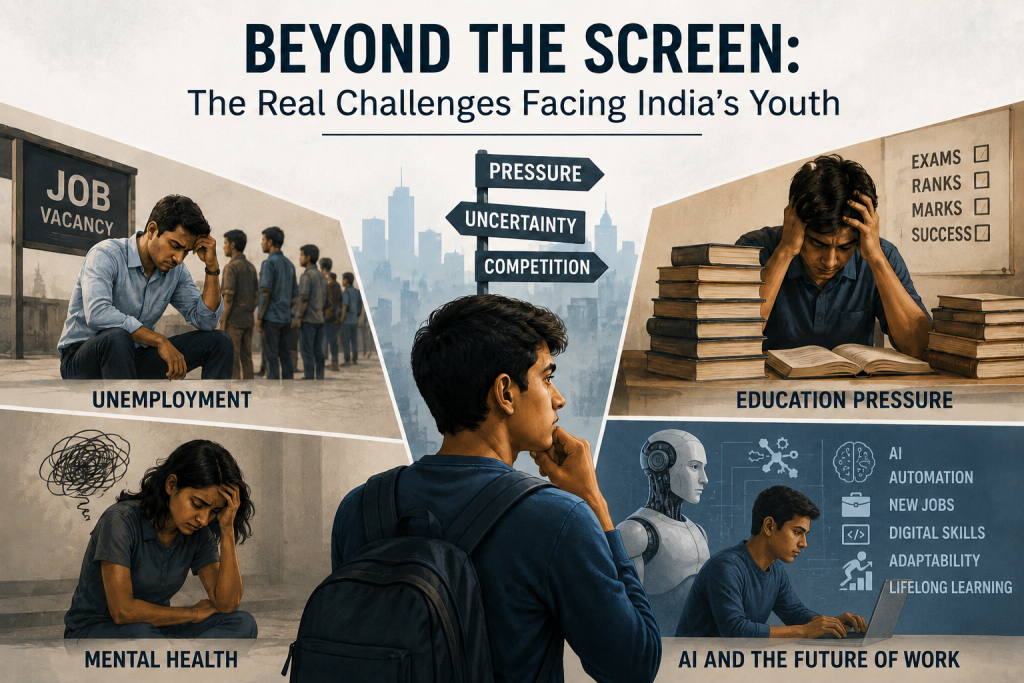
The Great Promise and the Growing Reality
For years, India’s youth have been projected as the nation’s greatest strength. Policymakers, economists, and global institutions have repeatedly emphasized that a young workforce can transform India into a global economic powerhouse.
However, the lived reality of many young Indians tells a different story.
Every year, millions of students graduate from colleges and universities. Families invest their savings in education with the expectation that degrees will lead to stable employment and upward mobility. Yet for many young people, the transition from education to employment is increasingly difficult.
Government jobs remain limited and highly competitive. Private-sector employment often offers low wages, contractual arrangements, and limited security. Many graduates find themselves unemployed or underemployed, working in positions unrelated to their education or aspirations.
The gap between expectations and opportunities has created widespread frustration. When years of education fail to produce meaningful employment, young people begin questioning not only the system but also themselves. Confidence declines. Motivation weakens. Hope becomes increasingly difficult to sustain.
The Digital Escape
In this environment of uncertainty, social media has emerged as a powerful refuge. For many young people, the day begins and ends with a smartphone. Instagram, YouTube, Facebook, Snapchat, gaming applications, and entertainment platforms dominate daily life. The attraction is understandable.
Social media offers instant gratification. A short video provides entertainment within seconds. A notification creates excitement. A like or comment delivers temporary validation. In contrast, real-world success demands patience, discipline, hard work, and resilience.
Building a career may take years. Learning a skill requires effort. Preparing for competitive examinations demands sacrifice. Digital platforms offer immediate rewards while real-life progress often appears slow and uncertain. As a result, many young people gradually become more invested in virtual experiences than in building their future.
The Culture of Reels and Shrinking Attention Spans
One of the defining trends of modern youth culture is the explosion of short form content. Fifteen-second videos, thirty-second clips, and rapidly changing streams of content have become the primary source of information and entertainment.
While these platforms are highly engaging, they may also influence attention spans and learning habits. Reading books, studying complex subjects, conducting research, or developing professional expertise requires sustained concentration. However, constant exposure to short-form content encourages rapid shifts in attention.
Teachers, professors, and employers increasingly report that many young people struggle to maintain focus for extended periods. The consequence is not merely academic. A society that loses its ability to concentrate risks losing its ability to innovate, solve complex problems, and think critically about its future.
The Illusion of Success
Social media has created a powerful illusion of success. Young people constantly see luxury lifestyles, expensive cars, foreign trips, designer clothes, and stories of extraordinary achievement. What they do not see are the years of struggle behind those achievements. Failures, sacrifices, and setbacks are often hidden. As a result, many compare their ordinary lives with carefully edited versions of other people’s success. This creates feelings of inadequacy and self doubt. A student from a small town may compare himself with successful entrepreneurs in big cities. An unemployed graduate may compare herself with influencers who appear to earn money and fame online. Such comparisons are unfair, yet they have become common among many young people.
The Influencer Dream
Many young Indians now dream of becoming content creators and social media influencers. This ambition is not wrong because the digital economy has created new opportunities and careers. However, social media usually shows only a few people who become highly successful. Millions try to build online careers, but only a small number achieve stable incomes from digital content. The danger comes when young people neglect education, skill building, or professional growth while chasing viral fame. A country cannot depend only on visibility and popularity. It also needs scientists, engineers, teachers, healthcare workers, entrepreneurs, researchers, farmers, and other skilled professionals. Influence without real capability cannot create lasting development.
Rural Youth: The Silent Challenge
The problem is especially serious in rural India. Farming, which once supported many families, is becoming more uncertain because of climate change, water shortages, rising costs, and unstable markets. Many young people no longer see agriculture as a secure future. At the same time, many rural areas do not have enough industries or jobs. As a result, rural youth often feel trapped between declining traditional livelihoods and limited modern opportunities. Smartphones have reached villages across India, but economic opportunities have not grown at the same pace. This gap has created frustration and disappointment among many rural young people.
Mental Health and the Burden of Expectations
The emotional impact of these challenges is becoming more visible. Unemployment is not only a financial problem. It also affects confidence, identity, and mental well being. Many young people feel anxious about the future. They want to meet family expectations but face an uncertain job market. Social media increases this pressure through constant comparison. Even though today’s generation is more connected online than ever before, many still feel lonely and isolated. Online followers cannot replace real relationships, supportive communities, and genuine human connection. Anxiety, stress, depression, and emotional burnout are becoming increasingly common, yet these issues are still not discussed enough.
The Rise of Quick Success Culture
Another worrying trend is the growing attraction to quick wealth. Online betting platforms, fantasy gaming apps, speculative investments, and get rich quick schemes are becoming popular among young people. When stable jobs seem difficult to find, promises of fast money become very attractive. However, shortcuts rarely provide lasting success. Many young people lose money, confidence, and valuable time while chasing unrealistic dreams. Slowly, the culture of instant rewards is replacing the values of patience, hard work, and long term effort.
Artificial Intelligence and the Future of Work
The rapid growth of Artificial Intelligence, or AI, has added another layer of uncertainty. Many young people worry that automation will reduce jobs and employment opportunities. Technology will certainly change the job market, but it will also create new industries and professions. The real challenge is preparing young people for these changes. Future success will depend more on adaptability, creativity, critical thinking, digital skills, and continuous learning. Unfortunately, many education systems are still not fully preparing students for these new realities.
Polarization and Vulnerability to Extremist Narratives
Another important concern is the growing exposure of some young people to misinformation, polarization, and extremist narratives. Social media algorithms often promote emotional and sensational content. False information spreads quickly, and simple explanations for complex problems become popular. Young people who feel unemployed, frustrated, or socially isolated may become more vulnerable to messages that offer easy answers and blame certain groups for society’s problems. Political polarization, religious tensions, online hate campaigns, and conspiracy theories are becoming more visible in digital spaces. Most Indian youth reject violence and extremism, but a generation facing uncertainty can still be influenced by people who try to exploit their frustrations for political or ideological goals. This affects not only young people but also social harmony and national stability.
The Decline of Civic Engagement
In the past, young people played a major role in social reform movements, nation building, environmental campaigns, and democratic participation. Today, many are very active online but less involved in community life. Digital activism often replaces direct participation. Volunteer work decreases, community engagement weakens, and local leadership opportunities become fewer. As a result, many young people become observers of social change rather than active contributors.
Rebuilding Purpose
The answer is not to blame young people. They are responding to the world they see around them. The responsibility is shared by governments, schools and colleges, families, businesses, civil society organizations, and communities. India needs stronger connections between education and employment. It needs more investment in skill development and entrepreneurship. It needs affordable and accessible mental health support. It also needs more opportunities for civic participation and community leadership. Most importantly, young people need help in rediscovering purpose. Purpose turns education into preparation, work into contribution, and challenges into opportunities for growth. Young people who have a clear sense of purpose are less likely to lose themselves in endless distractions.
Conclusion: India’s Defining Challenge
India is standing at an important turning point. One path leads to a future where its young population becomes a powerful force for economic growth and social progress. The other path leads to a future where many young people remain trapped in unemployment, digital dependency, anxiety, misinformation, and uncertainty. The real issue is not technology itself. The real issue is whether society is creating opportunities that match the talent, energy, and ambition of its youth. India’s future will depend on whether millions of young people can find meaningful work, learn valuable skills, participate in society, and build purposeful lives. The country’s future is already being shaped by the minds, habits, and aspirations of its young generation. If India succeeds in empowering its youth, its demographic dividend could become one of the greatest development stories of the twenty first century. If it fails, the same demographic advantage could become a major challenge. The choice and the responsibility belong to all of us.
