In the International Year of Volunteering, Mathew Mattam explores how the spirit of service leaves the world better than we found it and reveals how volunteering becomes a powerful force for personal growth, leadership, purpose, and lasting social change.
Some people measure success by the wealth they accumulate, the positions they hold, or the recognition they receive. Others measure it by the number of lives they touch. Looking back at my own journey, I realise that everything meaningful in my life began with one simple decision—to become a volunteer.
I often say that I was not born a social worker or an entrepreneur. I was first a volunteer. It was volunteering that shaped my values, my career, and eventually my life’s purpose.
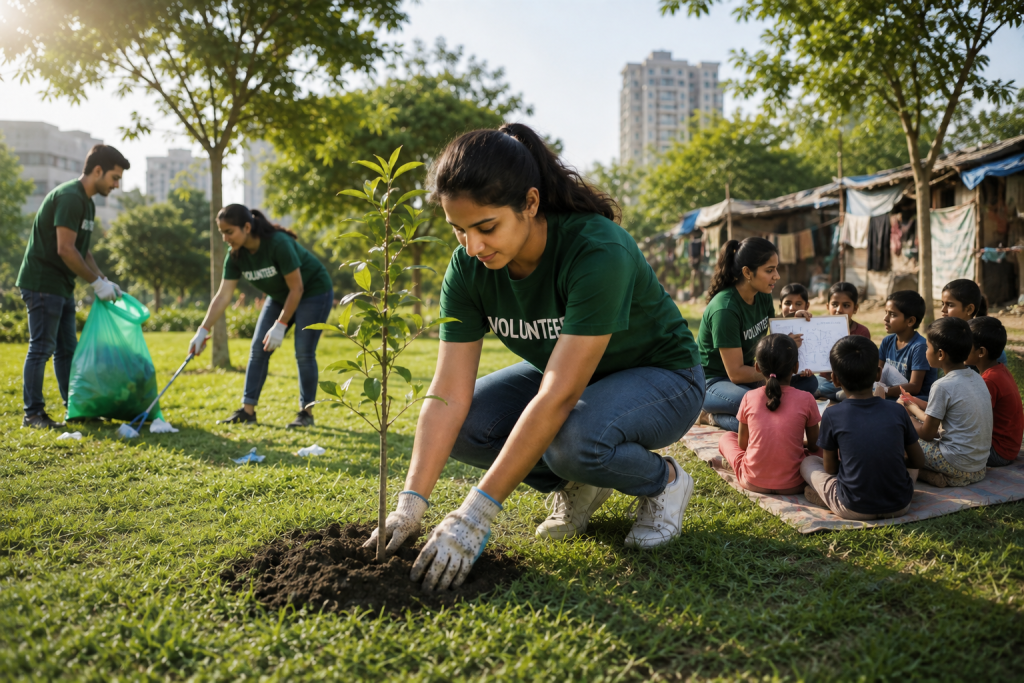
My journey began as a young boy in my village church. Long before I understood the meaning of development or social change, I became part of associations that served people in need. We organised fundraising events for poor families, visited those who required support, and learnt the joy of giving without expecting anything in return. Those small acts of service planted the first seeds of compassion in my heart. They taught me that happiness comes not from what we receive but from what we contribute.
When I entered high school, my world expanded beyond the church. I became actively involved in student movements and student politics. It was not politics that attracted me; it was the opportunity to stand up for justice, represent students’ concerns, and work collectively to solve problems. Volunteering taught me that leadership is not about holding a position but about accepting responsibility.
My college years opened even wider horizons. While studying in Mysore, I became associated with the All India Catholic University Federation (AICUF), an organisation that encouraged young people to think critically about society and engage with issues of justice and equality. Later, in Pune, I volunteered with the Student Christian Movement (SCM), where I met young people from different cultures, religions, and social backgrounds. Every camp, every discussion, every village visit, and every community programme became another classroom that no university could have offered.
Slowly, without my realising it, volunteering was shaping my personality far more than formal education alone. It taught me empathy before management, listening before leadership, and service before success.
These experiences transformed my career decisions. At a time when many considered a lecturer’s position to be a secure and respectable profession, I made what many believed was an irrational decision. I left my teaching career in Kolhapur to join YUVA in Mumbai, a voluntary organisation working with urban poor communities. It was not an easy choice. The salary was modest, the future uncertain, and the challenges enormous. But I had discovered something more valuable than job security—a sense of purpose.
Working with YUVA exposed me to some of India’s most significant people’s movements. I had the privilege of volunteering with the Narmada Bachao Andolan, where I witnessed firsthand the struggles of displaced communities and the courage of ordinary people fighting for justice. I travelled repeatedly to the Narmada Valley, not only to volunteer myself but also to encourage many young people to join these exposure visits. I believed that social transformation begins when young people witness reality with their own eyes rather than reading about it in books.
Around the same period, I found myself inspired by several other social movements. The Chipko Movement demonstrated how ordinary villagers, especially women, could protect forests through courage and collective action. The women’s movements of the 1980s challenged deeply rooted inequalities, while the environmental movements of the 1990s taught us that protecting nature is inseparable from protecting humanity. Each movement added another layer to my understanding of society. Every volunteer experience became another chapter in my education.
By the late 1990s, one conviction had become clear in my mind. India needed an organisation that believed in the power of young people to become agents of change. That conviction led to the birth of the Centre for Youth Development and Activities (CYDA) in 1999.
Those early years were anything but easy. We had enormous dreams but very limited resources. I was confident in mobilising youth, organising volunteers, and building community movements, but I had little understanding of organisational systems, fundraising, governance, or institutional development. Looking back, I realise that while I was building people, I had not yet learnt how to build a sustainable organisation.
Many opportunities for funding slipped away simply because I lacked the institutional knowledge to present our work effectively. There were moments when survival itself became uncertain. Financial pressures affected both the organisation and my personal life. During those difficult years, family support became my greatest strength. Their faith sustained me whenever my own confidence weakened.
Yet every challenge became another lesson. Volunteering had already taught me resilience, and resilience kept me moving forward. Slowly, I learnt how to strengthen institutions, build partnerships, manage resources, and create systems that could survive beyond individual passion.
Today, when I look back over more than five decades, I realise that volunteering has given me far more than I could ever have imagined. I now have the privilege of mentoring more than ten nonprofit organisations, supporting thousands of entrepreneurs and startups, and helping institutions grow, innovate, and become financially sustainable. If one were to estimate the social and economic value generated through these collective efforts, it would easily run into hundreds, perhaps even more than a thousand crore rupees. Yet the greatest reward cannot be measured in money. It lies in seeing young people discover confidence, organisations become stronger, entrepreneurs create livelihoods, and communities transform themselves.
People often ask me whether I still consider myself a volunteer after all these years. My answer is simple. Once a volunteer, always a volunteer. Titles may change. Responsibilities may grow. Organisations may expand. But the spirit of volunteering remains unchanged.
The world today needs volunteers more than ever before. Governments can create policies. Businesses can generate wealth. Educational institutions can produce graduates. But volunteers build compassionate societies. They bridge divides, inspire hope, mobilise communities, and remind us that humanity grows stronger when people choose to serve one another.
Every young person should volunteer at least once in life. Not because society needs free labour, but because volunteering develops character. It teaches patience, empathy, leadership, teamwork, resilience, and humility—qualities that no classroom alone can fully impart. A few hours of volunteering can sometimes teach more about life than years of formal education.
As I reflect on my own journey, I realise that volunteering never made me poorer; it made me richer in experiences, friendships, wisdom, and purpose. It introduced me to extraordinary people, meaningful causes, and opportunities that no career plan could have predicted.
I still believe what I learnt as a young volunteer many decades ago: the true measure of a life is not what we take from the world, but what we leave behind. And if every young person chooses to serve even a little, then together we can leave this world kinder, fairer, and better than we found it.
