
By ImpactLens Correspondent
A 0.4% transaction charge may look tiny. But for a small business surviving on a 2–5% margin, its impact can be much larger than the number suggests.
India’s Unified Payments Interface, or UPI, has achieved something remarkable. It has made digital payments part of ordinary life. A vegetable vendor, tea stall, tailor, beauty parlour, small restaurant, auto driver and neighbourhood kirana shop can receive money instantly without investing in an expensive card machine.
The QR code has become almost as important to a micro-business as its signboard.
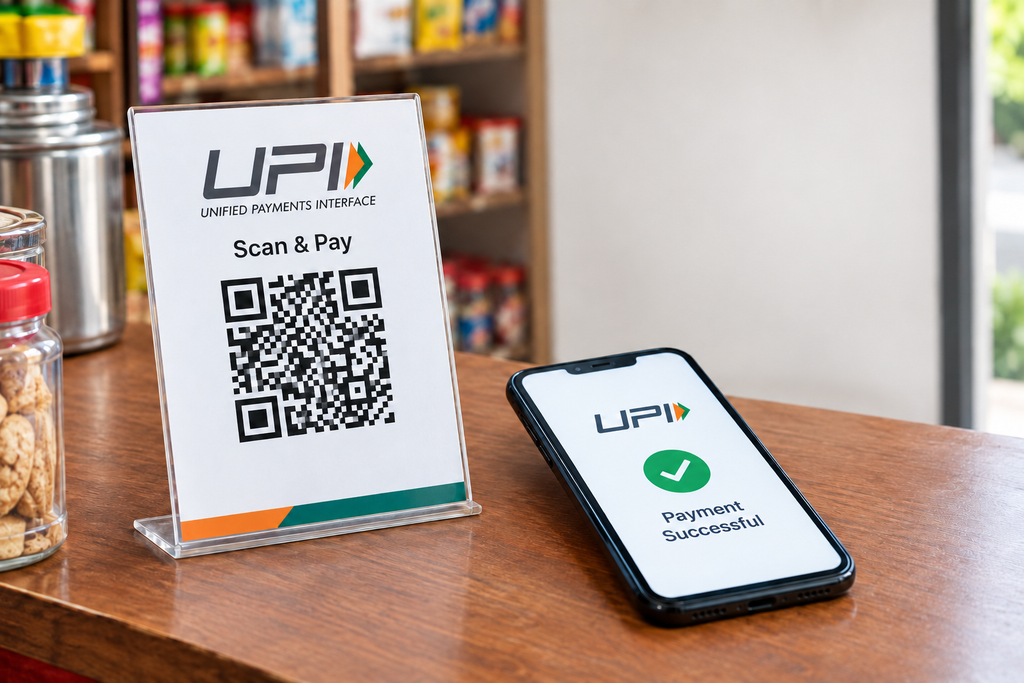
Now India is entering a new phase in this digital-payment journey. Under the new framework, a Merchant Discount Rate (MDR) of 0.4% will apply to specified Person-to-Merchant UPI transactions above ₹2,000. For transactions of ₹75,000 and above, the charge is capped at ₹300. Person-to-person transfers remain free, payments to merchants up to ₹2,000 remain outside the standard MDR, and eligible small merchants receiving up to ₹1 lakh per month through UPI QR codes under the P2PM framework continue to enjoy zero MDR. The government estimates that around 96% of merchant transactions will therefore remain unaffected.
The framework is intended to protect small merchants while creating a sustainable way of financing the enormous UPI ecosystem. But the important question is not simply: Who is officially charged?
The more important question is: Who ultimately bears the cost?
₹40 Is Small — Until We Look at the Profit
Consider a small shop selling a product for ₹10,000. If the transaction attracts the standard 0.4% MDR, the merchant pays ₹40. At first glance, ₹40 on ₹10,000 sounds insignificant. But the merchant does not earn ₹10,000. That is revenue, not profit. Suppose the merchant’s net margin is 4%. The profit on the ₹10,000 sale is only ₹400. A ₹40 payment cost therefore consumes 10% of that profit. If the merchant operates at a 2% net margin, the profit is ₹200. Now the same ₹40 MDR takes away 20% of the profit.
This is the point that can easily disappear in the debate. The material on the new framework itself highlights this distinction: MDR is small when measured against turnover, but its effect becomes much larger when measured against the actual profit retained by a low-margin business.
For a large company with scale, bargaining power and sophisticated pricing, 0.4% may be manageable. For a family-run shop, trader or first-generation entrepreneur, every fraction of a percentage point matters.
The ₹1-Lakh Question
The most important protection for micro-businesses is the exemption for eligible small merchants receiving up to ₹1 lakh a month through UPI QR codes under the P2PM category. That sounds reassuring. But ₹1 lakh per month in digital receipts does not necessarily represent a large business. ₹1 lakh per month is approximately ₹3,333 per day over a 30-day month. A neighbourhood grocery shop, mobile repair shop, small clothing outlet, home-based food entrepreneur, beauty parlour or local service provider can cross this level without being financially strong.
More importantly, turnover should not be confused with income. Imagine a trader receiving ₹2 lakh in monthly payments but operating on a 5% net margin. That represents only ₹10,000 in net profit before considering many personal and business uncertainties. A business can therefore cross the UPI threshold while still remaining economically vulnerable.
This raises a larger policy question: Should the definition of a small merchant depend primarily on digital transaction value, or should the system better recognise the economic realities of micro-enterprises?
The concern is particularly relevant because the threshold may eventually create an unintended incentive for some merchants to keep UPI collections below the exempt level, encourage cash payments or divide transactions. The source material itself raises the possibility that businesses could steer customers towards cash to remain below the threshold. That would run against years of effort to formalise and digitise India’s smallest businesses.
UPI Has Given Micro-Businesses Enormous Advantages
The debate should not become an argument against UPI itself. For small businesses, UPI has solved several old problems.
There is less need to keep change. Cash does not have to be counted repeatedly. The risk associated with carrying physical cash is reduced. Customers can buy even when they are not carrying currency. Payments are fast, and businesses have a digital trail of their transactions.
That digital history can itself become economically valuable. A small entrepreneur who previously operated almost entirely in cash may now be able to demonstrate regular business activity. Digital transaction records can support bookkeeping, improve financial visibility and potentially help formal lenders understand the business better.
UPI can also increase sales. A customer who has only ₹100 in cash may still make a ₹2,000 purchase because payment can be completed instantly from a bank account.
These benefits have a cost-saving dimension too. Cash is often treated as free, but managing cash is not entirely free. It takes time to count, store, deposit and reconcile. There are risks of theft, loss and human error. Digital payments can reduce some of these costs.
The provided material rightly notes that some businesses may find that the benefits of UPI — including increased sales, lower cash-handling costs, reduced collection risks and quick settlement — outweigh the MDR they incur.
So the real issue is not UPI versus cash. It is how to finance digital-payment infrastructure without weakening the smallest enterprises that helped make UPI successful.
Who Really Pays the MDR?
The government has clearly stated that MDR is a merchant-side charge and that consumers should not be charged MDR separately. Banks have been advised to ensure that merchants do not pass it on as an additional customer charge.
But economics is more complicated than the wording printed on a bill. A shop may not be allowed to tell a customer: “Your product costs ₹10,000 plus ₹40 because you paid through UPI.” But what prevents the shop from pricing the product at ₹10,050 next month?
What if a retailer reduces a 10% discount to 9.5%? What if a restaurant slightly revises menu prices? What if a small merchant simply says, “Cash preferred”?
Businesses normally try to recover increases in operating costs. Payment charges are no different from electricity, transport, rent, packaging or other business expenses.
The merchant may legally pay the MDR, but economically the cost can be distributed among the merchant, customer, supplier or even workers over time. The submitted material makes this distinction between who is formally charged and who ultimately bears the economic burden.
This is why saying that consumers will never be affected may be too simplistic. They may not see “UPI charge: ₹10” on their receipt, but they could eventually experience part of the cost through prices or smaller discounts.
Could MDR Push Some Businesses Back Towards Cash?
This is perhaps the greatest unintended risk. India spent years encouraging merchants to put QR codes outside their shops. Even tiny businesses became comfortable accepting digital payments.
Now imagine telling an entrepreneur that once digital receipts cross a particular level, some transactions may begin costing money.
The entrepreneur may start doing calculations: “Should I take this ₹5,000 through UPI or ask for cash?” “Am I approaching the monthly threshold?” “Should I keep accepting every digital transaction?”
That behavioural response matters. Digitalisation should ideally encourage a business to grow. A system should not create a psychological point at which an entrepreneur begins worrying that additional digital turnover will increase payment costs.
The policy challenge, therefore, is to ensure that MDR does not unintentionally become a digital-growth penalty for businesses graduating from very small to slightly larger operations.
But Someone Has to Pay for UPI
There is another side to the debate. UPI infrastructure is not costless.
Banks, payment service providers and UPI applications need technology infrastructure, cybersecurity systems, fraud prevention, customer support, innovation and processing capacity. India is operating a digital-payment system at extraordinary scale.
The government says MDR revenue will remain within the payment ecosystem and be shared among participants such as banks, payment service providers and UPI application providers to support UPI’s operation and expansion.
Therefore, the question cannot simply be, “Why charge anything?”
A better question is: What is the fairest way to pay for a digital public infrastructure that benefits consumers, merchants, banks, fintech companies and government?
If everyone benefits, placing a disproportionate burden on vulnerable micro-enterprises would be difficult to justify.
Equally, expecting the system to expand indefinitely without a sustainable financing mechanism has its own problems.
A More Micro-Enterprise-Friendly Approach
The government has already built significant protections into the framework. Payments up to ₹2,000 remain free of MDR; qualifying small merchants remain protected; the charge is capped at ₹300 on transactions of ₹75,000 and above; and essential and thin-margin sectors such as fuel, telecommunications, insurance, railways and agricultural inputs receive special treatment.
But implementation should now be watched carefully. The ₹1 lakh monthly threshold deserves particular attention. It should not remain static indefinitely while inflation, prices and business turnover rise.
A threshold that protects a genuine micro-business in 2026 may fail to protect the same type of business several years later.
There is also a case for examining whether a single threshold adequately captures the enormous diversity of Indian micro-enterprises. A grocery shop, tailor, restaurant, repair business and service provider can have very different gross margins despite similar turnover.
The impact should therefore be reviewed after implementation using actual evidence: Have prices changed? Are merchants reducing discounts? Is cash usage increasing among affected businesses? Are transactions being split? Which sectors are experiencing the greatest burden? Are women-led, home-based and first-generation enterprises affected differently?
The submitted material similarly argues for reviewing the effects across merchant sizes, sectors and income groups, and reconsidering thresholds if small merchants or low-income consumers bear a disproportionate burden.
Do Not Make Digital Growth a Punishment
UPI is one of India’s most visible digital achievements precisely because it did not remain confined to airports, shopping malls and large retailers.
It reached the tea seller. It reached the vegetable vendor. It reached the kirana shop It reached the home entrepreneur. It reached millions of people who never owned a card machine.
That inclusiveness must remain at the centre of the next phase of UPI.
MDR is not automatically bad. A secure, reliable and innovative payment ecosystem requires money to operate. A modest merchant contribution may be reasonable for businesses that can comfortably absorb it.
But 0.4% of turnover is not 0.4% of profit.
For a micro-enterprise operating on a 2% margin, even a small payment charge can represent a significant share of earnings. At the same time, UPI provides real savings, convenience, security, market access and financial visibility that can make the cost worthwhile.
The right debate, therefore, is neither “UPI must always be completely free” nor “0.4% is too small to matter.” The real question is one of fairness.
Who benefits from UPI? Who should finance it? How much should each participant contribute? And at what point does a reasonable infrastructure charge become a burden on the smallest entrepreneur?
India should finance UPI’s future without weakening the micro-businesses that made its success possible.
The QR code on a street vendor’s cart represents more than a payment mechanism. It represents financial inclusion, dignity, formalisation and access to a digital economy.
The next generation of UPI policy should ensure that as these entrepreneurs grow, digitalisation remains a ladder for growth — not a cost that makes them wish they had stayed with cash.

This Post Has One Comment
हा लेख एक महत्त्वाचा मुद्दा स्पष्टपणे मांडतो,व्यवहार शुल्क रकमेने कमी असले, तरी लघु उद्योजकांच्या नफ्यावर त्याचा परिणाम मोठा होऊ शकतो….
UPI ने छोट्या उद्योजकांना डिजिटल अर्थव्यवस्थेची दारे उघडली आहेत. त्यामुळे त्याच्या पुढील विकासात उद्योजकांची वाढ, आर्थिक क्षमता आणि डिजिटल समावेशन यांचा समतोल राखणे गरजेचे आहे.
डिजिटलायझेशनची किंमत अशी नसावी की उद्योजक वाढण्यापेक्षा थांबण्याचा विचार करेल….