
Dr. Kuldeepsingh Rajput
As drought intensifies livelihood insecurity across Maharashtra, seasonal migrant families remain overlooked in relief planning. Drought relief must extend beyond crop-loss compensation to protect migrant workers and their families through continued access to food security, healthcare, education and social protection at both source and destination. Maharashtra needs a proactive, migration-responsive approach that ensures migration does not mean exclusion from relief.
Maharashtra has recently declared 305 of its 358 blocks drought-hit, adding 40 more to the list. While the state government has announced drought-relief measures, seasonal migrants compelled to leave their villages in search of work remain a critical blind spot in drought-response planning. This exposes a major gap in the way drought is understood and addressed. The crisis is treated primarily as a problem of agricultural losses and rural livelihoods, while its consequences for labour mobility, social protection and workers’ rights receive insufficient attention. Families forced to migrate risk losing access to relief and essential services, particularly when administrative systems remain tied to their place of origin. A drought-response strategy that overlooks migration is incomplete. Maharashtra government must recognise seasonal migration not merely as a consequence of agrarian distress, but as a central dimension of the crisis itself.
When Drought Forces People to Migrate
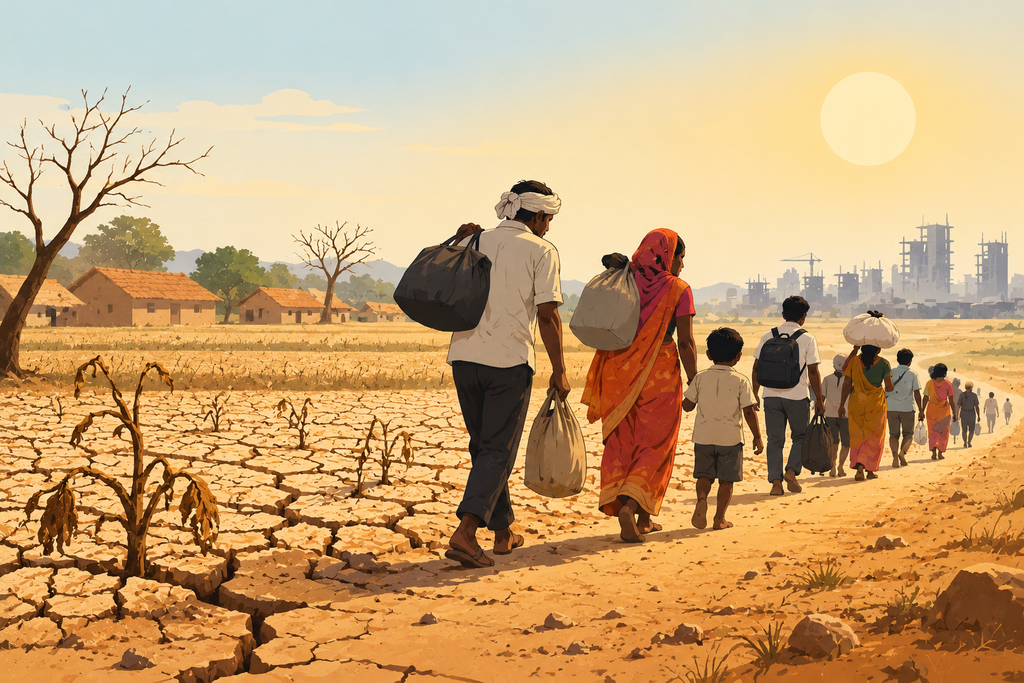
Last week, during a visit to Tuljapur block in Maharashtra’s Marathwada region, I spoke with villagers about rainfall and crop conditions. One of them told me, “It hasn’t rained for two months. The entire crop has been destroyed. Things are getting desperate. Now, more families will have no choice but to leave their villages in search of work.” His words captured the uncertainty confronting drought-affected rural communities. A failed monsoon means more than a ruined harvest. It can lead to lost livelihoods, mounting debt, declining household consumption and the prospect of families leaving their homes in search of employment. For many, crop failure marks the beginning of another season of distress migration. If drought-like conditions persist across vulnerable parts of Marathwada and Vidarbha, seasonal migration could increase. The question is not simply whether more workers will migrate, but whether Maharashtra’s administration is prepared to respond to the consequences.
Migration is neither inherently undesirable nor necessarily a sign of distress. It can improve household incomes and expand livelihood opportunities. The problem arises when migration becomes a compulsion rather than a choice due to the absence of viable alternatives. For landless agricultural labourers, small and marginal farmers, and informal rural-tribal workers, prolonged dry spells undermine livelihoods and reduce rural employment precisely when households need income most. Depleted savings and rising debt make it increasingly difficult to meet essential expenses, including food, healthcare and education. Under these circumstances, seasonal migration becomes a survival strategy. Economic distress can force workers to accept uncertain wages, long working hours and unsafe conditions, while labour contractors may exploit their limited bargaining power. Drought alone does not determine migration outcomes; its effects combine with inadequate employment, indebtedness and weak labour protection to deepen existing inequalities. The policy objective should not be to prevent migration, but to reduce distress-driven compulsion and protect workers’ rights and dignity wherever they migrate.
Distress Follows Migrant Families
The consequences of distress seasonal migration extend beyond employment and wages. When families move to sugarcane fields, brick kilns and other informal workplaces, access to education, healthcare, nutrition, childcare and social protection can be disrupted. Migration-affected children may miss school for months, lose access to supplementary nutrition or struggle to continue learning in unfamiliar linguistic and social environments. For first-generation learners and children from rural-tribal communities, these interruptions can deepen existing educational disadvantages and reinforce intergenerational poverty.
Migrant Women often bear a disproportionate burden. Alongside paid labour, they remain responsible for childcare, cooking and household management, while their own healthcare needs receive inadequate attention. Limited access to maternal healthcare, childcare, safe accommodation, drinking water and sanitation further compounds their vulnerability. The consequences are also felt by family members who remain behind. Children, older people and other dependants may experience reduced household income, disrupted care arrangements and greater difficulty accessing essential services. For some households, seasonal migration divides the family between the place where livelihoods have collapsed and the place where work may be available.
Administrative boundaries can further complicate access to protection. Seasonal migrant families may struggle to access food entitlements and other public services when systems are poorly coordinated across locations. Workers may be physically present in destination districts but remain disconnected from the institutions responsible for safeguarding their welfare. These challenges reveal why seasonal migration cannot be treated exclusively as a labour-market issue. It is also a question of children’s rights, gender justice, public health, education and social citizenship. The effects of drought travel with workers, extend to those left behind and often persist long after the immediate agricultural crisis.
The Missing Migrant in Drought-Relief Planning
The declaration of drought-affected blocks provides a critical opportunity to reconsider the scope of Maharashtra’s drought response. Agricultural losses and livelihood insecurity are immediate concerns; however, their consequences extend into labour markets, household survival strategies and patterns of migration. When drought relief fails to account for seasonal migrants, it risks excluding households whose vulnerability is intensified by their movement in search of work. Families who remain in drought-affected villages may be eligible for local relief and livelihood support. Yet those who leave may face difficulties accessing assistance at their destinations. At the same time, family members left behind may require continued support for education, nutrition, healthcare and care work. A relief framework that focuses primarily on conditions within drought-affected areas risks overlooking these interconnected needs. This raises a fundamental question, should access to protection depend primarily on where a person is registered, or should it respond to the needs created by a crisis? The answer has implications for both drought governance and migration policy. Seasonal migration often follows established routes and occupational patterns. Workers from particular villages move to specific destinations for sugarcane harvesting, brick-kiln work and other informal employment. These recurring patterns create opportunities for advance planning. Yet administrative responses frequently begin only after workers have left, children have dropped out of school or exploitation has been reported.
The absence of migration-sensitive planning is therefore not simply a data gap. It is a problem of institutional preparedness. Identifying vulnerable households is useful only when that information leads to timely employment support, continuity of essential services, labour protection and clearly assigned administrative responsibilities. Maharashtra needs a drought-response framework that recognises three interconnected groups, households at risk of distress migration, workers who migrate for employment, and vulnerable family members who remain behind. Each group faces different challenges, but all require coordinated protection.
Towards Proactive Drought and Migration Governance
District administrations must prepare for distress migration at both source and destination. Source districts must protect family members left behind and ensure continued access to education, nutrition and healthcare. Destination districts must facilitate migrant workers’ access to safe working and living conditions, food security, healthcare and social protection. Drought-prone districts in Marathwada and Vidarbha should develop pre-migration and post-migration action plans to identify vulnerable villages, assess livelihood insecurity, estimate migration flows, map destinations and identify workers’ needs. Migration data must trigger timely action, not merely produce administrative records. Districts must assign responsibilities, allocate resources and monitor access to essential services.
Timely livelihood support is equally important. Administrations should assess employment opportunities under the applicable rural employment guarantee framework, including the VB-G RAM G scheme wherever operational, alongside other drought-relief measures. Work must be available when households need it, with wages paid on time. The objective is not to eliminate migration, but to reduce distress-driven compulsion and prevent workers from being forced into exploitative employment. The District Collector must coordinate rural development, labour, education, health, women and child development, and tribal development departments. At destinations, Labour Departments must strengthen workplace inspections, monitor wage payments and provide accessible grievance-redressal mechanisms. Source and destination districts must also coordinate to ensure continuity of children’s education, nutrition and healthcare, with particular attention to first-generation learners and tribal children. Women, pregnant women, lactating mothers and young children must be explicitly included in migration plans.
Maharashtra can draw lessons from initiatives undertaken by the administrations of Nandurbar and Jalna. The Nandurbar District Collector’s Office has established a centre facilitating access to employment under the VB-G RAM G scheme, while Jalna’s USMITRA initiative focuses on identifying migrant families, assessing their needs and supporting children and other family members left behind. These initiatives offer potential lessons in identifying vulnerable households, facilitating employment and coordinating support. Their implementation and outcomes should be systematically documented and evaluated. Assessment must go beyond registrations to examine access to employment, entitlements, education and protection from labour exploitation. Evidence from these initiatives could inform a state-wide migration governance framework that clarifies source and destination districts’ responsibilities, strengthens interdepartmental coordination and ensures accountability for protecting migrant workers and their families.
Drought Governance Must Include Migration Protection
As rural distress deepens, Maharashtra must integrate seasonal migration into drought preparedness, relief and social-protection planning. Priorities include timely livelihood support in vulnerable villages, identifying migration patterns, protecting families left behind, strengthening labour safeguards at destinations and ensuring continuity of essential services across districts. This requires coordination among District Collector’s Offices, Labour Departments and agencies responsible for education, health, nutrition, tribal development and social protection. Migrant workers are rights-bearing citizens whose access to protection must not diminish when they move in search of work. When migration follows familiar routes year after year, failure to prepare raises questions of administrative responsibility and accountability.
Maharashtra’s drought-relief plan must recognise those who stay, those who migrate and those left behind. Its success must be measured not only by relief delivered in drought-affected areas, but also by whether workers are protected from exploitation, children continue their education and families retain access to essential services. Drought relief must extend beyond administrative boundaries, ensuring that no worker is forced to choose between livelihood and protection. This is an opportunity to move beyond reactive relief towards a coordinated system that safeguards seasonal migrant workers’ rights and dignity wherever they live and work.
Dr. Kuldeepsingh Rajput is a Migration Scholar and Development Leader. He leads RUBAL, a non-profit working with migrants and informal workers in Maharashtra and Madhya Pradesh.
