By Dr. Sakshi Rajput
The recent policy report by NITI Aayog, School Education System in India: Temporal Analysis and Policy Roadmap for Quality Enhancement (2025), highlights the persistent exclusion of migrant children from continuous, accessible, and equitable schooling within India’s formal education system.
India’s formal schooling has grown a lot over the years through better school infrastructure, higher enrolment, and stronger government policies. In states like Maharashtra, government schools have reached remote tribal areas, making education more accessible. Yet with this progress, the problems faced by migrant children are still largely ignored. Many children from seasonal migrant families, tribal communities, informal labour households, and poor rural backgrounds are unable to continue their education meaningfully. Moreover, frequent migration of parents leads to gaps in schooling, learning difficulties, problems with documents and school admissions, and in many cases, dropping out of school altogether. The Right to Education (RTE) Act, 2009 promises free and compulsory education for every child between 6 and 14 years of age. However, many migrant children are still unable to fully access this right. As a result, they fall behind in learning and move towards child labour (Rajan & Rajput, 2023).
The NITI Aayog report rightly highlights that migrant children form a large but often invisible chunk of India’s school-age population. It strongly recommends ensuring “education continuity for migrant and mobile populations” (NITI Aayog, 2025). This recognition is significant because migration in India is not just an economic phenomenon; it is also an educational challenge, a social justice issue, and fundamentally, a question of citizenship rights.
In many parts of rural Maharashtra, seasonal migration is not a choice but a survival strategy. In Buldhana district, several families from the Korku tribal community migrate every year to brick-kiln sites for nearly five to six months during the agricultural lean season. Entire families move from one place to another in search of work. Houses in villages remain locked, belongings are packed, and migration becomes a regular part of life because there are very few local job opportunities available. While all this happens, the education of children is often forgotten. For many migrant children, migration means missing school for months, falling behind in studies, and struggling to continue learning. Over time, many lose interest and confidence, and some eventually drop out of school completely (Smita, 2008). It is this problem that RUBAL decided to work on.
RUBAL Jidnyasa Centre: Learning amid Migration
Realizing that migrant children cannot wait for systems to reach them, RUBAL Foundation started the RUBAL JIDNYASA Centre directly at a brick-kiln site in Buldhana district. The initiative is a community-based Education Support Centre created specifically for tribal migrant children living at the kiln site with their families.
Today, the Centre successfully supports 35 migrant children between the ages of 6 and 14 years. Every day, within the dingy and dusty surroundings of brick-kiln labour, a small learning space comes alive with stories, songs, sports, laughter, reading, drawing, and learning activities. The RUBAL JIDNYASA Centre focuses on strengthening foundational literacy and numerical ability while using child-friendly and activity-based pedagogy thereby making learning meaningful and engaging. Storytelling, games, songs, creative expression, and play-based methods are used not only to teach but also to rebuild children’s confidence and create an emotional connection with education.
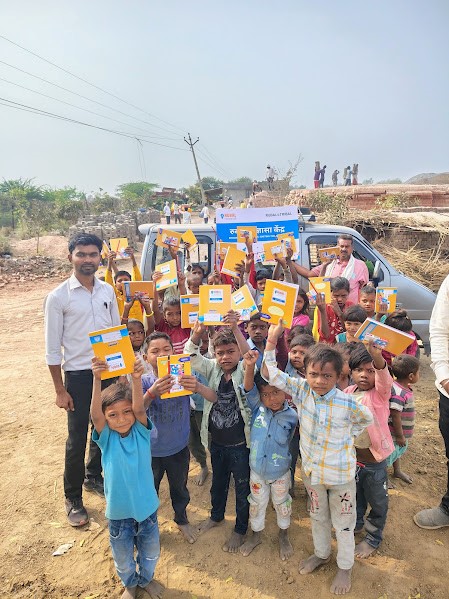
Education support centre at the Brick-Kiln site
The importance of the RUBAL JIDNYASA model lies in its practical and child-centred approach. Instead of forcing migrant children to adjust to a rigid education system, the model brings learning to the places where children live and move with their families. It accepts migration as a normal part of many families’ lives and responds with flexibility, care, and understanding. Studies in India have consistently shown that children from migrant and informal labour families are among the most vulnerable when it comes to education because of poverty, unstable living conditions, and constant movement (Breman, 1996). Global educational frameworks have also stressed the need for flexible and inclusive learning systems so that children are not denied education because of their social or economic background (UNESCO, 2020).
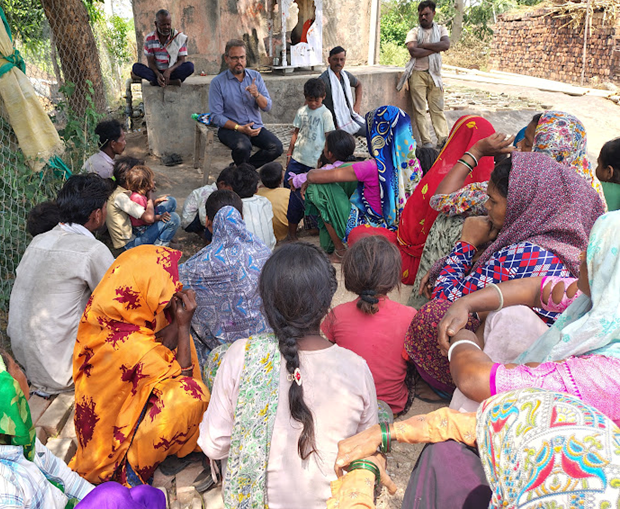
Parent Engagement Session at the Brick-kiln site
In many ways, the RUBAL JIDNYASA Centre reflects and aligns with the recommendations by NITI Aayog i.e. ensuring continuity of education for migrant populations through localised, community-based, and inclusive interventions. The experience of the Centre demonstrates that even within conditions of extreme precarity, educational inclusion is possible when policy vision is combined with grassroots commitment.
The Centre may still be small in space, but its work and message are powerful: “No child should lose education because their parents are forced to migrate for survival”. RUBAL Foundation remains deeply committed to protecting the Right to Education of migrant children. After successfully implementing this model at the brick-kiln site, the organisation now looks forward to expanding the RUBAL JIDNYASA Centres on a larger scale with the support of donors, institutions, and philanthropists. If India truly wishes to achieve equitable and inclusive education, migrant children cannot remain invisible any longer. Perhaps the most meaningful way to align with the vision of NITI Aayog is not only to speak about migrant children but to work and ensure that learning continues wherever their lives take them.
References:
Breman, J. (1996). Footloose labour: Working in India’s informal economy. Cambridge University Press.
Deshingkar, P., & Farrington, J. (2009). Circular migration and multilocational livelihood strategies in rural India. Oxford University Press.
NITI Aayog. (2025). School education system in India: Temporal analysis and policy roadmap for quality enhancement. Government of India.
Rajan I. & Rajput, K. (2023). Right to Education of Migrating Children in India. World Bank.
Smita. (2008). Distress seasonal migration and its impact on children’s education. Consortium for Research on Educational Access, Transitions and Equity (CREATE), University of Sussex.
UNESCO. (2020). Global education monitoring report 2020: Inclusion and education – All means all. UNESCO Publishing.
Dr. Sakshi Rajput
(Chief Operating Officer, RUBAL Foundation and Director, EduNexus Consultancy)
www.rubalfoundation.org
