
By Pruthvi Raj
The Five Guarantee Schemes introduced by the Karnataka Government after the 2023 Assembly Elections have become one of the most widely discussed welfare initiatives in recent years. These schemes were promised by the Indian National Congress in its election manifesto and were presented as a commitment to improve the living conditions of ordinary citizens, especially women, low-income families, youth, and vulnerable sections of society.
However, the idea of providing welfare benefits through government schemes is not new in India. Long before Karnataka introduced its Five Guarantees, several other states had already implemented similar welfare programmes to support their citizens. Over the years, state governments across the country have launched various initiatives such as free or subsidised electricity, free bus travel for women, financial assistance to farmers, direct cash transfers, subsidised food grains, and social security schemes. While supporters view these programmes as important welfare measures that improve the quality of life of people, critics often describe them as “freebies” due to the financial burden they may place on state budgets.
States such as Tamil Nadu, Andhra Pradesh, Telangana, Rajasthan, Delhi, and Chhattisgarh have been at the forefront of implementing welfare-oriented schemes. Tamil Nadu, for instance, has a long history of social welfare programmes, while Andhra Pradesh and Telangana have introduced several farmer-support and income-assistance schemes. Similarly, the Delhi Government has gained attention for providing free electricity and water benefits to eligible households. These initiatives have significantly influenced the welfare policies adopted by other states across India.
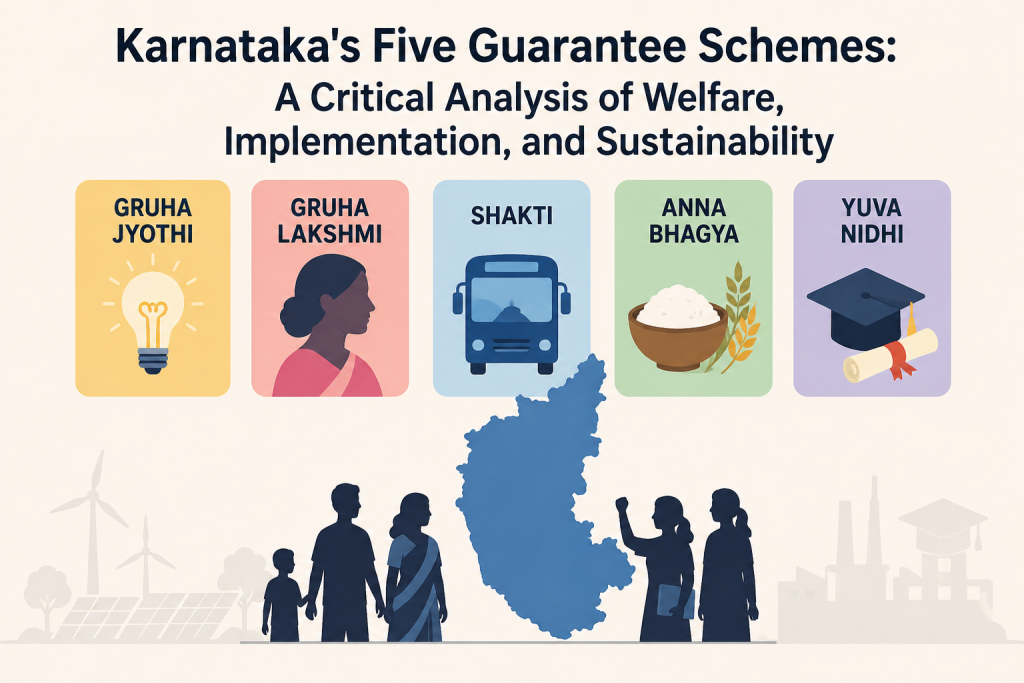
Against this background, the Karnataka Government introduced the Five Guarantee Schemes as a comprehensive welfare package designed to reduce the financial burden on households and promote social and economic well-being. The guarantees represent a continuation of India’s evolving welfare model, where governments increasingly focus on providing direct support to citizens through targeted public programmes.
The Karnataka Government’s Five Guarantee Schemes were designed to address the everyday needs of citizens and provide targeted support to different sections of society.
1. Gruha Jyothi Scheme
The Gruha Jyothi Scheme aims to reduce the financial burden of electricity expenses on households. Under this scheme, eligible domestic consumers are provided with free electricity of up to 200 units per month. The initiative primarily benefits middle- and lower-income families by helping them save on monthly household expenses.
2. Gruha Lakshmi Scheme
The Gruha Lakshmi Scheme focuses on empowering women and strengthening their economic independence. Under this programme, women who are recognized as the heads of their households receive direct financial assistance of ₹2,000 per month. The scheme seeks to improve the financial security of women and enhance their role in household decision-making.
3. Shakti Scheme
The Shakti Scheme was introduced to promote women’s mobility and reduce transportation costs. It provides free travel for women on ordinary and express buses operated by Karnataka’s state-run transport corporations, including KSRTC, BMTC, NWKRTC, and KKRTC. However, the benefit does not extend to premium services such as luxury and air-conditioned buses.
4. Anna Bhagya Scheme
The Anna Bhagya Scheme aims to strengthen food security among economically weaker sections of society. Under this programme, additional food grains are provided to members of Below Poverty Line (BPL) and Antyodaya households. The scheme helps ensure that vulnerable families have access to sufficient food and nutritional support.
5. Yuva Nidhi Scheme
The Yuva Nidhi Scheme is intended to support unemployed youth who have completed their education but have not secured employment. Under this scheme, eligible graduates receive a monthly unemployment allowance of ₹3,000, while diploma holders receive ₹1,500 per month for a specified period. The programme seeks to provide temporary financial assistance and support young people during their job search.
As discussed earlier, the Five Guarantee Schemes were a key component of the Congress Party’s manifesto for the 2023 Karnataka Assembly Elections. Following its electoral victory, the government fulfilled its promise by implementing these guarantees across the state.
The growing popularity of such welfare schemes has sparked an important debate across India. Many state governments have begun introducing similar programmes aimed at providing financial assistance, subsidized services, and social security benefits to their citizens. As a result, welfare schemes and so-called “freebies” have become a significant feature of contemporary electoral politics.
Administrative Challenges in the Initial Implementation of the Five Guarantee Schemes
While the Five Guarantee Schemes were widely welcomed by the public, their implementation posed several challenges for the administrative machinery during the initial stages.
One of the major issues was the lack of clear operational guidelines immediately after the announcement of the schemes. Although people had become aware of the guarantees through election campaigns, television advertisements, newspapers, social media, and the distribution of Guarantee Cards by the Congress Party, the administrative departments responsible for implementing the schemes were still in the process of understanding their roles and responsibilities.
In the beginning, there was considerable confusion regarding which department would be responsible for implementing each guarantee scheme. Government officials at various levels required time to coordinate among departments and establish proper implementation mechanisms. As a result, citizens often approached multiple government offices seeking information and clarification.
The public response was overwhelming. Large numbers of people rushed to different centres, cyber cafés, and government offices to submit applications. This sudden surge in demand placed significant pressure on the administrative system. In many instances, government portals experienced technical difficulties due to heavy traffic, making it difficult for applicants to register and submit their details.
Another major challenge was the verification of beneficiary data. Many applicants faced issues related to Aadhaar linkage, bank account details, mobile number registration, and Know Your Customer (KYC) compliance. Some applications contained incorrect information, while others involved beneficiaries whose records had not been updated. There were also cases where deceased persons continued to appear in beneficiary databases due to the absence of updated death records.
In addition, many citizens were not fully aware of the eligibility criteria, application procedures, or the benefits available under each scheme. To address this issue, the government organized awareness programmes, public outreach campaigns, and information sessions to educate people about the guarantees and guide them through the application process.
As awareness increased and administrative systems became more streamlined, access to the schemes gradually improved. However, the initial phase highlighted the significant challenges faced by government officials in managing large-scale welfare programmes. Identifying eligible beneficiaries, removing duplicate or incorrect records, resolving technical issues, and ensuring transparency required substantial administrative effort and coordination.
The experience demonstrates that while welfare schemes can provide significant benefits to citizens, their successful implementation depends heavily on effective planning, clear guidelines, robust digital infrastructure, and efficient administrative management.
This scheme raises an important question: Do welfare schemes make people dependent on government support, or do they serve as essential tools for social and economic development?
Gruha Jyothi Scheme: Benefits, Challenges, and Alternative Approaches
The Gruha Jyothi Scheme is one of the flagship guarantees introduced by the Karnataka Government. The primary objective of the scheme is to reduce the financial burden of electricity expenses on households by providing free electricity up to 200 units for eligible domestic consumers. To prevent misuse, the government calculated eligibility based on the average electricity consumption of households during previous billing periods and provided benefits accordingly.
From a social welfare perspective, the scheme has benefited many low-income and middle-income families. Electricity is an essential household requirement, and the savings generated through the scheme allow families to allocate their income to other important needs such as education, healthcare, food, and savings. For economically weaker households, even a small reduction in monthly expenses can significantly improve their quality of life.
However, from a public finance perspective, the scheme raises important questions regarding long-term sustainability. Providing free electricity to a large number of households requires substantial government expenditure. Once such a benefit is introduced, it may become politically difficult for future governments to withdraw or reduce it. Political parties may also feel compelled to continue or expand similar schemes to remain electorally competitive, which could increase pressure on the state’s finances over time.
An alternative approach could involve investing in renewable energy solutions, particularly rooftop solar power systems. Instead of continuously subsidizing electricity consumption, the government could provide substantial subsidies for the installation of solar panels in residential households. Such an approach would create a long-term solution by enabling families to generate their own electricity for many years.
A large-scale solar programme could also generate employment opportunities for youth in areas such as installation, maintenance, repair, and technical support services. Furthermore, increased household solar generation would reduce pressure on the state’s power distribution system and allow more conventional electricity to be utilized for commercial and industrial activities, thereby supporting economic growth.
Therefore, while the Gruha Jyothi Scheme provides immediate financial relief to citizens, a combination of welfare support and long-term investments in renewable energy infrastructure may offer a more sustainable solution for both the public and the government.
Gruha Lakshmi Scheme: Benefits, Challenges, and Alternative Approaches
The Gruha Lakshmi Scheme is one of the most ambitious welfare programmes introduced by the Karnataka Government. Under this scheme, women identified as the heads of their households receive direct financial assistance of ₹2,000 per month. The main objective of the programme is to strengthen the financial position of women and improve their economic independence within the family.
The scheme has positively impacted many households across Karnataka. For several women, the monthly assistance has reduced their dependence on other family members for daily expenses. Beneficiaries use the money for children’s education, tuition fees, healthcare costs, household needs, and other essential expenditures. In some cases, women have also invested the amount in small businesses and self-employment activities, helping them generate additional income and improve their family’s economic condition.
However, the scheme also places a significant financial responsibility on the state government. Providing monthly assistance to lakhs of beneficiaries requires substantial public expenditure every year. While the programme offers immediate relief, concerns remain regarding its long-term sustainability. If welfare spending continues to increase without corresponding growth in employment, production, and revenue generation, it may place additional pressure on the state’s finances.
A more sustainable approach could involve combining financial assistance with economic empowerment programmes. Instead of depending only on direct cash transfers, the government could focus on skill development, entrepreneurship training, market creation, value-added industries, and livelihood generation for women.
For example, in Kalaburagi district, many women’s self-help groups are involved in preparing and marketing traditional jowar rotis. Government support and branding initiatives have helped these products gain wider recognition, creating employment opportunities and increasing women’s incomes. Women involved in these activities are able to earn regular income while preserving local food traditions. Recent efforts to promote products such as “Kalaburagi Pulses” have also encouraged farmers and self-help groups to participate in processing, packaging, and marketing agricultural products directly. Kalaburagi is widely known for crops such as jowar, tur dal (pigeon pea), pulses, groundnut, cotton, and other rain-fed agricultural products.
Similarly, Tumakuru district offers strong opportunities for rural entrepreneurship and women’s economic participation. The district is popularly known as “Kalpataru Nadu” because of its large-scale coconut cultivation. Coconut is one of the most important agricultural products in the region, along with ragi, groundnut, maize, flowers, fruits, and horticultural crops. Instead of providing only cash assistance, the government could support women through coconut-based industries such as coconut water processing, virgin coconut oil production, coir products, handicrafts, food processing units, and packaging industries. Better marketing facilities, branding support, storage infrastructure, and direct market access could significantly improve rural incomes.
The government can also strengthen women-led self-help groups by providing business training, low-interest loans, digital marketing support, and entrepreneurship development programmes. Such initiatives would help women create sustainable sources of income rather than depending entirely on monthly welfare assistance.
Therefore, while the Gruha Lakshmi Scheme has provided valuable financial support to women and families, its long-term success may depend on integrating welfare benefits with employment generation, agricultural value addition, entrepreneurship, and local economic development. This approach can empower women not only as beneficiaries of government schemes but also as entrepreneurs, producers, and contributors to Karnataka’s economic growth.
Anna Bhagya Scheme: Benefits, Challenges, and Alternative Approaches
The Anna Bhagya Scheme is one of the most important welfare programmes implemented by the Karnataka Government to strengthen food security among economically vulnerable families. Under the scheme, eligible beneficiaries receive food grains through the Public Distribution System (PDS). The programme primarily benefits families holding Below Poverty Line (BPL) and Antyodaya ration cards, ensuring that basic food requirements are met even during periods of economic hardship.
For poor households, the scheme provides significant relief. Food expenditure constitutes a major portion of household spending for low-income families. By providing food grains at subsidized rates or free of cost, the government helps reduce the financial burden on these families. As a result, they can utilize their limited income for other essential needs such as education, healthcare, housing, and transportation.
The scheme has been particularly beneficial for daily wage labourers, agricultural workers, elderly persons without regular income, widows, and economically disadvantaged families. For such households, access to food security is not merely a welfare benefit but a basic necessity that contributes to their overall well-being and quality of life.
However, like many welfare programmes, the Anna Bhagya Scheme has also generated debate. Some critics argue that long-term dependence on government support may reduce individual initiative and create a culture of dependency. Others contend that food security is a fundamental responsibility of the state and that no citizen should suffer from hunger due to poverty.
Another important concern is the identification of beneficiaries. In some cases, households with relatively higher incomes may continue to receive benefits, while genuinely deserving families may face difficulties in accessing them. This can reduce the efficiency of welfare spending and increase the financial burden on the government.
To improve the effectiveness of the scheme, the government could strengthen beneficiary verification mechanisms. Today, government databases contain information from various departments, including land records, vehicle registrations, property records, income certificates, tax records, and other digital databases. By integrating these records, the government can more accurately identify economically vulnerable households and ensure that benefits reach those who genuinely require assistance.
For example, families owning substantial agricultural land, multiple vehicles, high-value properties, or other significant assets may not require the same level of support as economically weaker households. At the same time, care must be taken to ensure that deserving beneficiaries are not excluded due to data errors or administrative issues.
Therefore, the objective should not be to eliminate food security programmes but to make them more targeted and efficient. By using modern technology, digital governance systems, and accurate beneficiary identification, the government can ensure that welfare benefits reach the right people while reducing unnecessary expenditure. Such an approach would strengthen both social justice and fiscal responsibility, ensuring that public resources are utilized effectively for those who need them the most.
Yuva Nidhi Scheme:Benefits, Challenges, and Alternative Approaches
The Yuva Nidhi Scheme was introduced by the Karnataka Government to provide financial support to educated youth who are unable to secure employment after completing their studies. Under the scheme, eligible graduates receive a monthly allowance of ₹3,000, while diploma holders receive ₹1,500 per month for a specified period.
The primary objective of the scheme is to reduce the financial burden on unemployed youth during their job search. Many graduates and diploma holders face challenges immediately after completing their education. They require financial support for transportation, attending interviews, applying for jobs, preparing for competitive examinations, and meeting other daily expenses. For such individuals, the allowance provides temporary relief and helps them continue their search for employment without placing additional pressure on their families.
The scheme has particularly benefited youth from poor and middle-class families. However, during my experience as a research assistant working in the field, I observed that the actual utilization of the scheme varies among beneficiaries. Some eligible youth receive the allowance but do not actively pursue further education, skill development, or employment opportunities. In such cases, the financial assistance provides temporary support but may not significantly improve their long-term employability.
At the same time, there are many students and job seekers who genuinely require support and are eager to improve their skills and secure employment. Many of these young people come from economically weaker backgrounds and are unable to afford higher education, technical courses, competitive examination coaching, software training, or professional certification programmes because of their high cost. As a result, they often struggle to compete in the job market despite having completed their formal education.
While the Yuva Nidhi Scheme provides short-term financial assistance, it does not directly create employment opportunities. From an economic perspective, continuous payment of unemployment allowances can become a financial burden on the government if employment generation does not increase simultaneously. Therefore, it is important to address the root causes of unemployment rather than only providing financial assistance.
A more sustainable approach would be to combine unemployment assistance with free or highly subsidized technical education, skill development programmes, and career guidance services. The government could provide training in areas such as information technology, artificial intelligence, digital marketing, renewable energy, agriculture technology, advanced manufacturing, and entrepreneurship. Such programmes would help youth acquire industry-relevant skills and improve their chances of securing employment.
The government could also strengthen public libraries and learning centres across the state. Modern libraries equipped with internet facilities, digital resources, study materials, and career guidance services would greatly benefit students preparing for competitive examinations and professional careers. For many rural and economically disadvantaged students, government libraries can provide access to educational resources that would otherwise be unaffordable.
In addition, stronger partnerships between educational institutions and industries through apprenticeship programmes, internships, and vocational training initiatives would help bridge the gap between education and employment. Districts such as Tumakuru and Kalaburagi also offer opportunities for youth entrepreneurship in sectors such as agriculture, food processing, coconut-based industries, pulse processing, and rural enterprises. The government could support young entrepreneurs through business development training, startup incubation centres, and low-interest loans.
Therefore, while the Yuva Nidhi Scheme provides valuable short-term support to unemployed youth, its long-term success depends on whether it is linked with education, skill development, entrepreneurship, and employment generation initiatives. Investing in human capital through technical education, libraries, training programmes, and career development may produce more sustainable outcomes, reduce the long-term financial burden on the government, and create a skilled workforce capable of contributing to Karnataka’s economic growth.
Shakti Scheme: Benefits, Challenges, and Alternative Approaches
Although the Shakti Scheme was introduced with the objective of reducing transportation expenses for women, its implementation has also created several challenges for the public transport system and other sections of society.
One of the major issues observed after the introduction of the scheme is the severe overcrowding of buses. Since travel became free for women, the number of passengers increased significantly, putting enormous pressure on the existing public transport infrastructure. In many places, buses operate beyond their capacity, making travel uncomfortable and difficult for passengers.
During field observations, it was found that students are among the groups most affected by overcrowding. Many students struggle to board buses during peak hours and often reach schools and colleges late. Delays in transportation can negatively affect attendance, punctuality, and academic performance. Similarly, senior citizens face difficulties travelling in crowded buses, especially when seats are unavailable.
Another important observation is that the scheme has not substantially benefited many women employed in factories, industries, and private companies. Most private employers maintain strict attendance requirements, and even a delay of 10 to 20 minutes may result in salary deductions. Since public bus schedules do not always align with company timings, many working women continue to depend on company-provided transport services rather than public buses. Therefore, the actual benefit of the scheme for this category of women appears to be limited.
The scheme has also increased the financial burden on the state government. Transport corporations lose a substantial portion of their passenger revenue and must rely on government reimbursements. In the long run, maintaining such expenditure may affect the government’s ability to invest in other important sectors such as education, healthcare, infrastructure, and employment generation.
From a policy perspective, a more targeted approach may have produced better outcomes. Instead of universal free travel, benefits could have been focused on economically weaker women, students, senior citizens, widows, and other vulnerable groups. Such a system would reduce financial pressure on the government while ensuring that assistance reaches those who genuinely require support.
The resources spent on universal free travel could also be used to purchase additional buses, improve transport infrastructure, increase service frequency, and modernize public transportation. These improvements would benefit all citizens and help address the root causes of transportation challenges rather than merely reducing travel costs.
Therefore, while the Shakti Scheme has provided financial relief to some beneficiaries, its implementation has revealed significant concerns related to overcrowding, service quality, financial sustainability, and unequal benefits among different groups of women. These challenges suggest the need for a more targeted and sustainable public transport policy.
Conclusion
The Five Guarantee Schemes introduced by the Karnataka Government have provided significant support to many citizens, particularly women, low-income families, students, unemployed youth, and other vulnerable sections of society. For many beneficiaries, these schemes have reduced financial stress and improved access to essential services such as food, electricity, transportation, and income support.
However, from an administrative and financial perspective, large-scale welfare schemes also create substantial expenditure commitments for the government. If such programmes continue to expand without corresponding growth in revenue, employment, and economic productivity, they may increase the fiscal burden on the state. Over time, excessive dependence on welfare spending can limit the government’s ability to invest in critical sectors such as education, healthcare, infrastructure, industrial development, and employment generation.
This does not mean that welfare schemes should be discontinued. Many citizens genuinely depend on government support, and social welfare remains an important responsibility of the state. The challenge is not whether welfare should exist, but how it can be delivered more effectively and sustainably.
Governments should focus on identifying and supporting those who genuinely require assistance through better beneficiary targeting, digital governance systems, income verification mechanisms, and integrated databases. By ensuring that benefits reach the most deserving sections of society, public resources can be utilized more efficiently while reducing unnecessary expenditure.
At the same time, long-term development should receive equal attention. Investments in quality education, technical training, skill development, entrepreneurship, employment generation, renewable energy, agricultural value addition, and industrial growth can create sustainable livelihoods and reduce dependence on welfare programmes over time.
Ultimately, the goal of public policy should not only be to provide financial assistance but also to empower citizens to become self-reliant. A balanced approach that combines targeted welfare with economic development can improve the quality of life of citizens while maintaining the financial sustainability of the state. Such a strategy would contribute not only to social welfare but also to the long-term growth and development of Karnataka and India as a whole.
