
Dr. Vaishali Sonavane
Mental health conversations often focus on the individual: what a person feels, how they cope, and what treatment they may need. But for communities living with generations of discrimination, humiliation, exclusion and violence, distress cannot always be understood in isolation from the structures that produce it.
This is the starting point of Dalit Alchemy, a research initiative that explores how caste-based marginalisation shapes mental health and what healing can look like when dignity, autonomy, lived experience and community are placed at the centre.
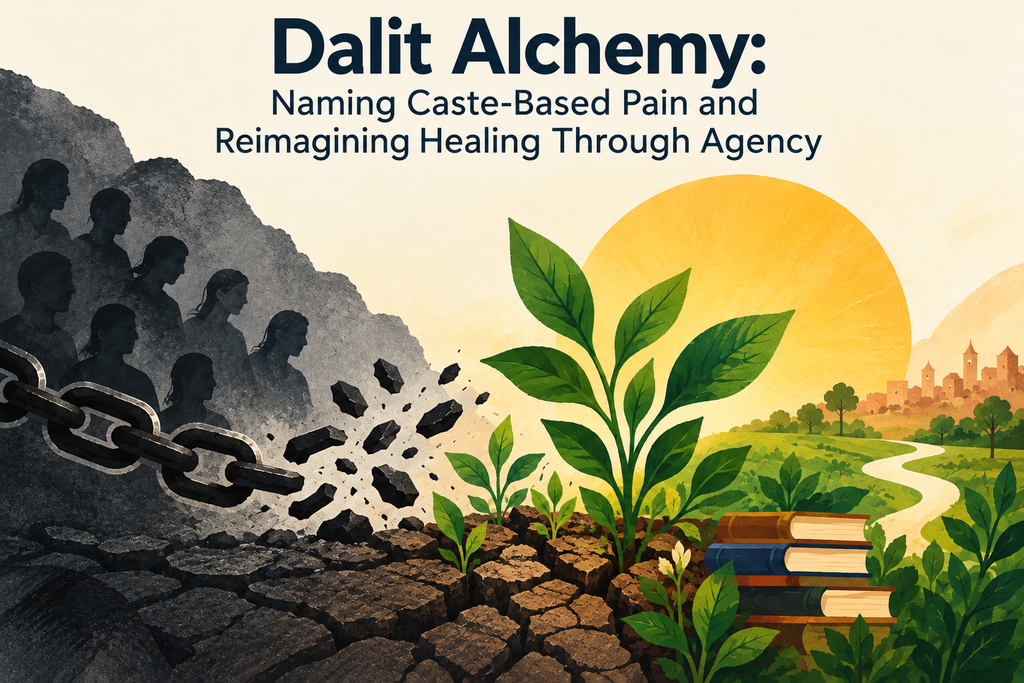
The research is conducted and authored by Dr. Vaishali Sonavane with Dalit Alchemy collaboratorsunder the Mariwala Health Initiative (MHI). It brings together qualitative inquiry, lived experience and reflective analysis to understand the psychological and emotional consequences of castebased oppression, while also exploring user-led and culturally grounded approaches to care.
The full research report, Dalit Alchemy: Naming the Pain and Discovering User-Centric Mechanisms to Heal the Generational Trauma of Being a Dalit, is available through the Mariwala Health Initiative (MHI).
Why “Naming the Pain” Matters
One of the central ideas behind Dalit Alchemy is that healing begins by recognising where pain comes from.
Dalit communities have historically experienced caste-based discrimination, untouchability, social exclusion and violence. These experiences do not simply disappear with one generation. They can shape emotional wellbeing, relationships, feelings of safety, identity and the ways people learn to
move through the world.
The report argues that mainstream mental health approaches can sometimes individualise distress while overlooking caste as a structural source of psychological harm. Dalit Alchemy therefore asks a different question: what changes when distress is understood not as a personal deficiency, but in relation to histories of oppression, exclusion and chronic insecurity?
This process of “naming the pain” creates space for people to connect personal experiences of humiliation, fear or silence with larger social realities.
A Study Centered on Lived Experience
Dalit Alchemy used a qualitative and participatory approach rather than a conventional clinical model. The study engaged five Dalit Human Rights Defenders, whose experiences were explored through interviews, reflective conversations and other forms of participant-led engagement. The methodology was designed around trust and lived experience. Participants provided informed consent, could request edits or anonymisation, and retained the right to withdraw consent for the use of their information. The final report has been presented and approved by the participants before publication. The research also recognised that conversations about caste, violence and generational trauma could be emotionally demanding and therefore placed attention on participant wellbeing and emotional safety.
This matters because the study was not simply collecting information about Dalit communities. It attempted to create a process in which participants themselves remained active knowledge creators.
The Mental Health Allowance: Creating Space for Choice
An important part of the research was a monthly unconditional mental health allowance provided to each participant for one year. Participants were free to decide how they wanted to use the allowance. It was not dependent on disclosure, participation or a particular outcome.
This freedom was intentional. Instead of directing participants towards one predetermined therapeutic approach, the initiative allowed them to explore practices that felt meaningful within their own personal, cultural and political contexts.
The allowance therefore represented more than finance. It created access to something that structural marginalisation can repeatedly restrict; the choice. The research describes this as an opportunity for people to experiment with their own forms of care rather than having healing defined for them.
What Healing Looked Like in Practice
Participants chose different ways of using the space and resources available to them. The report documents practices that included solitude, rest, reflection, journaling, inner-child work, embodied forms of care, ritual, community activity and remembrance. These were not presented as a standard treatment programme. Instead, they emerged from the participants’ own understanding of what they needed.
For some, healing meant creating time away from continuous work and responsibility. For others, it involved reconnecting with experiences of childhood deprivation, engaging in reflective practices or transforming grief into acts of collective care. The study also documented community oriented practices such as storytelling, music, shared reflection and other forms of connection.
From Individual Coping to Reclaiming Agency
Across the participants’ experiences, several common mechanisms of healing emerged.
- Reclaiming agency- gaining greater control over time, resources and personal boundaries.
- Narrative integration- understanding distress in relation to social and structural conditions rather than interpreting it only as an individual failure.
- Embodied restoration- creating experiences of rest, safety, touch and physical regulation.
- Collective connection- allowing personal healing to become connected with relationships, community practices and shared forms of care.
- Agency through resources- giving participants the ability to experiment with and personalise what healing meant to them.
Together, these themes suggest that mental health support can take on a different meaning when people are allowed to shape it themselves.
Healing Is Not Only Clinical
One of the strongest ideas to emerge from Dalit Alchemy is that healing cannot only be reduced to a clinical encounter. For communities experiencing structural inequality, wellbeing is also connected to dignity, economic conditions, social belonging, safety, cultural identity and the
agency. The report therefore places mental health within a broader social and political context. It does not argue that clinical care is unnecessary. Instead, it challenges the idea that clinical care alone can fully address distress produced by structural injustice. In this framework, healing can
also mean reclaiming time. It can mean recognising anger rather than suppressing it. It can mean making space for grief. It can mean being able to rest without guilt. It can mean telling one’s story and having that story recognised as knowledge. And it can mean rebuilding a sense of agency
where generations of exclusion have repeatedly limited it.
The Importance of Community
Dalit Alchemy also moves away from the assumption that healing must always happen privately. The research places significant emphasis on collective reflection, community relationships and shared forms of care. This is particularly important for human rights defenders, whose work often
involves supporting other people through experiences of discrimination, violence and injustice while carrying their own emotional burden.
The study suggests that healing becomes more meaningful when care is not separated from the communities and social realities in which people live. This connects individual wellbeing with collective dignity.
A Pathway from Recognition to Sustained Care
The report identifies a broad pathway that emerged through the participants’ experiences. It begins with acknowledging caste-inflicted pain. Then naming that pain. It then moves towards allocating resources and time, enabling individuals to exercise agency. From there, participants can engage in rejuvenating practices that make sense within their own lives. Individual practices may then become embedded in collective spaces, organisational norms or community-based approaches. Finally, the aim is to sustain dignity and care within personal and professional environments over time. This is not presented as a fixed formula. It is better understood as a reflection on how meaningful support can move from recognition towards autonomy, practice, community and sustainability.
What the Research Does Not Claim
It is equally important to understand the limits of the work. Dalit Alchemy was not designed as a clinical trial, impact evaluation or universally applicable model. The study involved a small group of participants and intentionally prioritised depth, lived experience and relational knowledge over statistical generalisation. The report itself cautions readers against treating participants’ experiences as prescriptions or recommendations that should automatically be reproduced elsewhere. Its contribution lies in opening questions and possibilities. What happens when mental health support begins with upholding agency rather than instruction? What becomes possible when people have the freedom to decide what care means to them? How should mental health practice respond when psychological distress is closely connected with caste, power and structural inequality? These are the questions at the heart of Dalit Alchemy.
From Pain to Power
The word “alchemy” is central to the philosophy of the initiative. Traditionally, alchemy refers to transformation. In this context, Dalit Alchemy uses the idea to describe the movement from historically accumulated pain towards agency, dignity, resistance and collective care. The research
does not deny the reality of trauma. Instead, it refuses to define Dalit lives only through trauma. Alongside pain, the report foregrounds resilience, relationships, resistance, imagination and the capacity to create new forms of care.
The conclusion is therefore about recognising that mental health, for Dalit communities, is inseparable from histories of exclusion as well as histories of courage and resistance. The report ultimately frames healing and justice as interconnected rather than separate goals.
Why Dalit Alchemy Matters
Dalit Alchemy contributes to an important conversation at the intersection of caste, mental health and social justice. It asks practitioners, researchers, institutions and funders to think beyond standardised models of care and pay closer attention to whose knowledge defines healing. It also demonstrates the importance of material dignity. Sometimes support does not begin with prescribing a solution. It begins by creating the conditions in which a person has agency, time, resources and autonomy to identify what care could look like for themselves. For Dalit communities, this approach also means recognising that emotional distress cannot be separated from the realities of caste.
By naming that pain, centring lived experience and restoring agency, Dalit Alchemy offers a way of thinking about mental health that is simultaneously personal, relational, cultural and structural.
About the Research
Research: Dalit Alchemy: Naming the Pain and Discovering User-Centric Mechanisms to Heal the Generational Trauma of Being a Dalit
Author and Researcher: Dr. Vaishali Sonavane (MHI 2021-025)
Published by: Mariwala Health Initiative (MHI)-Dalit Mental Health Initiative- Dalit Alchemy.
Publication: February 2026
The report was developed through collaboration between Mariwala Health Initiative and Dalit Human Rights Defenders.
Read the complete original research report: https://mhi.org.in/media/insight_files/Dalit_Alchemy_Digital_1.pdf
Original MHI Resources Page: https://mhi.org.in/resources/

This Post Has 4 Comments
Congratulations, Dr. Vaishali Sonavane for your report. This very important initiative address the historical trauma experienced by Dalit communities and its enduring impact on mental health, an issue that has long remained unheard, unacknowledged, and inadequately addressed.
Dalit communities continue to carry the burden of historical and intergenerational trauma while courageously navigating the challenges of a caste-dominated society. I firmly believe that Dalit Alchemy has the potential to create meaningful change and positively impact millions of lives in the years to come.
This is an important step towards building a more just, inclusive, and compassionate society. There is still a long way to go, but I remain hopeful that, with the contributions of committed intellectuals and changemakers like you, we will continue moving closer to that vision. ✊🏽
Thank you for your thoughtful words and encouragement Dr Kalpana. I hope this work helps bring Dalit lived experiences and knowledge into mental health research, practice, and policy. It is important that we recognise caste-based distress in its social and historical context and build healing processes that respect the dignity, agency, and knowledge of Dalit communities. There is much work ahead, and I hope this research contributes to that effort.
Innovative, Technical, Useful and skill full research done. It can show positive response on societal behavior. Will be happy to know more relevant research from the researcher. If possible you can connect me on 99229 48488 or [email protected].
Thank you, Mangesh Akhade for your appreciation and interest in my research. I am glad that you see its relevance for understanding and changing societal behaviour. I will be happy to stay connected and share my future work on caste, mental health, and healing rooted in the lived experiences and agency of Dalit communities. I appreciate your reaching out and look forward to further conversations. I will certainly get in touch using the contact details you have shared.