
By Ms. Sujata Kutinho, Project Coordinator, CYDA
It was supposed to be another farming season.
In a small village in Maharashtra, a farmer prepared his field with hope, just as his father and grandfather had done before him. The first rains arrived late. Then they arrived all at once. Within days, standing crops were submerged under floodwaters. Months of labour disappeared overnight.
Hundreds of kilometres away in Odisha, coastal families watched the sea inch closer to their homes after yet another cyclone. In Rajasthan, women walked farther than ever before to collect water from shrinking sources. Across rural India, stories like these are no longer exceptional. They are becoming routine.
The climate crisis is no longer a distant warning. It is today’s reality.
In 2025 alone, India experienced extreme weather events on 331 out of 334 days. Heatwaves scorched regions that had never experienced such temperatures before. Floods destroyed homes and farmlands. Droughts depleted water sources and livelihoods. More than 4,400 lives were lost, over 181,000 homes were damaged, and 17.4 million hectares of cropland were affected (Pandey, 2025).
For the 650 million people living in rural India, climate change is not measured in degrees Celsius. It is measured in failed harvests, empty wells, lost income, and uncertain futures.
Yet amid this crisis, another story is unfolding—one of resilience, innovation, and hope.
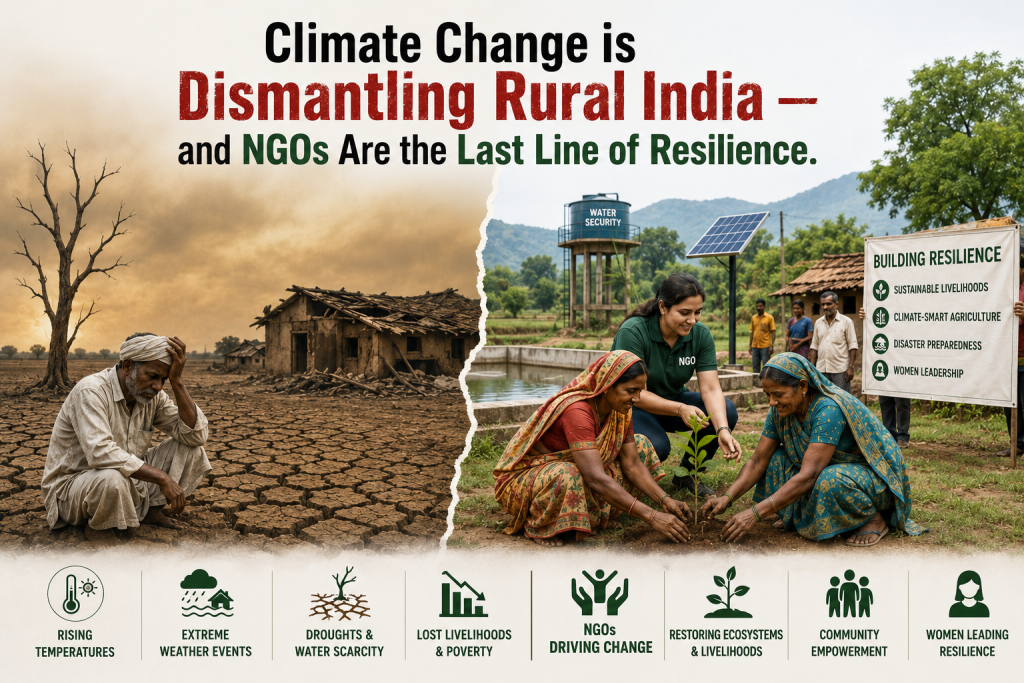
Across India’s villages, communities are refusing to surrender. Supported by grassroots organisations and local NGOs, they are rebuilding livelihoods, restoring ecosystems, and creating solutions tailored to their realities. While global climate negotiations continue and policy frameworks evolve, local communities are taking action today.
The Human Cost Behind the Numbers
Statistics tell us the scale of the crisis, but they often fail to capture its human impact.
For small and marginal farmers, who make up the overwhelming majority of India’s farming population, a single climate shock can erase an entire year’s income. For fishing communities, rising seas and stronger storms threaten both homes and livelihoods. For tribal populations living in ecologically fragile regions, changing weather patterns disrupt traditional ways of life that have sustained generations.
Research increasingly shows that climate change is not only damaging ecosystems—it is deepening poverty. Recent studies indicate that every one-degree rise in temperature can significantly reduce rural household consumption, directly affecting food security and economic well-being.
Climate change is therefore not merely an environmental challenge. It is a development challenge, a livelihood challenge, and a social justice challenge.
Women: The Silent Pillars of Resilience
Among those bearing the greatest burden are rural women.
Women constitute more than 60 percent of India’s agricultural workforce, yet they often remain excluded from land ownership, agricultural services, and decision-making processes.
When water sources dry up, women walk farther.
When crops fail, women manage household food shortages.
When disasters strike, women carry the responsibility of caring for children, elders, livestock, and families.
Yet despite these challenges, women are emerging as some of India’s most effective climate leaders.
Across villages, women’s self-help groups are promoting climate-resilient farming, water conservation, seed banks, and disaster preparedness. Kudumbashree women’s Self-Help Groups in Kerala (Kudumbashree Mission )have promoted collective farming, community seed banks, and sustainable agricultural practices, demonstrating how women are leading climate resilience at the grassroots level . They are not simply adapting to climate change—they are leading the adaptation movement.
Where Hope Takes Root
Across the country, NGOs are demonstrating that resilience can be built when communities are empowered to lead.
In Tamil Nadu, climate-resilient village initiatives are helping communities prepare for floods and cyclones through climate-smart infrastructure, renewable energy solutions, and improved waste management systems.
Along Odisha’s vulnerable coastline, restored mangrove ecosystems are acting as natural barriers against cyclones while simultaneously supporting fisheries and biodiversity.
In Maharashtra, women farmers are adopting drought-resistant crops and water-efficient farming practices, strengthening food security while reducing climate risks.
In Rajasthan, traditional water harvesting systems that once seemed forgotten are being revived, replenishing groundwater and helping communities withstand recurring droughts.
These efforts share a common lesson: the most effective climate solutions are often local solutions.
Communities understand their vulnerabilities better than anyone else. When provided with knowledge, resources, and institutional support, they become the architects of their own resilience.
The Role of NGOs: Bridging Policy and Reality
For many rural communities, NGOs serve as the critical bridge between climate policy and practical action.
They translate complex climate concepts into local solutions. They help communities access government schemes, strengthen local institutions, build disaster preparedness systems, and restore natural resources.
Most importantly, they ensure that adaptation efforts reach those who are often overlooked—small farmers, women, tribal communities, and vulnerable households.
As climate risks intensify, the role of NGOs is becoming increasingly important. Their work demonstrates that resilience is not built in conference rooms alone. It is built in villages, fields, forests, and coastal communities through sustained engagement and trust.
The Road Ahead
The scale of India’s climate challenge demands bold action.
Climate finance must reach local communities. Women’s leadership must be recognised and strengthened. Climate-resilient agriculture must become the norm rather than the exception. Early warning systems and ecosystem restoration must be treated as essential infrastructure.
Most importantly, local communities must be placed at the centre of climate action.
As the world prepares for the next phase of global climate commitments, India’s villages offer an important lesson: resilience cannot be imposed from above. It must be built from the ground up.
Because in a country where climate disasters are becoming an almost daily reality, resilience is no longer a development aspiration.
It is a survival imperative.
And every day, in villages across India, communities and NGOs are proving that even in the face of an escalating climate crisis, hope can still take root.
References:
a) Kudumbashree Mission. (n.d.). Farm activities: Mahila Kisan Sashaktikaran Pariyojana (MKSP). Government of Kerala. Retrieved July 25, 2026, from https://www.kudumbashree.org/pages/511
b) Pandey, K. (2025, December 18). Year of extremes: India hit by disasters on 331 of 334 days in 2025, up from 295 in 2024 and 292 in 2022. Down To Earth. https://www.downtoearth.org.in/climate-change/year-of-extremes-india-hit-by-disasters-on-331-of-334-days-in-2025-up-from-295-in-2024-and-292-in-2022
