
By Soumyashree Mohanty, ImpactLens Correspondent
You may have friends or relatives living abroad. When they visit India, conversations often turn to everyday issues such as waste, pollution and traffic. They may tell us how clean their surroundings are and how well things are organised. We often hear about clean streets, well-maintained roads and organised waste collection in cities across Europe and North America. Compared with many Indian cities, the difference can be striking.
But when we admire the cleanliness of these cities, there is another question we rarely ask: Where does all the waste go after it leaves the street/landfills?
Where Does the Waste Go?
Waste does not disappear once it is collected. Some of it is recycled. Some goes to landfills or incineration facilities. Some is sent to other countries. Yes, waste can cross borders too. Recyclable paper, plastic and other materials are bought and sold internationally because industries can use them as raw materials. In 2024, the United States exported around 12.1 million tonnes of used paper and cardboard for recycling. India was the largest destination, receiving about 2.1 million tonnes. These figures are based on U.S. Census Bureau trade data reported by Resource Recycling.
Why Does Waste Move Across Borders?
There are clear economic reasons behind the global waste trade. Waste management is expensive, especially in countries with strict environmental regulations. Companies have to spend money on collection, segregation, treatment, recycling and safe disposal. Processing contaminated waste can cost even more. At the same time, imported recyclable materials can provide cheaper raw materials for industries in countries where processing and labour costs are lower. Waste can therefore become a commodity.
There is nothing inherently wrong with importing recyclable materials. Paper, plastic, metal and other materials can be recovered and used again. International trade in recyclable materials can support recycling businesses, industries and jobs. The problem begins when a shipment contains large amounts of material that cannot actually be recycled.
The exporting country may reduce pressure on its own waste-management system. But the importing country is left with the cost of inspection, sorting, treatment and disposal. Instead of solving the waste problem, the trade can simply move the environmental and health risks from one country to another.
Waste Colonialism
This is where the term “waste colonialism” becomes important. The concept emerged in discussions about the international movement of hazardous waste in the late 1980s. There were growing concerns that wealthy countries were transferring unwanted and hazardous waste to poorer countries. Academic research has since used the term to examine the unequal movement of waste from the Global North to the Global South.
The Basel Convention, adopted in 1989, was an important international response to the growing problem of hazardous waste moving across borders. It established rules to control the movement and disposal of hazardous waste between countries. It also reflected growing concerns about the environmental and health risks of transferring such waste. The idea behind waste colonialism is simple. Countries that consume large quantities of products also generate large amounts of waste. When difficult-to-manage, waste is exported to countries where processing and labour costs are lower, part of the environmental burden can move with it. The people who consume the products may live thousands of kilometres away from the communities that eventually sort, recycle, treat or dispose of the waste.
This does not mean that every shipment of recyclable material is an example of waste colonialism. Much of the international trade in recyclable materials is legitimate. The concern is about who bears the environmental risk. Wealthy countries consume products but often transfer difficult-to-manage waste to countries with weaker infrastructure or enforcement.As a result, poorer communities may bear a larger share of the environmental burden
China Tightened Its Waste Imports. Where Did the Waste Go?
For many years, China was one of the world’s major destinations for imported waste, particularly plastic and other recyclable materials. But concerns about contamination and the environmental impact of low-quality waste imports led to tighter controls. In 2018, China introduced its National Sword policy. It restricted imports of 24 categories of solid waste and imposed much stricter contamination standards. These restrictions changed global waste flows. Exporters began looking for alternative destinations. Countries across Southeast and South Asia became increasingly important in the international recycling and waste trade. The whole dynamic of the global waste trade changed. India was among the countries affected by this shift. When one major importing country tightens its controls, waste does not necessarily disappear. It can simply move to another country.
India: Recycling Hub or Waste Destination?
India has a large recycling industry. Imported recyclable materials can provide raw materials for paper mills, plastic recyclers and other industries. Therefore, importing recyclable materials is not, in itself, a problem. The real concern is what enters the country, how it is declared and whether it can be safely processed. Several cases show that waste declared as recyclable has sometimes entered India as contaminated or municipal waste.
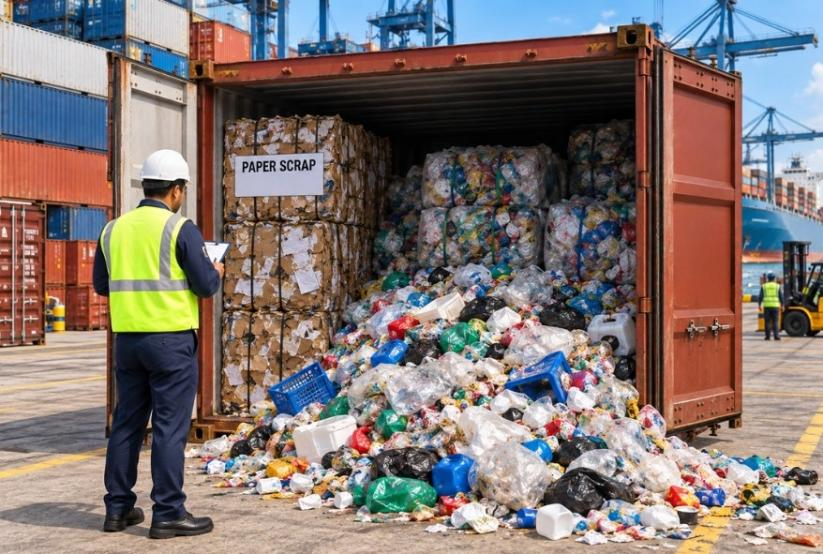
A Comptroller and Auditor General of India (CAG) audit found 20 containers at Tuticorin Port, Tamil Nadu, that were declared as mixed plastic waste, wastepaper or paper scrap. They were found to contain municipal waste. Ten of these containers originated from Saudi Arabia and the United States. Some remained at the Tuticorin Inland Container Depot for two to eleven years.
The CAG also recorded 12 containers from Southampton, UK. They were imported in 2009 as waste paper but were found to contain highly contaminated municipal and domestic waste. These cases raise a serious concern: what is declared on paper may not always match what is inside the container.
A similar case emerged in 2022. Five containers from Canada, weighing 121.970 metric tonnes, were declared as waste paper. They were found to contain municipal waste, including PET bottles, street sweepings, plastic waste and broken glass. In June 2026, the Madras High Court ordered the containers to be re-exported to their respective ports of origin within 60 days. It also imposed ₹50,000 per day in environmental compensation for any delay.
But Can India Manage Its Own Waste?
This brings us to a difficult question. If India is already struggling to manage the waste generated within its own cities and towns, how much additional waste can it safely take from other countries?
According to the 2026 report, Municipal Solid Waste Management in India: Policy and Technology Pathways for Climate Action, India generates around 170,000 tonnes of municipal waste every day. About 104,000 tonnes are processed.Around 40% of municipal waste does not undergo formal processing. Some of the remaining waste reaches disposal sites without proper processing. Some also remains unaccounted for in official data.
These figures reveal an important difference between waste collection and waste management. Collecting garbage from a street does not mean that the waste has been properly managed. Once a garbage truck leaves, the waste still has to be segregated, transported, recycled, treated, or safely disposed of. If these stages are weak, the waste simply moves from one location to another. A country may have a strong recycling industry but still lack enough capacity to deal with contaminated or hazardous material. This is why the question of waste imports cannot be separated from India’s own waste-management capacity.
What Should India Do?
India does not need to shut the door on legitimate imports of recyclable materials. Instead, it needs stronger safeguards. These safeguards should ensure that recycling does not become a route for importing waste that cannot be safely managed.
First, imported recyclable material needs stronger inspection and verification before it enters the country. Misdeclaration should attract meaningful penalties. Companies responsible for contaminated shipments should also bear the cost of re-export and disposal.
Second, India needs better traceability of imported waste. Authorities should be able to identify what material enters the country, who imports it, where it will be processed and what happens to it after processing.
Third, India’s domestic waste-management capacity must improve. Better segregation at source, modern material-recovery facilities, scientific treatment and safe disposal systems are essential. Worker safety must also be treated as a core part of waste management.
Finally, India needs transparent and reliable data on waste generation, processing, imports and disposal. Without accurate information, it is difficult to know how much waste the country is actually managing and where the gaps remain.
Waste Does Not Disappear
For developed countries, responsibility should not end when waste crosses their borders. Exporting waste may make a city look cleaner. But it does not necessarily mean that the environmental problem has been solved. For India, becoming a recycling and circular-economy hub should not mean becoming a destination for waste that other countries are unwilling or unable to manage safely. International trade in clean recyclable material can support the recycling industry. But contaminated, misdeclared or unsafe waste should not be allowed to enter simply because it is cheaper to process elsewhere.
Waste does not disappear. It only moves.
It moves from our homes, factories and industries to collection points, then to processing facilities or landfills. Sometimes, it moves from one country to another. The real measure of a clean city is not just what we see on its streets. It is also not whether we see no landfills. We must ask what happens after the garbage truck takes the waste away. Is it actually recycled? Where does the unrecyclable waste end up?
And most importantly, who bears the environmental and human cost? If India wants to become a responsible recycling and circular-economy hub, it must first build a waste-management system strong enough to safely manage its own waste. At the same time, it must ensure that imported recyclable materials meet strict environmental and safety standards. A clean city should not be created by making another community bear the cost of its waste.
