
ImpactLens Correspondent
Peace Series: 12
What does peace really mean when violence can exist even without a war? This is one of the questions that runs through the ideas of Mr Rajgopal P. V., a Gandhian social activist and founder of Ekta Parishad, a people’s movement working on land rights and nonviolence. In an interview with ImpactLens, he spoke about what peace means beyond the absence of war, and about the connections between violence, injustice, education, values and social change. On the occasion of the International Day of Peace, observed every year on 21 September, ImpactLens brings his thoughts to readers, drawing attention to the forms of violence that can become part of everyday life and the role nonviolence can play in responding to them. His experience of working with communities and social movements gives context to his reflections on peace, justice and nonviolent action.
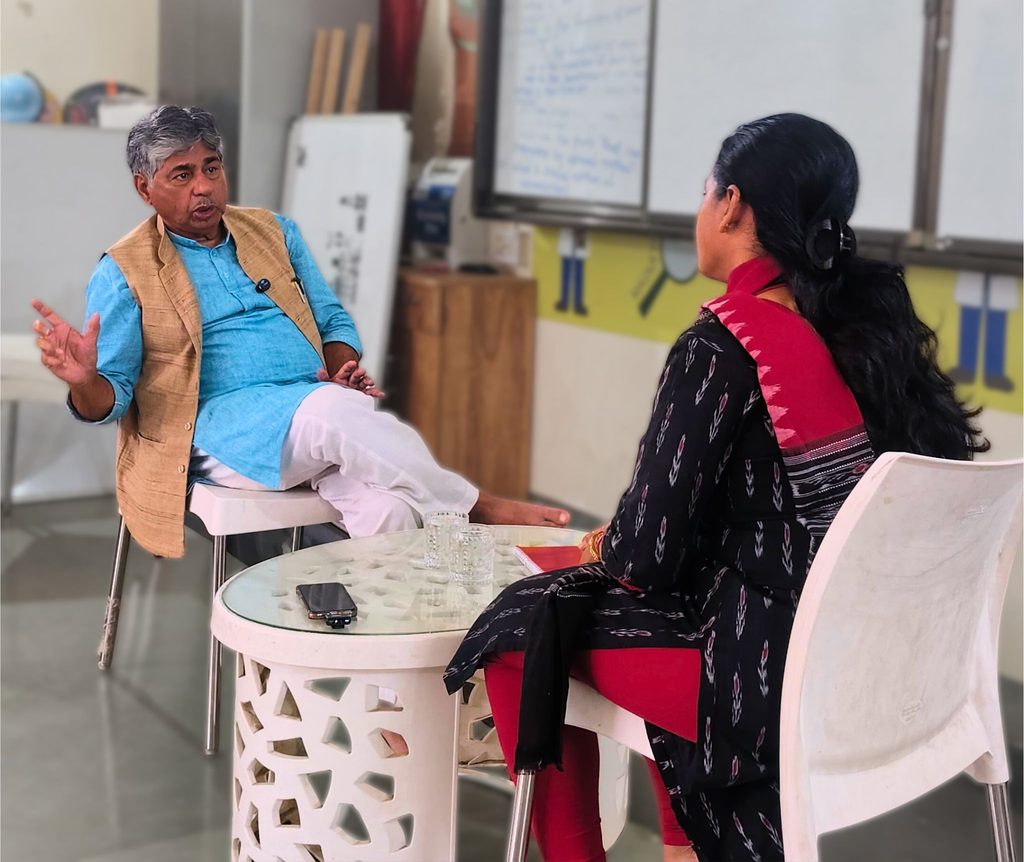
For him, violence is not limited to war or physical attacks. Poverty, injustice, oppression, corruption, caste discrimination and violence against women can also be forms of violence. Some are visible, while others remain hidden in everyday life. “We need to understand the roots and different layers of violence,” he says, because recognising these layers is the first step towards understanding how violence affects people and how society can respond to it.
He also points to the way society talks about violence. Violence can receive considerable attention and, at times, can even be glorified, while the work of people promoting peace and nonviolence receives far less visibility. He points to an imbalance in reporting: there are war reporters and crime reporters, but very few people reporting on peace and nonviolence. He believes young people need to understand peace and become part of efforts to build a culture that recognises and values nonviolence.
The need to look deeper also applies to poverty. When someone begs, society may simply assume that the person does not want to work. But he believes we need to ask why that person is begging and understand the circumstances behind it. Looking at the root causes of such situations, he says, is part of understanding the everyday violence within society.
Gandhi is not just a name
For him, the idea of nonviolence is closely connected with Gandhi. But he does not see Gandhi simply as a historical figure. “Gandhi is not a word, Gandhi is an action,” he says, describing Gandhi as a representation of values and virtues that can provide direction in everyday life. He compares Gandhi to a lighthouse. Just as a lighthouse provides direction to ships, Gandhi’s values can provide direction to people living in a society influenced by consumerism, addiction and a strong focus on money. This is why, he says, children and young people need to understand Gandhi through his life and actions rather than only learning about him as a historical personality.
What do we do with our anger?
Peace, in his view, does not mean remaining silent when people experience injustice. Anger can arise when people face discrimination or unfairness, and he does not see anger as automatically negative. The important question is what people do with that anger.
Anger can become energy for change when it is understood, managed and channelled constructively. He points to the Salt March as an example of how dissatisfaction and anger can be transformed into nonviolent action. For people working in the social sector, this requires the ability to recognise the anger within communities, bring people together and develop a course of action that uses nonviolent methods.
The challenge, therefore, is not to deny anger but to learn how to manage it. When anger is allowed to become violence, it can deepen conflict. When it is understood and channelled through peaceful action, it can become part of a constructive movement for change.
Learning to resolve conflict
Conflict is part of every society. It exists within families, schools, communities and larger social systems. He believes the first step is to accept that conflict exists and then understand both the reasons behind it and the people involved. Only after that can people begin looking for ways to resolve it peacefully.
He believes these skills should be taught from childhood. Schools can become important spaces for helping children understand conflict and bullying, including physical and indirect forms such as gossip. He refers to the idea of a “peace corner” in some classrooms, where children involved in a conflict can sit together and talk about their differences. Peace clubs can also help children learn how to resolve conflicts in an amicable way.
The same approach can extend beyond schools. He believes governments should look at development through a “nonviolence lens” and address problems at their roots so that conflict and violence can be prevented before they grow. Even equality within the family, he says, can play a role in preventing conflict.
The values we choose to nurture
For Mr Rajgopal P. V., understanding peace is also closely connected with the values that society chooses to nurture. He compares values to a plant: when a plant is nurtured, it grows, and when violence is nurtured, violence can also grow. This makes it important to ask what families, schools and society are teaching and encouraging.
He points to consumerism and competition as factors that can affect values such as sharing and compassion. Development may bring short-term gains, but society also needs to consider longer-term effects. Education becomes particularly important in this context because a classroom can become a small reflection of the society around it.
If children are taught mainly to compete, compare marks and measure success through achievement and wealth, cooperation can lose importance. He points to Gandhi’s idea of Nai Talim, which brings together the hand, the heart and the head. Education, in this understanding, should not be limited to intellectual development; it should also help people develop values, skills and self-reliance. For him, values are not something separate from education or social development. They are part of what keeps society together.
Looking at structural violence
Peace also requires society to recognise structural violence. He says the struggles of marginalised and oppressed communities need to be understood and discussed, because people can become so accustomed to inequality that they stop questioning it.
He also believes the role of religion, politics and education needs to be examined because these can sometimes give acceptance to forms of structural violence. Understanding these structures is necessary if people are to find ways of reducing them.
Change can take different forms. Empathy and love can play a role, while organised movements and laws can also be used to work towards justice. He refers to Vinoba Bhave’s work encouraging people who owned land to give land to those who were landless. For him, such examples show the importance of continuing to act even when results are not immediate. Social change may take time, but that should not become a reason to stop working for it.
Peace begins with us
Building a culture of peace cannot be left only to governments or social movements. It also begins with individual behaviour. He points to a decline in values in areas such as leadership, politics, democracy, business and religion and believes these values need to be rebuilt through families, schools and communities.
Social organisations also need to examine their own behaviour. Even organisations that work for social change can become authoritarian. Participation, compassion and democratic behaviour therefore need to be practised within organisations as well as advocated outside them. He encourages people to ask whether they themselves can be democratic, compassionate and participatory in their everyday lives.
People also learn values by watching others. This makes personal example important. If people want to build a culture of peace, the values they speak about also need to be visible in the way they behave and work with others.
Working together despite differences
His experience with social movements has also shaped his understanding of cooperation. People may have very different ideologies and approaches, but they can still work together when they focus on a common issue rather than allowing their differences to become the centre of the conversation. Mr Rajgopal P. V. recalls Jan Satyagraha, where Gandhian, socialist, communist, Dalit and women’s groups came together around the issue of land. These groups did not have to agree on every ideological question. They were able to work together because they focused on a larger goal.
For him, friendship, networking and participation are important in creating such cooperation. Working together requires conscious effort and, at times, sacrifice. A larger social goal can bring people together even when their individual beliefs and backgrounds are different.
What makes a peacebuilder?
For him, working for peace requires more than good intentions. A peacebuilder needs to understand the connection between justice and peace and use nonviolent methods in the pursuit of justice.
Humility and simplicity are equally important. People working with communities need to move beyond ego and follow a participatory approach. Gratitude and respect matter as well. Those who join a movement should not be treated simply as a crowd; they are participants and deserve to be respected for their contribution. “Love connects people, ego doesn’t,” he says. For him, building peace is therefore not only about changing systems but also about changing the way people relate to one another.
Between silence and violence
For young people, his message ultimately comes back to values and ethics. “Everything that gives economic benefit may not be ethically correct,” he says. Money and material success should not become the only measures of achievement. People also need to ask whether what they are doing is ethical and what values guide their actions. At the heart of his message is a simple but powerful thought: “Between silence and violence there is a path called nonviolence.”That path begins with understanding violence in all its forms. It means learning how to manage anger, resolve conflicts and nurture values. It means responding to injustice without allowing anger to become violence, working with people across differences and continuing to act even when change takes time.
As the International Day of Peace provides an opportunity to reflect on what peace means, his perspective invites us to look beyond the absence of war. Peace is also about how we respond to injustice, how we resolve our differences, what values we nurture and how we choose to act in our everyday lives.
