By Amruta Pawar, STEM Coordinator
Supported By EMpower
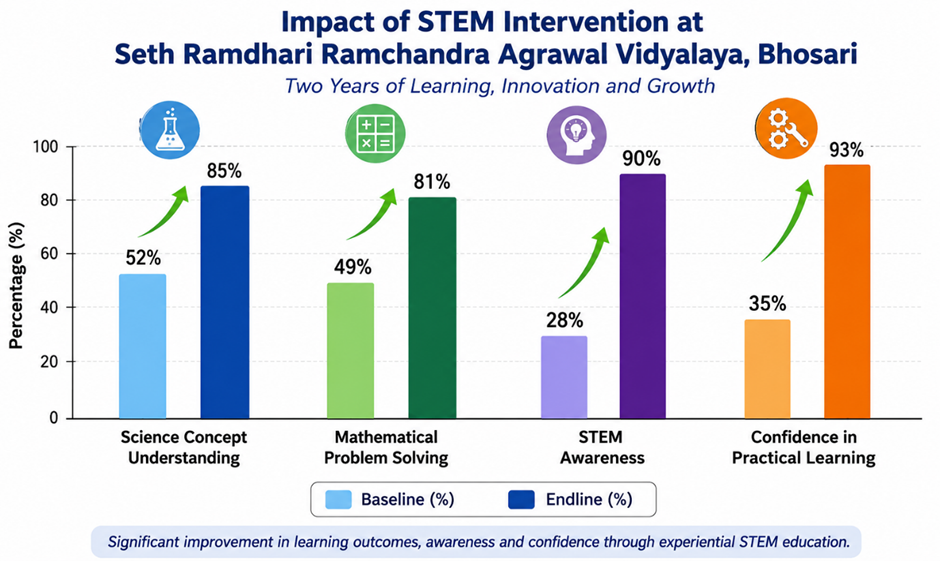
For the past two academic years, the Centre for Youth Development and Activities (CYDA) has been working to transform learning experiences at Seth Ramdhari Ramchandra Agrawal Vidyalaya, Bhosari, Pune, through its comprehensive STEM (Science, Technology, Engineering, and Mathematics) Education Program. Reaching nearly 450 students from Classes 5 to 10 and involving 18 teachers, the initiative has successfully made education more practical, engaging and future-ready.
At the start of the program, baseline assessments revealed that many students perceived Science and Mathematics as difficult subjects and had very limited opportunities for hands-on learning. To bridge this gap, CYDA established a structured STEM learning ecosystem that included experiments, model-making, coding, robotics, electronics, mathematics activities, design thinking challenges, and innovative projects.
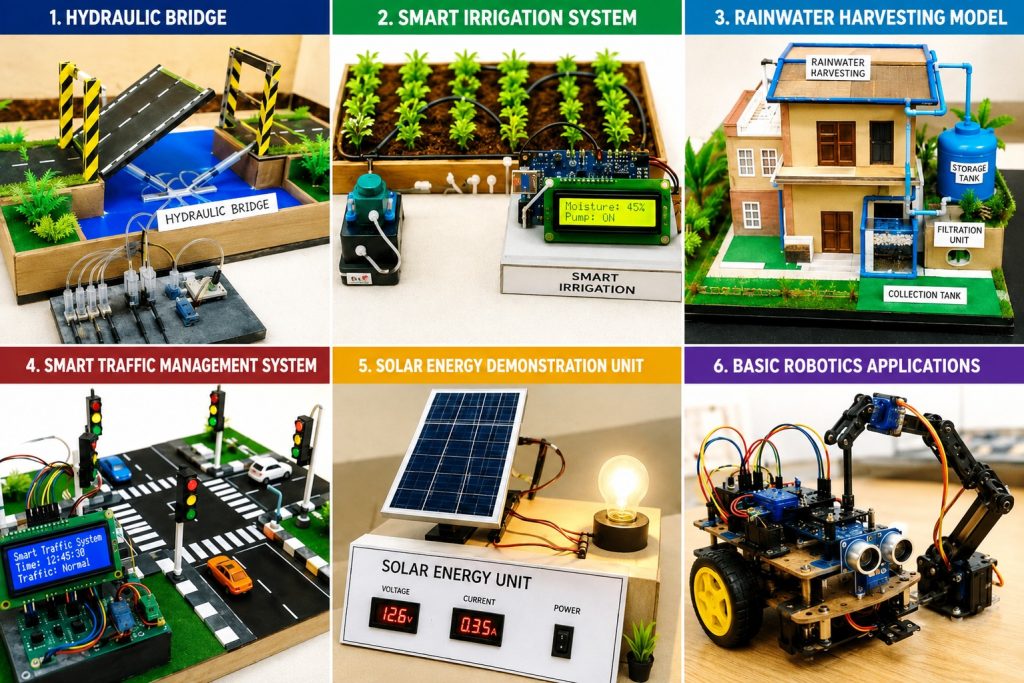
Over two years, students participated in more than 180 STEM sessions and developed over 60 science and engineering models. Projects such as the Hydraulic Bridge, Smart Irrigation System, Rainwater Harvesting Model, Smart Traffic Management System, Solar Energy Demonstration Unit, and basic robotics applications enabled students to connect classroom concepts with real-world challenges.
Learning Outcomes
Teachers observed significant improvements in students’ analytical thinking, curiosity, classroom participation and problem-solving abilities, which were witnessed through the following.
- Students actively asked questions and explored concepts through hands-on activities, reflecting increased curiosity and engagement in learning.
- Students confidently participated in group discussions and presentations, showing higher classroom participation and collaboration.
- Students successfully applied STEM concepts to solve practical challenges, demonstrating enhanced problem-solving abilities and creativity.
The intervention also contributed to stronger academic performance. Students relied on experimentation and conceptual understanding rather than rote memorization. A total of 37 students (16 girls and 21 boys) appeared for the Grade 10 examination. Among them, six students 3 girls & 3 boys scored above 90%, while the remaining students achieved excellent marks in Science and Mathematics.
The Labor Friend project by the students won Second Rank at the national-level Idea First YESummit India, and the team was felicitated for with Rs.20,000/- prize money which is being used to improve the model and develop better prototypes, helping students strengthen their innovation, entrepreneurship, and problem-solving skills.
“Earlier I used to memorize science answers without understanding them. Through STEM activities, I learned by doing experiments and creating models. Now Science is my favourite subject.”
— Sanskriti Kamble Class X
“The robotics and coding sessions inspired me to think about becoming an engineer. I never imagined I could build working models myself.”
—Sakshi Suryavanshi Class VIII
“Students who were usually quiet in class started asking questions and presenting projects confidently. The STEM program has transformed the learning culture of our school.”
— MR. Sunil Kamble
“My child now discusses scientific ideas at home and shows greater interest in studies. We have seen remarkable growth in confidence and communication skills.”
— Parent
Promoting innovation and leadership was another major key focus of the program. Students actively participated in STEM exhibitions, innovation fairs, and project presentations. Special emphasis was placed on encouraging girls’ participation. Out of 320 students enrolled in STEM activities, 168 (53%) were girls, many of whom took leadership roles in coding, robotics and innovation projects.
To ensure sustainability, CYDA conducted 12 teacher capacity-building sessions emphasized on STEM pedagogy, experiential learning, project-based teaching, AI, robotics, coding, classroom learning, low-cost teaching and learning materials and assessment techniques.
Beyond Academics: Developing 21st Century Skills
Apart from academic improvement, students developed critical life skills such as:
- Creativity and Innovation
- Communication Skills
- Teamwork and Collaboration
- Critical Thinking
- Leadership
- Problem Solving
- Digital Literacy
These competencies are essential for future education and employment opportunities. Beyond academics, the program nurtured creativity, communication, teamwork, leadership, critical thinking, and digital literacy. The STEM intervention proved how experiential learning can transform school education and prepare students to become confident innovators and problem-solvers of the future.
