By ImpactLens Correspondent
The tragic collapse at the Moshi dumping yard in Pimpri-Chinchwad, which claimed one life and injured several others, should not be seen as an isolated accident. It is a warning to every Indian city. Mountains of unsegregated waste have become ticking time bombs. They threaten not only the environment but also the lives of those who work tirelessly to protect public health.
The unfortunate incident occurred because mixed waste continued to be dumped without adequate processing. The landfill exceeded its capacity, resulting in structural failure. Rescue teams from the NDRF, Fire Brigade, Police, and municipal authorities worked relentlessly to save nine people, but one precious life was lost.
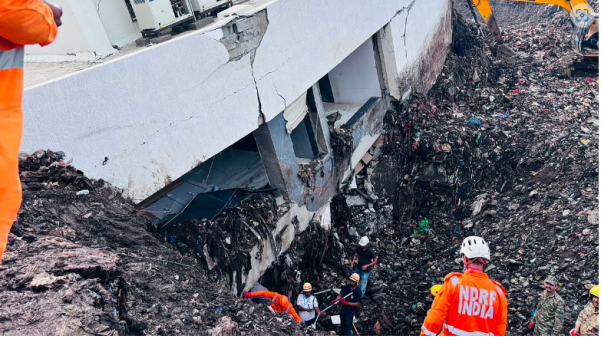
The question India must ask is simple: How many more lives must be lost before we take waste management seriously?
- Waste Managers Are Public Health Protectors
India has traditionally viewed sanitation workers as “kachara walas” or “kachara walis.” This mindset is not only disrespectful but also dangerous. These men and women are not merely collecting garbage—they are protecting millions of people from disease, pollution, and environmental disasters.
A soldier guards our borders against external enemies. A waste manager guards our homes and cities against invisible enemies—bacteria, viruses, contaminated water, toxic air, and disease outbreaks.
Both protect lives. One protects our nation. The other protects our health. If doctors cure diseases, waste managers prevent diseases before they begin. They are India’s frontline public health workers.
It is time to replace the word “kachara wala” with “Waste Manager.” Language shapes respect, and respect shapes policy.
Sometimes Children Teach Adults. During a school interaction, a young student stood up and said something that every policymaker should hear. “I always tell my mother not to call them ‘kachara walas.’ They come to clean our surroundings. We are the real garbage generators.”
The classroom became silent. That child understood something many educated adults still fail to recognize. Waste does not begin with the waste collector. Waste begins with us. Every plastic bottle, food packet, tissue paper, broken toy, and disposable cup originates from our homes, schools, offices, and markets. Waste managers do not create garbage. We do. Perhaps India’s greatest challenge is not waste. It is a mindset.
2. Policies Without Practice Cannot Build a Clean India
India has excellent policies on waste management. The Solid Waste Management Rules, Plastic Waste Management Rules, Extended Producer Responsibility (EPR), Swachh Bharat Mission, and municipal guidelines clearly outline what citizens, institutions, and local governments must do. Yet implementation remains inconsistent.
Segregation at source is ignored. Open dumping continues. Mixed waste reaches landfills every day. Many local bodies still depend on dumping grounds instead of resource recovery systems. Policies alone do not clean cities. People do.
Unless implementation is monitored, rewarded, and enforced, even the best policies remain paperwork. India must move from policy compliance to behavioural compliance.
3. Teach Cleanliness in Every School—Not Just in Textbooks
Cleanliness should not remain a chapter in Environmental Studies. It should become a life skill. Every school should dedicate weekly practical sessions where students participate in cleaning classrooms, maintaining school surroundings, understanding waste segregation, composting organic waste, and learning how toilets should be maintained hygienically. Such activities are not punishment; they are character-building exercises that teach dignity of labour, responsibility, teamwork, and respect for public spaces.
Countries admired for their cleanliness did not achieve it through fines alone. They educated children early. When children develop responsible habits, they influence families and communities. India must invest in creating “Cleanliness Warriors” who understand that keeping public spaces clean is everyone’s responsibility. A child who learns cleanliness today becomes a responsible citizen tomorrow.
4. Segregate Waste at the Source—Not at the Dumping Yard
Waste should never be sorted after reaching a landfill. By then it has already become contaminated. Every household, apartment, school, office, hospital, hotel, and commercial establishment must separate biodegradable waste, recyclable waste, sanitary waste, hazardous waste, and electronic waste before handing it over to municipal collection systems.
Proper segregation dramatically reduces landfill volume, increases recycling rates, creates employment opportunities, improves worker safety, and generates valuable resources like compost, recycled plastic, paper, glass, and metals. Source segregation is the foundation of a circular economy. Without segregation, waste management becomes impossible. Every Indian household must remember one principle:
If waste is mixed, resources are lost. If waste is segregated, wealth is created.
5. Never Dump Waste Outside Your Home
One of India’s most common yet harmful practices is placing waste bags on roadsides, empty plots, street corners, or drains. This creates secondary dumping points, attracts stray animals, blocks drainage systems, spreads foul odours, and increases disease transmission.
Citizens must hand over segregated waste directly to authorised waste managers during scheduled collection hours. Waste should never be someone else’s problem. It is our responsibility until it reaches a recognised processing facility.
Municipal corporations should strengthen door-to-door collection systems while citizens must cooperate by following collection timings and segregation norms. A clean street begins with responsible households.
6. Invest in Public Awareness and Behaviour Change
India spends thousands of crores on waste collection and landfill management but comparatively little on sustained public education. Behaviour change campaigns should become continuous, multilingual, community-driven initiatives involving schools, colleges, resident welfare associations, industries, religious institutions, media, and youth volunteers. People must understand why segregation matters, not simply that it is mandatory. Lasting cleanliness is achieved through awareness, participation, and civic responsibility rather than fear of penalties alone.
7. Support Waste Processing Companies
Many innovative waste processing companies struggle because policies often remain stronger on paper than in implementation. Governments should provide easier land access, faster approvals, viability-gap funding, incentives for recycling industries, market support for recycled products, and long-term municipal contracts. Without robust processing infrastructure, India’s landfill crisis will continue despite good intentions.
8. Give Waste Managers the Respect They Deserve
Every waste manager should receive health insurance, accident insurance, protective equipment, regular health check-ups, skill development, mental health support, and dignified salaries. Their work exposes them to infections, hazardous materials, toxic gases, sharp objects, and occupational risks every day. Society depends on them, yet many continue to work without adequate protection. Recognising waste managers as essential public health professionals is both a moral responsibility and a practical investment in national well-being.
9. The Way Forward: A National Clean India Mission 2030
If India truly wants to become a developed nation by 2047, cleanliness cannot remain a cosmetic campaign. It must become a national culture.
- Every child should graduate from school knowing how to segregate waste.
- Every household should practice source segregation.
- Every municipality should eliminate open dumping.
- Every business should embrace circular economy principles.
- Every citizen should respect waste managers.
- Every policymaker should invest in prevention rather than merely managing crises.
The Green Youth Movement initiated by CYDA and the efforts of TrashTech Pvt. Ltd. demonstrate that young people can become catalysts for behavioural change. By empowering youth as environmental leaders, India can build a generation that sees waste not as a burden but as a resource.
The Moshi tragedy should become India’s turning point. Let it be remembered not as another landfill accident, but as the moment when India finally decided to respect its waste managers, educate its children, and build a truly circular economy.
Our message is simple:
We are not “Kachara Walas.” We are Waste Managers. We are Public Health Protectors. Respect us. Support us. Work with us. Together, India can become clean by 2030.