
Mathew Mattam, Chairperson, YEFi
“India is the world’s fastest-growing major economy.” This statement is repeated by governments, media, investors, and global institutions. But recently, social media posts have challenged this claim, arguing that India is actually becoming poorer because the rupee is weakening against the US dollar. The argument sounds convincing: if India’s GDP grows by 7% in rupees, but the rupee depreciates by 10%, then India may actually become smaller in dollar terms. So, is India truly growing, or is it just a statistical illusion?
The answer lies somewhere in between the extremes. First, it is important to understand how GDP is measured. Gross Domestic Product (GDP) is the total value of goods and services produced within a country. Every country calculates GDP in its own currency. India measures GDP in rupees, Japan in yen, Europe in euros, and so on. When international comparisons are made, GDP is converted into US dollars because the dollar is the dominant global currency.
This is where confusion begins.
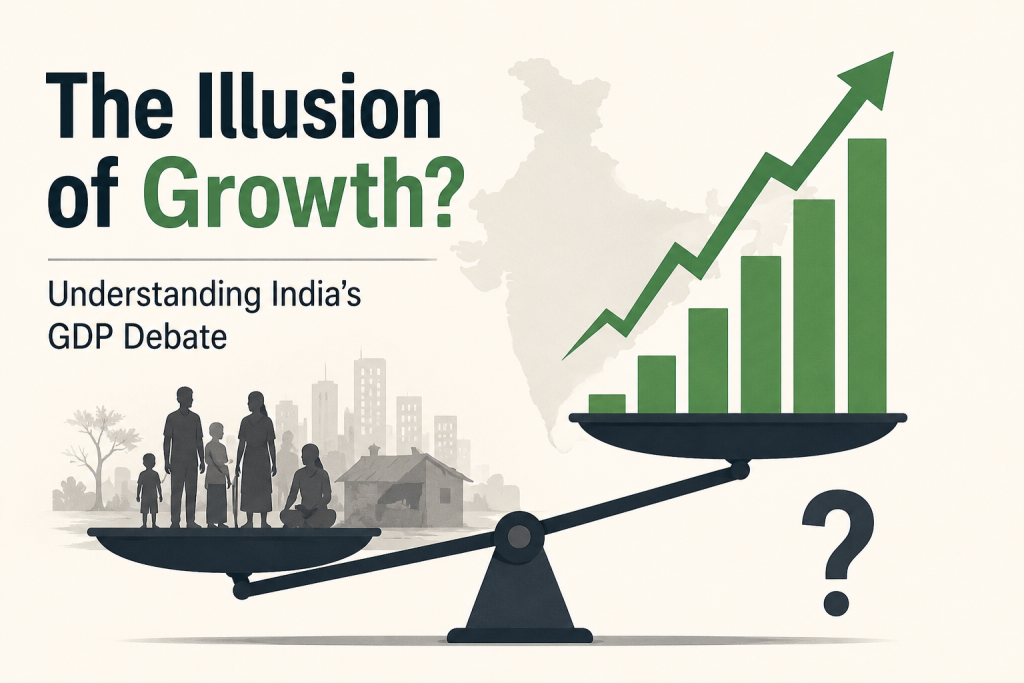
A country can experience real domestic economic growth while simultaneously seeing fluctuations in dollar-denominated GDP because of exchange rate movements. Currency values rise and fall for many reasons — inflation, oil prices, foreign investment flows, geopolitical tensions, trade deficits, and central bank policies. A weaker currency does not automatically mean the economy is collapsing.
The viral argument correctly highlights one important issue: currency depreciation reduces international purchasing power. If the rupee weakens from ₹74 per dollar to ₹96 per dollar, imports become more expensive. Fuel, machinery, electronics, and foreign education costs rise. Indians traveling abroad feel poorer. Companies dependent on imported raw materials face higher costs. In that sense, citizens do lose purchasing power in global terms.
However, the argument becomes misleading when it concludes that India is therefore a “negatively growing economy.”
Economic growth is not measured only through dollar conversion. If factories produce more goods, farmers harvest more crops, services expand, roads are built, digital payments increase, startups grow, and employment opportunities rise, then the domestic economy is indeed expanding. India’s large internal market of over 1.4 billion people functions largely in rupees, not dollars.
The post also ignores the difference between nominal GDP and real GDP. Inflation increases prices and inflates nominal GDP numbers. Economists therefore adjust GDP for inflation to calculate “real GDP growth.” India’s reported growth rates are generally real growth estimates, not merely inflated nominal numbers.
At the same time, critics of India’s growth story are not entirely wrong. There are serious concerns hidden behind headline GDP numbers.
Economic growth has not translated equally across society. Youth unemployment remains high. Many MSMEs struggle with debt, rising costs, and weak demand. Income inequality has widened significantly. Rural distress continues in several states. Millions of workers remain in informal and low-paying jobs. If ordinary citizens do not feel economic improvement in daily life, scepticism about “high growth” narratives naturally increases.
The rupee’s depreciation also matters because India depends heavily on imports, especially crude oil, semiconductors, electronics, and industrial equipment. A continuously weakening currency can create inflationary pressure and reduce investor confidence. Sustained depreciation without productivity gains is unhealthy for any economy.
But it is equally important to recognize that some currency depreciation can actually support exports by making Indian goods cheaper globally. Countries like China, Japan, and South Korea have historically used competitive currencies to boost manufacturing and exports. Therefore, exchange rate movements alone cannot define economic success or failure.
India today presents a mixed picture. On one side, it is among the fastest-growing large economies in terms of domestic output, infrastructure expansion, digital transformation, startup activity, and consumption. On the other side, the country faces structural challenges — unemployment, unequal wealth distribution, inflation, skill gaps, environmental stress, and currency vulnerability.
The viral message succeeds in questioning the blind celebration of GDP figures. It reminds people that growth must be examined carefully and not accepted as propaganda. But calling India a “negatively growing economy” is an exaggeration that oversimplifies complex economic realities.
The truth is more nuanced.
A nation’s economic health cannot be judged by one indicator alone — neither rupee GDP nor dollar GDP. Real prosperity depends on whether growth improves people’s lives: stable jobs, better incomes, affordable healthcare, quality education, productive industries, strong exports, and sustainable development.
India’s challenge is not merely to become the fastest-growing economy on paper. The real challenge is to ensure that growth creates genuine wealth, reduces inequality, strengthens the rupee through productivity, and improves the lives of ordinary citizens. Only then will economic growth become meaningful beyond statistics and headlines.
