By ImpactLens Correspondent
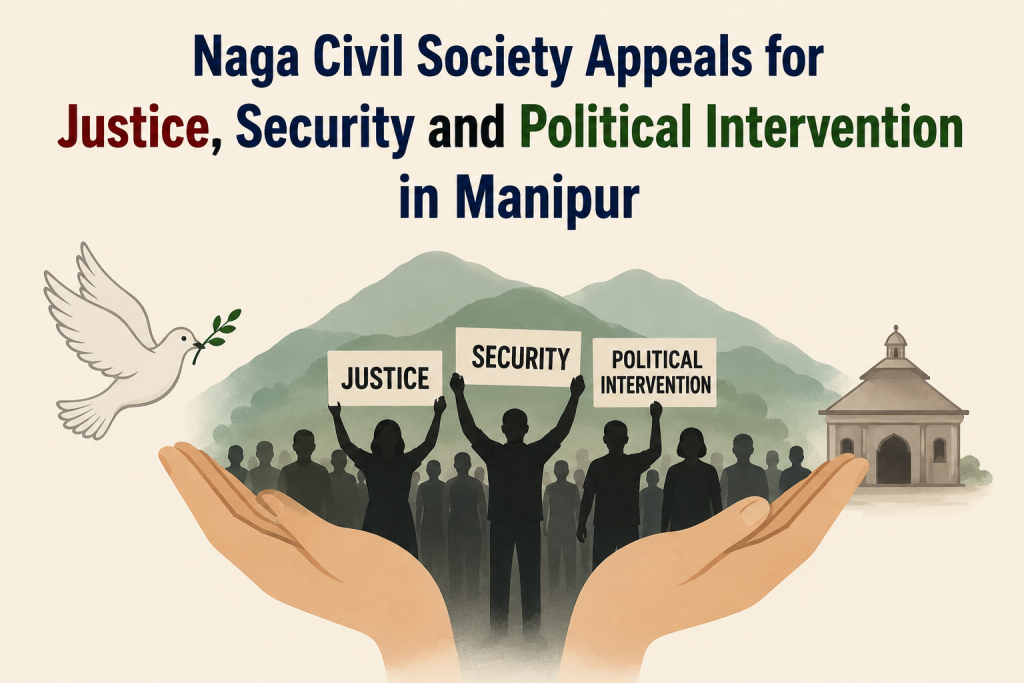
Naga civil society organisations from Manipur have appealed to Prime Minister Narendra Modi to intervene in the worsening security situation in the state following the abduction and killing of six Naga civilians. The organisations have demanded justice for the victims, protection of Naga-inhabited areas, and direct political intervention by the Union Government. Their appeal highlights growing concerns that the ongoing crisis in Manipur is expanding beyond the Meitei-Kuki conflict and increasingly affecting Naga communities.
The demands were presented at a press conference in New Delhi by the United Naga Council (UNC), supported by the Naga Women’s Union and the All Naga Students’ Association, Manipur (ANSAM). These organisations submitted a memorandum to the Prime Minister seeking urgent constitutional and political intervention. Senior Naga leaders stated that their visit to the national capital aimed to place the Naga perspective before political leaders, civil society organisations, church bodies, and the national media.
The immediate cause of the appeal was the killing of six Naga civilians who had been abducted in May 2026. According to the organisations, 20 Naga civilians were allegedly abducted from villages in the aftermath of earlier killings involving members of another community. Fourteen captives were released, but six remained missing despite repeated appeals to the authorities. The organisations said they deliberately exercised restraint, relying on government assurances that efforts were underway to locate the missing individuals.
In an effort to reduce tensions, Naga village guards, with the facilitation of Naga organisations, released 14 Kuki detainees on humanitarian grounds. The organisations hoped this gesture would encourage the release of the remaining captives. Instead, the six missing civilians were later found dead, with their bodies reportedly mutilated. The incident caused widespread grief and anger among the Naga community and severely damaged public confidence in the ability of the authorities to protect civilians.
Describing the killings as one of the gravest attacks on Naga civilians in recent years, the organisations demanded a time-bound, independent, and court-monitored investigation. They stressed that justice for the victims is essential to restore faith in the rule of law and to prevent further violence. They also sought stronger security arrangements in Naga-inhabited areas where communities have reportedly faced intimidation and insecurity.
Another major concern relates to the protection of Naga ancestral lands. The organisations argued that certain areas, particularly in Kangpokpi district, form part of the traditional homeland of Naga communities. They warned that violence, demographic pressures, and armed activities in these areas should not be viewed merely as law-and-order problems but as issues affecting the territorial rights and security of the Naga people.
The memorandum also argues that the recent violence represents a broader security challenge involving cross-border movement of armed groups and violations of existing peace arrangements. The organisations cited alleged attacks on Naga villages in Ukhrul and Kamjong districts involving sophisticated weapons, drones, and coordinated operations. They claimed that some attackers crossed into India from Myanmar, raising concerns that extend beyond internal ethnic conflict.
On this basis, the organisations invoked Article 355 of the Constitution, which places a responsibility on the Union Government to protect states against external aggression and internal disturbances. They argued that the involvement of armed groups and cross-border movements requires direct intervention by the Centre rather than leaving the matter solely to the state administration.
The memorandum further expressed concern that the violence could undermine the Framework Agreement signed between the Government of India and the NSCN (IM) in 2015. The organisations described the agreement as the foundation of the ongoing Indo-Naga peace process and urged the government to ensure that violence in Naga areas does not weaken public confidence in the peace negotiations.
Another significant demand concerns the Suspension of Operations (SoO) agreement with Kuki militant groups. The organisations alleged that some groups have violated the terms of the agreement by moving outside designated camps and engaging in violent activities. Consequently, they called upon the Union Government to review or terminate the arrangement, arguing that it has weakened public confidence and administrative control.
The memorandum also demanded legal action against individuals allegedly involved in the abduction and killing of the six civilians. Additionally, the organisations raised concerns regarding certain public officials and sought accountability wherever conflicts of interest or failures of governance may have occurred. These allegations, however, have not yet been independently verified.
Beyond criminal investigations, the organisations proposed several administrative and political measures. These include removing armed groups from Naga-inhabited areas, protecting Naga ancestral lands, ensuring that future political arrangements do not affect these territories, restoring security along national highways, and conducting judicial inquiries into recent attacks. They also called for an early and honourable Indo-Naga political settlement.
The appeal takes place against the backdrop of the long-standing Naga political movement and ongoing peace negotiations that began after the 1997 ceasefire between the Government of India and the NSCN (IM). Questions of identity, territory, and political representation continue to shape the politics of the region, particularly in Manipur, where multiple communities have overlapping historical claims.
The continuing ethnic violence in Manipur since May 2023 has claimed hundreds of lives and displaced thousands of people. The organisations argue that the concerns of the Naga community must be addressed within the larger framework of peacebuilding, border security, and political dialogue. They emphasized their commitment to constitutional and democratic means and appealed to civil society, church groups, women’s organisations, and democratic institutions across India to support justice, accountability, and lasting peace.
The appeal by Naga civil society organisations highlights the complex and overlapping security, political, and ethnic challenges facing Manipur. Their demands seek not only justice for the six victims but also broader guarantees for peace, security, and an inclusive political solution for the region.