By Mathew Mattam
“Every generation believes it understands the next one. Yet every generation is eventually surprised by what young people become.”
Who exactly are today’s young people?
Are they ambitious innovators or distracted dreamers? Are they socially conscious activists or self-absorbed digital natives? Are they resilient entrepreneurs or anxious individuals struggling with mental health? The answer, perhaps frustratingly, is that they are all of these—and much more.
Trying to define Generation Z through a single lens is like trying to hold a falling leaf still in the wind. Every young person carries a different story, shaped by family, education, technology, geography, opportunity, and circumstance. No stereotype can capture the diversity of an entire generation.
Much has been written about Gen Z’s obsession with social media, instant gratification, and digital lifestyles. Critics argue that young people today lack discipline, are impatient, and prefer virtual relationships over meaningful human connections. Others point to increasing levels of anxiety, depression, substance abuse, and loneliness as evidence of a generation losing its way.
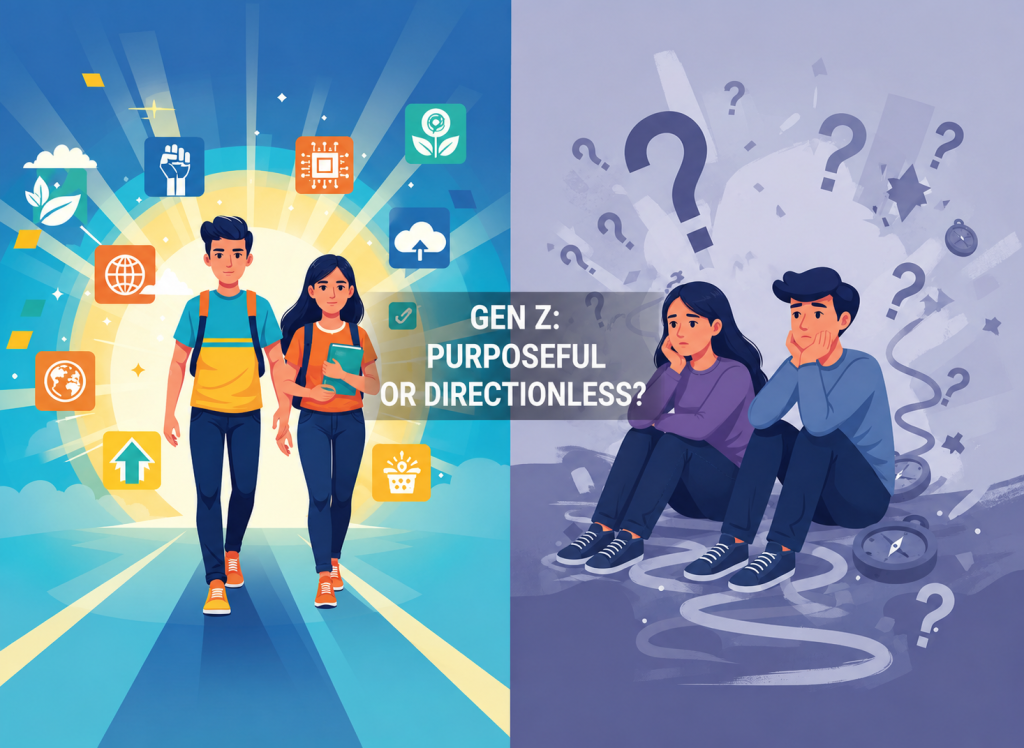
Yet, this is only one side of the story. The same generation has produced young entrepreneurs building companies before graduation, climate activists demanding accountability, artists using digital platforms to reach global audiences, innovators solving community problems, and volunteers working tirelessly for social change.
Today’s youth are not lacking ambition; they are redefining what ambition means. Unlike previous generations that largely pursued stable careers, Gen Z seeks purpose alongside prosperity. They question traditional norms, challenge outdated systems, and expect institutions to become more transparent, inclusive, and accountable. They want careers that create impact, not merely income. They are willing to speak up on issues ranging from mental health and gender equality to environmental sustainability and social justice.
Technology has transformed this generation in unprecedented ways. Information that once required hours in a library is now available within seconds. Social media has become both a classroom and a battlefield. It empowers young people to learn, collaborate, create businesses, and mobilize social movements. At the same time, it exposes them to unrealistic expectations, misinformation, comparison, cyberbullying, and emotional exhaustion.
The internet has become both their greatest opportunity and their greatest distraction.
The challenge before society is not whether Gen Z is good or bad. The real question is whether adults are helping them navigate this complex world.
Legendary basketball coach John Wooden wisely observed, “Young people need models, not critics.” That statement may be more relevant today than ever before.
Parents, teachers, employers, policymakers, and community leaders often expect young people to become responsible citizens while providing few opportunities to develop responsibility. We lecture more than we listen. We evaluate more than we encourage. We compare rather than understand.
Are we teaching young people how to communicate effectively, negotiate disagreements, manage stress, recover from failure, and build resilience? Are we creating safe spaces where they can ask difficult questions without fear of judgment? Are we supporting them in pursuing their dreams—or simply expecting them to fulfil ours?
These questions deserve honest reflection. During my interactions with thousands of adolescents and youth across India through CYDA, I have encountered remarkable diversity. I have met young people who are launching enterprises in villages, creating environmental solutions, promoting gender equality, composing music, developing artificial intelligence applications, volunteering in communities, and leading campaigns for positive change.
I have also met young people who feel invisible, overwhelmed, addicted, anxious, and uncertain about their future. Some struggle under immense academic pressure. Others battle unemployment despite qualifications. Many silently carry emotional burdens that adults rarely notice.
Both realities exist simultaneously. The voices of young people themselves reveal this complexity.
Mahzarin, a 25-year-old from Mumbai, believes today’s youth are using freedom of expression more effectively than previous generations. Social media has given them platforms to examine multiple perspectives before forming opinions.
Sudiksha, 19, feels today’s generation is becoming increasingly inclusive and accepting. She believes young people are learning to embrace diversity despite pressures from parents, peers, and society.
Karishma, 22, points to one of Gen Z’s greatest strengths—bringing mental health into public conversation. Issues that were once hidden behind stigma are now openly discussed, encouraging more people to seek help without shame.
Karina, 18, sees youth as drivers of social transformation. Easy access to knowledge has enabled young people to question traditions, think independently, and imagine new possibilities beyond conventional boundaries.
Vansh, 21, believes today’s youth are politically aware and socially conscious, yet vulnerable to misinformation and manipulation. He urges young people to focus on solving real problems rather than becoming instruments of division.
Gargi, 20, offers a different perspective. She worries about growing insecurity among young people, peer pressure, substance abuse, and a culture of instant gratification that sometimes weakens perseverance.
Dhriti, 21, observes that today’s youth are decisive, informed, and willing to express their opinions with confidence. Yet she also believes empathy remains an area where young people can continue to grow.
Kayan, 20, captures perhaps the deepest contradiction. He describes youth as engaged in a lonely struggle for survival—working hard to secure their own future while feeling that society rarely takes them seriously. Their achievements often feel individual rather than connected to a larger purpose.
Together, these voices remind us that Gen Z cannot be understood through headlines or stereotypes. They are thoughtful, conflicted, hopeful, anxious, innovative, and searching—all at once.
Former U.S. President Franklin D. Roosevelt famously said: “We cannot always build the future for our youth, but we can build our youth for the future.”
That may be the greatest responsibility before us. India stands at a historic moment. By the end of this decade, one out of every five working people in the world will be Indian. The nation’s future will not be determined only by economic growth or technological advancement, but by whether its young people are equipped with values, skills, emotional resilience, critical thinking, entrepreneurship, and compassion.
At CYDA, we believe that every young person possesses immense potential. Our role is not to shape them into copies of ourselves but to help them discover the best version of themselves. Through life skills, employability, entrepreneurship, leadership development, mental health awareness, and community engagement, we strive to prepare adolescents and youth not merely for jobs, but for meaningful lives.
The question, therefore, is not whether Gen Z is purposeful or directionless.
The real question is whether society is providing them with purpose, opportunity, trust, and the guidance they deserve.
Because when young people are given hope instead of criticism, responsibility instead of suspicion, and opportunities instead of obstacles, they do not merely build successful careers.
They build stronger communities, a more compassionate society, and a better future for all.