By Jayashree Sapkale, Program Manager, Nandurbar
Sabarsing Jasha Choudhary, a 28-year-old resident of a rural village in Nandurbar district, has studied up to the 10th standard and lives with his wife and three children. The family owns only two acres of rainfed agricultural land, making farming dependent on the monsoon. To support his household throughout the year, Sabarsing worked as an agricultural laborer during the off-season. However, irregular employment and low wages made it difficult to provide a stable income and meet the educational and household needs of his growing family.
Challenges
Sabarsing faced several socio-economic challenges:
- Dependence on rainfed agriculture with only one cropping season.
- Seasonal and uncertain income from agricultural wage labor.
- Limited opportunities to generate year-round income.
- Inadequate financial resources to invest in livelihood diversification.
- Difficulty in supporting a family of five and ensuring better opportunities for his children.
These challenges kept the family economically vulnerable and dependent on uncertain sources of income.
Intervention
Under the Samruddha Kisan Project (Phase II), supported by A.S.K. Foundation and implemented by the Centre for Youth Development and Activities, Sabarsing was identified as a potential rural entrepreneur and encouraged to diversify his livelihood.
He participated in a three-day Entrepreneurship Development Program (EDP), where he gained practical knowledge on business planning, financial management, customer service, and enterprise development.
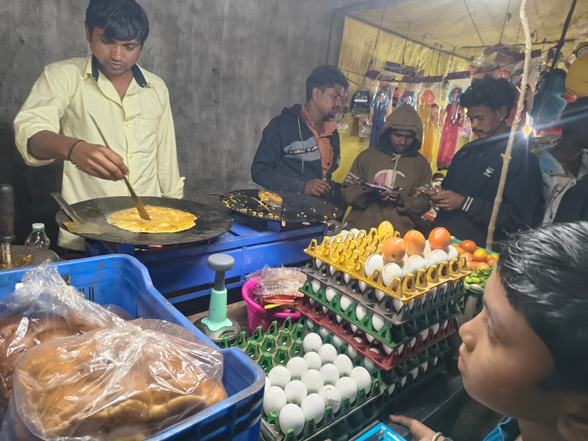
Following the training, the project supported him in establishing an Anda Bhurji (egg stall) by providing:
- A vending cart
- Gas stove
- Cooking utensils
- Table and chairs
The enterprise enabled him to generate a regular daily income while continuing his agricultural activities.
Sustainable Livelihood Outcomes
The intervention transformed Sabarsing’s livelihood by helping him build multiple and sustainable sources of income. His Anda Bhurji stall now provides a net daily income of Rs.200 to Rs.300, and during busy periods such as village fairs, he earns up to Rs.50,000 in a month. Using the income from his business, Sabarsing installed a borewell on his farm, which converted his rainfed land into irrigated farmland. This enabled him to grow crops in two seasons instead of one, increasing his agricultural income from Rs.12,000–15,000 during the monsoon to Rs.35,000–40,000 in the winter season alone. He also earns an additional Rs.24,000 every year by supplying irrigation water to neighboring farmers. Today, Sabarsing is no longer dependent on agricultural wage labour and has created a stable and diversified livelihood for his family.
“Previously, I depended on daily wage work and seasonal farming, and it was difficult to support my family throughout the year. The entrepreneurship training and support to start my Anda Bhurji stall gave me a regular source of income. I invested my earnings in a borewell, which transformed my farming as well. Today, I have multiple sources of income and feel confident about securing a better future for my children.”– Sabarsing Jasha Choudhary.