
By Deepika Dhumal, Research Associate, YouthAid Global Pvt Ltd
Education often celebrates improved results, higher attendance, and successful outcomes. Yet meaningful change begins much earlier- with understanding where students stand before any intervention takes place.
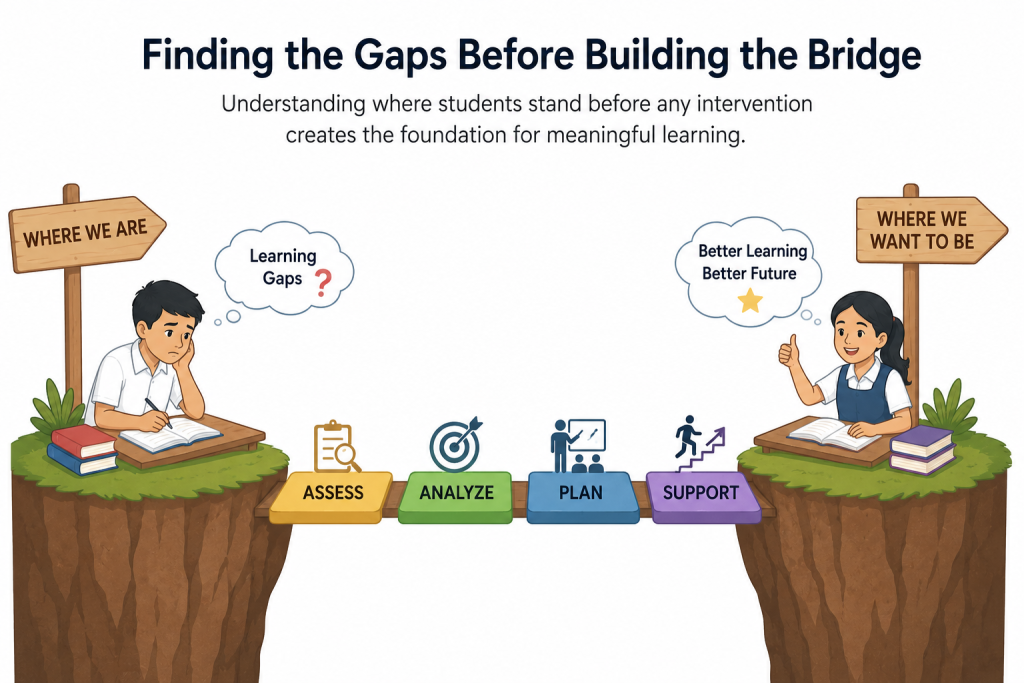
A baseline assessment is more than a diagnostic exercise – it is an opportunity to pause, observe, and understand the realities of learning before designing solutions. Conducted across six secondary schools in Dahanu Block, the assessment covered 1,259 students from STD 8 and 9 across English, Mathematics, and Science. Rather than relying on assumptions, it established a clear evidence base for understanding students’ learning levels, identifying foundational gaps, and guiding future academic support.
The Baseline in Numbers
The baseline assessment provides a clear picture of students’ learning levels before the intervention. Across English, Mathematics and Science, students recorded an average score of around 50%. English achieved the highest average at 50.45%, followed by Science at 49.9%, while Mathematics emerged as the weakest subject at 46.94%.
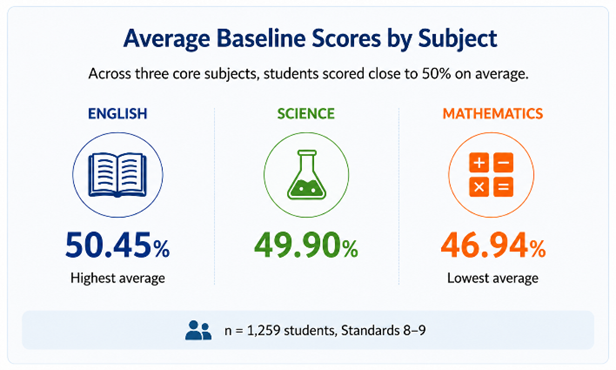
Figure 1: Average baseline scores by subject (n = 1,259 students, Std 8–9)
A closer look reveals that learning gaps are most pronounced in Mathematics. Nearly one in five students (18.9%) scored below 35% in the subject, compared with 15.8% in English & 11.9% in Science. This concentration of low-performing learners highlights Mathematics as the area requiring the greatest academic support.
The findings point to challenges that extend beyond subject knowledge. While many students could recall information, they found it difficult to apply concepts, solve unfamiliar problems, and explain their reasoning. The weaker performance in Mathematics suggests gaps in foundational numeracy, logical thinking, and problem-solving skills that are essential for learning across subjects.
Uneven Ground: A Tale of Six Schools
What stood out even more was the considerable variation in learning outcomes across the participating schools. Average scores ranged from approximately 38% to 59%, revealing a gap of nearly 20% points despite schools operating in broadly similar contexts. These differences suggest that factors such as learning environment, students’ engagement, attendance & access to academic support influence students’ starting points in different ways.
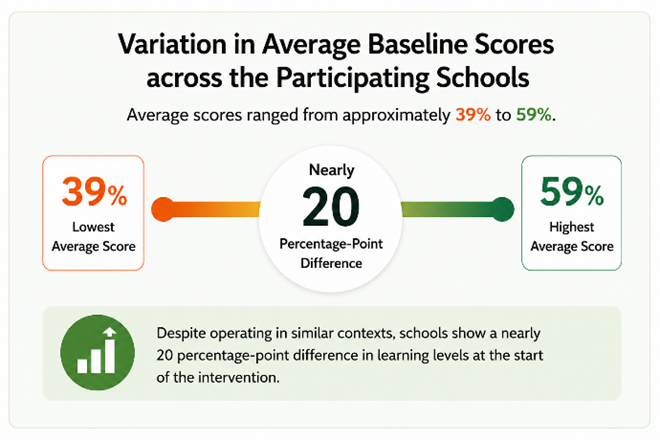
Figure 2: Variation in average baseline scores across the six participating schools
Across most participating schools, students in STD 9 recorded higher baseline scores than those in STD 8, reflecting the expected progression in learning with grade level. However, a few schools showed the opposite trend, where STD 8 students outperformed their senior peers. These findings suggest that learning outcomes are influenced not only by grade level but also by factors such as foundational skills, classroom practices, attendance, and the overall learning environment, highlighting the need for context-specific academic support.
Beyond the Scores: What the Numbers Alone Could Not Show
The baseline assessment revealed that a considerable number of students were entering secondary school without the foundational competencies expected at their grade level. Many could comprehend subject concepts in isolation but struggled to apply that knowledge to unfamiliar questions or solve problems independently.
The subject also revealed significant gaps in students’ conceptual understanding, logical reasoning and problem-solving abilities. These challenges extended beyond Mathematics, influencing students’ confidence in Science & other subjects that require analytical thinking and conceptual application.
A striking pattern emerged around the midpoint of the score distribution: a large proportion of students clustered around the 50 percent mark, indicating partial understanding rather than mastery. Students could often recall information directly from their textbooks, but struggled to explain concepts in their own words, connect ideas across topics, or apply what they had learned to real-life situations. It is a pattern that calls for classrooms built around conceptual understanding, critical thinking and regular formative assessment rather than memorisation alone.
Listening to the Classroom
These learning gaps became even more evident during classroom observations and reflective discussions with remedial facilitators. Many described classrooms where students hesitated to answer questions despite knowing the response. Fear of making mistakes, low confidence and irregular attendance often limited active participation. Facilitators also observed that students within the same classroom demonstrated widely different learning levels, requiring them to constantly balance the needs of struggling and comparatively advanced learners side by side.
“The greatest challenge was not teaching the lesson itself, but creating an environment where every student felt confident enough to participate without fear of being judged.” – A Facilitator
From Diagnosis to Response
To address these challenges, facilitators adopted a range of learner-centred strategies, including pair discussions, group activities, educational games, storytelling, peer learning and activity-based teaching. These approaches gradually encouraged students to engage more actively, ask questions and build confidence in their own abilities. At the same time, facilitators recognised the need to strengthen their own practice, pointing to further training in Mathematics pedagogy, classroom management, assessment techniques, communication skills and interactive teaching methods.
Their reflections point to a simple but often overlooked truth: meaningful improvement in student learning requires continuous investment in both learners and educators alike. The baseline did more than measure where students stood – it provided the evidence needed to design targeted support, strengthen classroom practices & build a bridge between learning gaps & meaningful progress.