
By Pramodini Naik, Assistant Director, CYDA
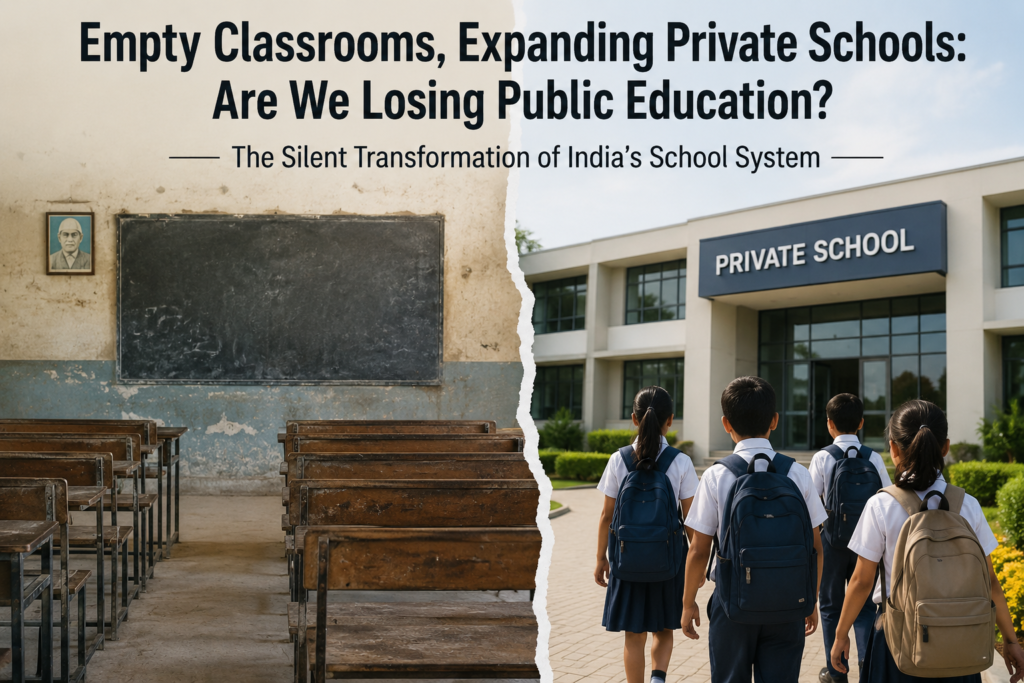
A strange paradox is unfolding in India’s education landscape. On one side, thousands of government schools are witnessing declining enrolment, empty classrooms, and the possibility of closure or merger. On the other side, private schools continue to expand, attracting children even from low-income families who struggle to pay fees but believe that private education offers a better future. This is not merely a story about changing school preferences. It represents a deeper transformation in India’s education system — the gradual weakening of public schooling and the increasing privatisation of education.
A government school was envisioned as a democratic institution where every child, irrespective of caste, class, gender, or economic status, could access quality education. However, today, the growing perception that government schools provide inferior education is pushing families towards private alternatives. The question that India must confront is: Are we allowing education, a fundamental right, to become a privilege determined by purchasing power?
AI-generated image for illustrative purposes
Schools Without Children: A Symptom of a Larger Crisis
Across Maharashtra and several other states, government schools are facing declining student numbers. According to NITI Aayog reports, nearly 8,000 schools across India have reported zero student enrolment, while more than one lakh schools operate with only a single teacher. Maharashtra, despite being one of India’s most developed states, has also witnessed declining enrolment in many government and local body schools.
The reasons are complex. Migration, declining birth rates, and demographic changes have contributed to fewer children in some regions. However, the most significant factor is the declining confidence of parents in government education.
Parents are not rejecting government schools because they do not value education. On the contrary, their aspirations have increased. They want their children to learn English, develop digital skills, access better opportunities, and compete in a changing economy. When government schools fail to meet these expectations, families often choose private schools, even when it places a heavy financial burden on them.
The Growth of Private Schools: Choice or Compulsion?
The expansion of private schools is often presented as a sign of parental choice. However, for many families, it is not a choice but a compulsion created by the declining quality and reputation of public education.
Across urban and rural India, low-cost private schools have expanded rapidly. They attract parents by promising English-medium education, discipline, regular assessments, and closer monitoring of children. Many parents working in informal sectors, daily wage labour, and small businesses sacrifice a significant part of their income to pay school fees because they fear that government schools may not provide adequate opportunities for their children.
This trend raises a serious concern. When families who cannot afford private education are forced to depend on it, education becomes a source of inequality rather than a tool to reduce inequality.
A child’s future should not depend on whether their parents can pay school fees.
The Myth That Government Schools Lack Only Infrastructure: The common explanation for the decline of government schools is poor infrastructure. While infrastructure gaps have existed historically, the situation has changed significantly. Government investments through programmes such as Samagra Shiksha have improved school buildings, toilets, electricity, digital facilities, and learning resources.
However, a school is not defined only by its building. The heart of education lies in the classroom.
One of the major challenges affecting government schools is that teachers are frequently engaged in non-teaching responsibilities such as elections, government surveys, administrative documentation, data collection, and implementation of various schemes. While these duties are important, excessive administrative responsibilities reduce the time teachers spend on lesson planning, student engagement, assessment, and remedial support.
As a result, many teachers struggle to address learning gaps among students. Children from disadvantaged backgrounds, who often depend entirely on government schools, require additional academic support but may not receive adequate attention.
The problem, therefore, is not simply a lack of infrastructure. It is the weakening of the core teaching-learning process.
NEP 2020 and the Promise of Public Education: The National Education Policy (NEP) 2020 recognises that India cannot achieve educational transformation without strengthening public education. It emphasises foundational literacy and numeracy, teacher development, equitable access, experiential learning, and reducing disparities between different groups of learners.
However, achieving the vision of NEP requires more than policy documents. It requires sustained investment in government schools, empowered teachers, strong school leadership, and meaningful engagement with communities.
If public schools continue to weaken while private schools expand without adequate regulation, India risks creating a deeply divided education system — one quality education system for those who can afford it and another for those who cannot.
Education Cannot Become a Marketplace: Private schools have contributed to expanding educational opportunities and introducing innovation. However, education cannot be treated only as a market commodity. The purpose of education is not only to produce skilled workers but also to create informed citizens, strengthen democracy, and promote social equality. A society where quality education depends on economic status will struggle to achieve inclusive development.
The solution is not to close government schools or replace them with private institutions. The solution is to restore confidence in public education.
Rebuilding Trust in Government Schools: The future of Indian education depends on whether we are willing to strengthen public schooling. Government schools need teachers who can focus on teaching, classrooms that encourage learning, strong academic support systems, and communities that believe in their importance.
Empty classrooms are not just a result of fewer children. They are a warning sign of declining faith in public education. India’s challenge is not merely to build more schools but to ensure that every existing school becomes a place where children learn, dream, and develop the confidence to shape their future.
A nation cannot build an equitable future by allowing its public education system to disappear silently.

This Post Has 3 Comments
Thanks, Pramodini for writing on the burning issue!
Thanks, Nitin, for reply!
Very good article. Covered all the problematic aspects which need to be addressed through concrete policy measures.