By Kalyani Mudaliar, Documentation Coordinator
Science becomes interesting when learners can observe, question, experiment and connect concepts with everyday experiences. Exposure to astronomy and STEM through simple, hands-on demonstrations strengthens teachers’ scientific understanding, helps them discover innovative teaching approaches and creates more engaging, curiosity-driven learning experiences for students.
On 16 September, 27 teachers (21 female, 6 male) from schools of Pimpri Chinchwad Municipal Corporation, Pune participated in an educational exposure visit to the Inter-University Centre for Astronomy and Astrophysics (IUCAA), Pune. The visit aimed to strengthen teachers’ understanding of astronomy, physics and innovative science teaching methods while introducing them to IUCAA’s educational initiatives and research facilities.
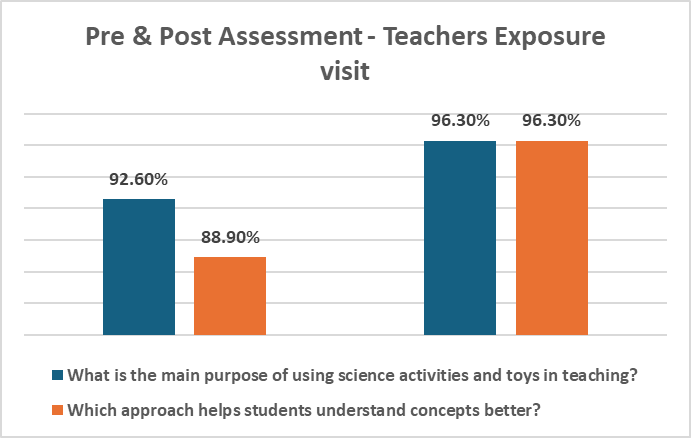
Prior to the actual session, to assess the understanding of the teachers, pre- and post-tests were conducted.
- 88.90% of the participants during the pre-test said that students better understand the concepts through learning by doing, while the post-test revealed 96.30% saying learning by doing.
- 92.60% of the participants during the pre-test shared that learning through exploration and experiment is the main purpose of using science activities and toys in teaching. There was an increase of more than 3.7% (i.e. 96.30%) of participants agreeing that learning by doing is the main purpose in teaching during the post-test.
Understanding Astronomy and Astrophysics
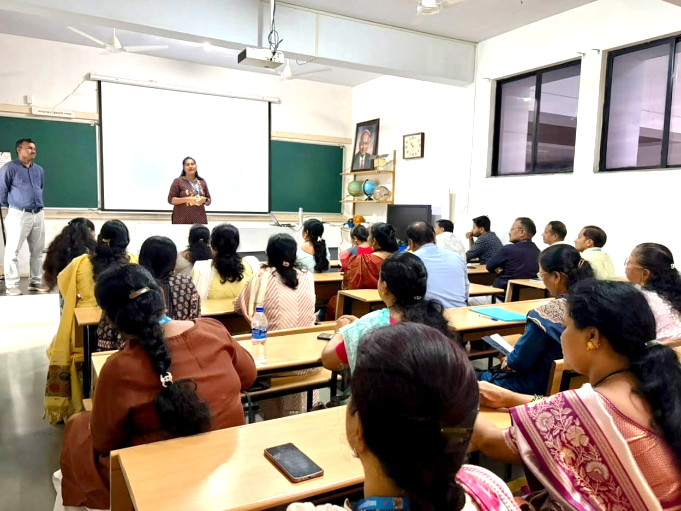
Mr. Rupesh Labade, Science Educator and Outreach Associate at IUCCA, introduced participants to the fascinating world of astronomy and astrophysics. He explained that astronomy is not only about observing stars but also involves theoretical science, calculations and engineering. Using the example of planning a journey to the Moon, he emphasized that scientists must calculate the distance, study the atmosphere, estimate oxygen requirements and consider the physical capabilities needed for space travel. These calculations form the foundation of theoretical science.
Career opportunities in Astronomy and Science
The session highlighted several national and international scientific projects that offer exciting career opportunities for students.
1.Thirty Meter Telescope – A future international telescope project offering opportunities in research, engineering, and technology.
2.LIGO-India – Introduced as one of the world’s most sensitive scientific instruments for detecting gravitational waves.
3.IUCAA Gravity Observatory – The observatory welcomes educational visits and provides computer-based learning facilities.
4. Giant Meter wave Radio Telescope – Includes 30 large radio dishes, GMRT explains how scientists observe distant galaxies using radio waves.
These examples helped teachers understand how classroom science connects to real-world scientific careers.
Law of Reflection
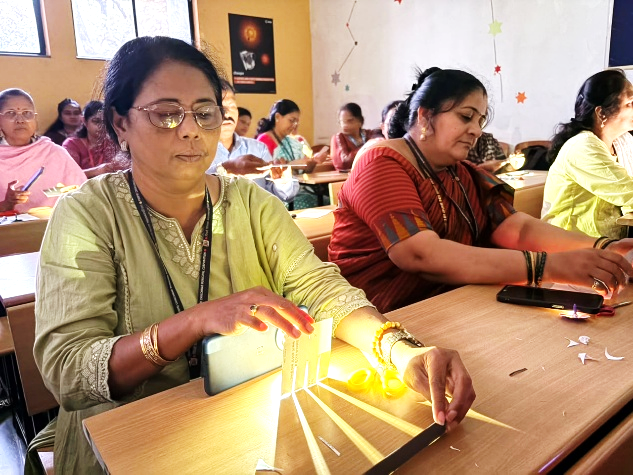
Mr. Rupesh conducted simple experiments to explain the Laws of Reflection. To verify the laws of reflection and demonstrate that both the angles are equal, while reflected ray and the normal lie in the same plane. This helps young learners understand and verify the laws of reflection through a simple hands-on experiment. The activity demonstrated how everyday materials such as a mirror, protractor and small card sheet can be used to teach physics concepts in an interactive and engaging way. He also encouraged teachers to adopt such low-cost, hands-on experiments in classrooms. Students can understand abstract physics concepts more effectively through observation, measurement with a protractor and active participation rather than memorizing formulas alone.
Disc Spin Experiment
To help teachers understand and demonstrate how white light is formed from seven different colours by spinning the disc, the facilitator showed how a simple spinning disc can make the seven colours of the rainbow appear as white, making the concept of light and colour easy to teach in classrooms. When the disc spins slowly, the individual colours remain visible. As the speed increases, the colours blend together and the disc appears nearly white. The hands-on demonstrations like Newton’s Disc encourage curiosity and make physics concepts easier for students to understand. Teachers learnt how to recreate this low-cost experiment in their classrooms to explain the visible range and colour mixing through active participation.
What is Sound
Sound is a form of energy produced by vibrations. Using pipes of different lengths, he demonstrated how vibrations travel through air and how the length of a pipe changes the pitch of the sound. Shorter pipes produced higher-pitched sounds while longer pipes produced lower-pitched sounds, illustrating the modulation of voice. A practical illustration using the throat and the voice box (larynx) helped the participants understand how sound is produced and how it can vary from a low to a high pitch. Through the demonstration, they observed how the vocal cords vibrate when air passes through them, producing sound. This simple activity helped the teachers connect the concept of vibration with sound productionand understand how the human voice can be modulated from a low to a high sound.Top of Form
Bicycle Balancing Experiment
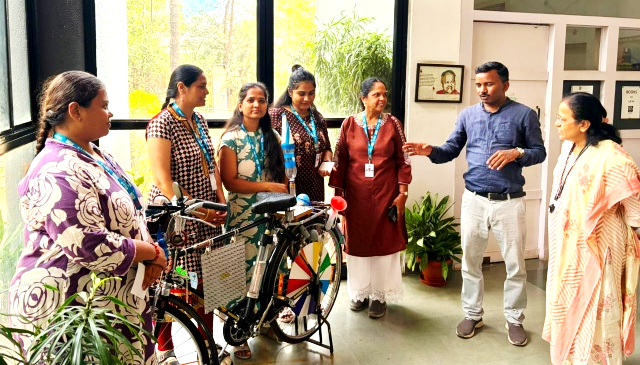
The example of a bicycle explained the science behind balance and stability. He explained how the movement of the wheels, steering, centre of gravity and continuous adjustment by the rider work together to keep a bicycle balanced while in motion. This helped participants understand the physics of balance through an everyday example rather than only through theoretical concepts. Practical understanding of concepts such as stability, motion, centre of gravity and balance and learnt how these can be explained to students through simple real-life demonstrations.
Learning through observation and experimentation
- A key message throughout the visit was that children learn science by observing, questioning and experimenting. Introduce students to astronomy and various STEM learning opportunities.
- Mr. Labade emphasized that teachers should encourage students to search for information independently using authentic websites instead of relying solely on textbooks.
- Rather than providing ready-made answers, teachers were encouraged to ask students questions that stimulate curiosity and critical thinking.
- The most fruitful part of the visit was the demonstration of simple science experiments that teachers can easily replicate in schools. Bring concepts to life through simple experiments through hands-on learning.
- Explore interactive teaching by connecting science with everyday experiences. Incorporate the teachings with more practical experiments.
Key learnings
- Teachers expressed a desire to learn more new classroom activities.
- Teachers also recognized the potential of these workshops to strengthen students’ critical thinking, creativity and problem-solving skills.
- Participants gained new experiences, practical STEM knowledge and innovative teaching-learning methods.
The interactive session, led by Mr. Rupesh Labade, encouraged teachers to think beyond textbook learning and explore ways of making science more engaging, practical, and inquiry-based for children.
