
Soumyashree Mohanty, ImpactLens
Women live with many unwritten rules. How they should dress, speak and behave. When they should marry. Whether they should work after marriage. How they should raise their children. The rules and expectations are endless.Many of these expectations are so common that questioning them can itself be seen as going against society’s norms.
A recent incident in Bengaluru made me think about these expectations again. A parent exploring schools in Bengaluru’s Banashankari area alleged that some schools favour children whose mothers are homemakers.
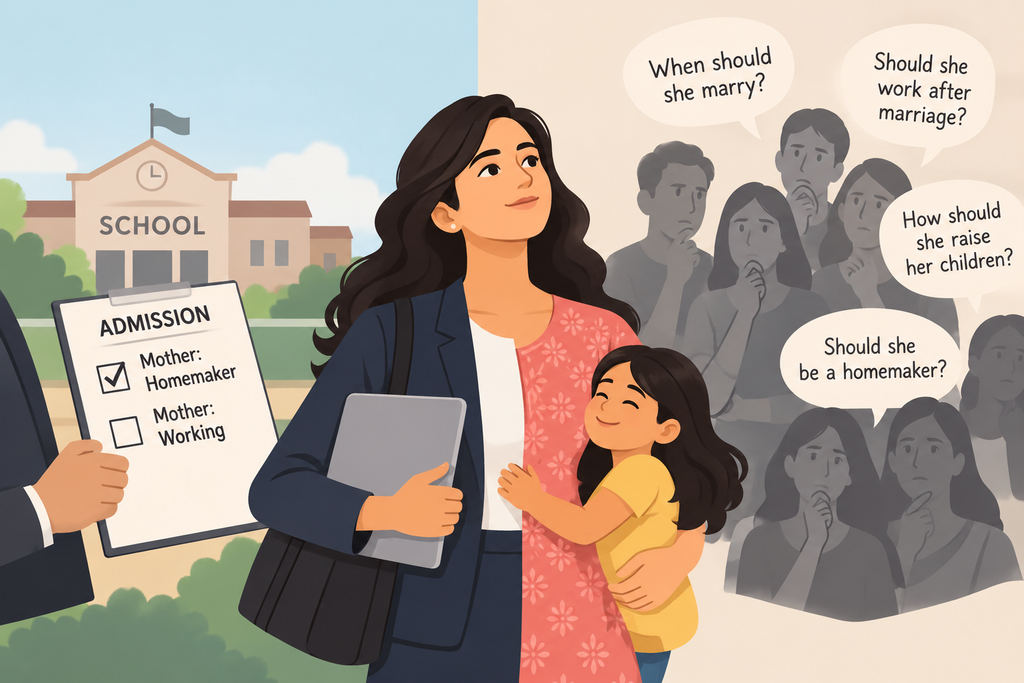
According to the parent’s post on Reddit, one school was reluctant to accept a child whose mother was working. When the family discussed the issue with other parents, they were reportedly told that this was common practice. They were even advised not to disclose that the mother had a job. The parent also alleged that the schools ask about the mother’s employment status every year. This raises concerns about whether they continue to check if she remains a homemaker. This leaves us with a question: Why should a mother’s employment status matter when her child is seeking admission to a school?
It also raises a larger question about the values we pass on through schools. We may have policies that speak about equality and equal opportunity. But these values must also be reflected in everyday practices. Whether a woman chooses to be a homemaker or a working professional should be a decision made by her and her family. It should not be decided by society or an institution.
Perhaps the assumption is that a homemaker has more time to help with a child’s studies, attend school activities and be available at home. But these responsibilities should not fall only on mothers. Fathers are equally responsible for their children’s care and development. If time and availability are the concern, the same standard should apply to both parents.
If schools are indeed asking mothers to remain homemakers, another question arises. Does the same expectation apply to the women working in those institutions? Do they have only male teachers/professionals?
The expectation to be an “expert mother”
This question becomes more relevant when we look at another recent statement. At the 41st convocation of Chhatrapati Shahu Ji Maharaj University in Kanpur, Uttar Pradesh Governor Anandiben Patel told women to become “expert mothers” before becoming IAS officers. She also spoke about continuing education and careers after marriage while contributing to family responsibilities.
It makes one wonder whether the men in the audience were also being asked to become “expert fathers” before pursuing their careers. Parenting is important. Raising a child requires care, time and responsibility. But why was this expectation directed specifically at women?
There is a difference between saying “parenting is important” and saying “women must first prove themselves as mothers before pursuing professional ambitions.” The first recognises family responsibility. The second places an extra condition on women.
What does the evidence tell us?
Gender bias is not held only by men. Women can also absorb and repeat the same expectations. According to the UNFPA’s GENDER NORMS AND THE WELLBEING OF WOMEN AND GIRLS IN INDIA: A REVIE (2024) gender norms continue to affect women’s access to rights, education, employment, health and opportunities. It cites findings from the Gender Social Norms Index that 99% of men and women in India held at least one of seven measured gender biases, while 86% held at least two. It means that almost everyone covered by the study expressed at least one belief that reflected a measured gender bias.
Gender bias is not always obvious. Sometimes it appears as a rule or as advice. Sometimes it is a casual question or an assumption about what a woman should or should not do. These ideas shape how we think about work, marriage, parenting and responsibilities at home.
The question we need to ask
The question is whether the same responsibilities are being shared and judged equally. A woman can be a mother and a professional. She can be a homemaker. She can choose to work or change her priorities at different stages of life. What should matter is that these choices are hers. She should not be judged by a different standard simply because she is a woman.
Perhaps it is time to question the written and unwritten expectations that tell women how they should live. Equality is not about giving women a favour. Equal rights and opportunities are their rights as human beings.

This Post Has 2 Comments
Women are becoming stronger , independent amd must challenge the historical orthodox practices by society . Men must now change for betterment of the society and also appreciate the role of women in every aspect
All human beings are equal & deserves respect. Our mindset has to be changed towards women then only Our personal & social life can improve.