How schools and universities can use AI to deepen learning – without outsourcing the learner
By Prof Ujjwal K. Chowdhury
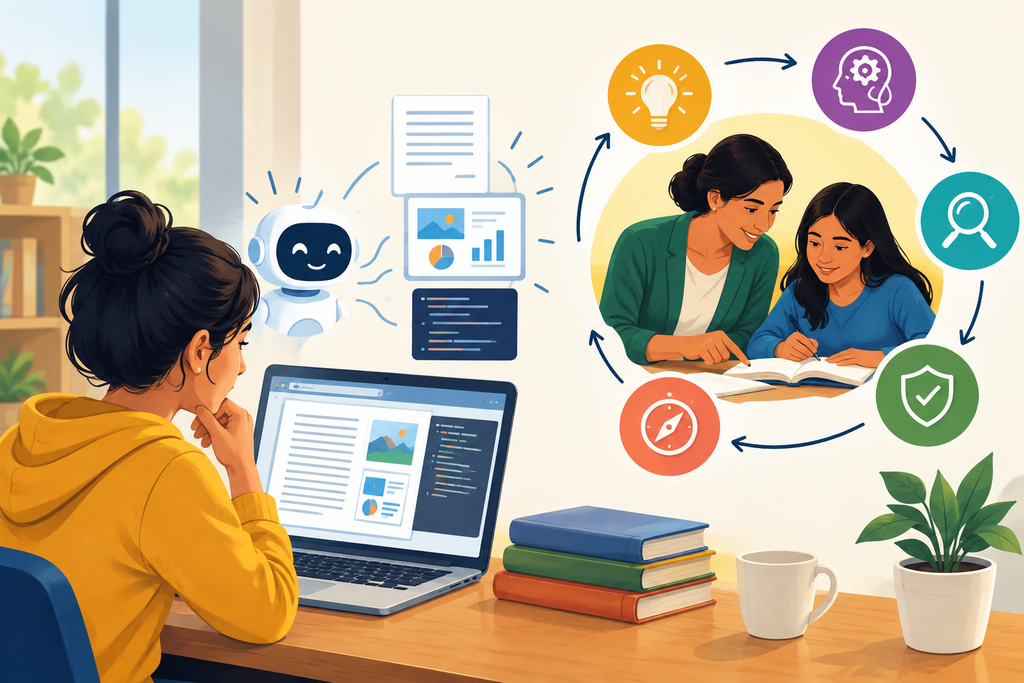
Education is entering a strange new phase: a student can hand in a fluent essay, working program or persuasive presentation before understanding the ideas inside it. The answer is not to ban AI or surrender to it. The sustainable path is a human-led learning loop in which AI expands reach, while teachers and learners retain purpose, judgement, verification and responsibility.
THE NON-NEGOTIABLE AI may raise the quality of a learner’s output. It must never hide whether the learner can formulate, think, verify, explain, transfer and take responsibility.
A polished answer can be a learning failure
At 10:15 on a Tuesday morning, a Class 10 mathematics teacher asks a student to change one number in a problem she has just submitted. The answer on the screen is flawless: neat steps, correct notation, a confident conclusion. The student stares at the altered problem. The path has disappeared. She remembers the answer, not the reasoning.
This is the new educational anxiety in miniature. A learner can move from a vague prompt to a polished essay, presentation, image, translation, spreadsheet or program before building the mental model that the work seems to prove. The problem is not simply that a student may have cheated. The deeper problem is that the artefact has outrun the learner.
The OECD’s Digital Education Outlook 2026 makes the distinction plainly: generative AI can support learning when guided by sound teaching principles; when it merely takes over tasks, it can improve performance without producing real learning gains. [1] A large field experiment in high-school mathematics reached an equally uncomfortable conclusion: unguarded access helped students while the tool was present but weakened later unaided performance. Guardrails changed the result, but access alone did not. [5]
That is why sustainable education must be defined more seriously than “education with more devices”. It is learning that lasts after the screen goes dark; relationships that keep a learner curious and accountable; access that does not depend on a premium account or perfect English; privacy that protects dignity; and a teaching system in which time saved by automation is reinvested in human attention.
The target is not less AI. It is more learner.
The bargain must change: AI for leverage, humans for meaning
AI can do useful work in education. It can produce extra examples, translate a difficult explanation, simulate a debate, suggest a counterargument, generate code tests, organise observations or give a learner a second chance to ask the same question without embarrassment. Those are real gains in reach and access.
But AI cannot decide what a particular learner needs to understand, what a community considers fair, which uncertainty matters or what a student is ready to do alone. It cannot replace the teacher who notices the pause before a child answers, the confidence that is slipping, the misconception hidden inside a correct sentence or the ethical consequence of a proposed solution.
Human-in-the-loop therefore cannot mean that a teacher sees the final file and clicks “approved”. That is a rubber stamp. A real loop puts human purpose, dialogue and accountability before, during and after AI use. The better learning chain is: question, attempt, AI dialogue, evidence, demonstration and reflection.
UNESCO’s student framework gives this idea a global vocabulary. It describes 12 competencies across a human-centred mindset, ethics of AI, AI techniques and applications, and AI system design, progressing from understanding to applying to creating. Its teacher framework names 15 competencies across human-centred thinking, ethics, AI foundations, AI pedagogy and professional learning. Both frameworks place human agency, inclusion and sustainability at the centre. [2] [3]
AI literacy cannot be an isolated workshop on clever prompts. It must sit inside science, languages, history, mathematics, design, engineering, medicine, business and the arts. The subject still supplies the questions and standards; AI is one instrument in a larger human practice.
Why deep learning needs friction
Learning is not the same as recognition. A student may recognise a good explanation on a screen and still be unable to retrieve the concept, connect it to prior knowledge, detect an error, explain a choice or use the idea in a new situation. Durable learning needs carefully designed effort.
Learning research gives schools and universities a practical spine: retrieve before reviewing; engage actively instead of only listening; plan, monitor and evaluate one’s thinking; act on feedback; and return to the idea later in a different context. Retrieval practice helps across subjects and levels, while a major PNAS review found that active learning improves performance and reduces failure in undergraduate STEM compared with traditional lecturing. [6] [7]
AI is powerful precisely because it can remove effort. Sometimes that is the point: accessibility tools, language support and a simulation can open a door that was previously closed. But when the learner has not yet made the first attempt, instant completion removes productive friction – the small struggle through which a mental model is built.
A robust learning loop has seven moves. The learner retrieves, frames the problem, struggles productively, stress-tests an idea, rebuilds the work, explains it to someone else, and transfers it to a new problem. AI can support every move, but it must not silently perform every move. The critical question is: what changed in the learner’s thinking because of the interaction?
THE REVEAL RULE AI should reveal the next useful step only after the learner has shown the current step. If a complete answer is necessary for accessibility or safety, the learner must still reconstruct, explain and apply the essential idea independently afterwards.
The sandwich method: think, ask, own
The most memorable classroom rule is the AI Sandwich: human first, AI in the middle, human last. It is not a fixed percentage of human and machine work. The layers grow or shrink with age, subject, risk and expertise. Its purpose is to keep thinking visible.
Human first means that the learner starts. The student recalls what she knows, makes a prediction, draws a diagram, writes a rough thesis, attempts the equation, sketches the code architecture, or names the people affected by a policy decision. This first move gives the teacher something to teach and gives the learner something to compare.
AI in the middle means that the tool receives one clear job. It may ask a question, offer a hint, translate, simulate an opposing viewpoint, generate a counterexample, critique structure, vary practice problems or organise raw observations. It should not automatically become the ghostwriter, ghost coder or ghost researcher.
Human last means that the learner verifies, revises in an authentic voice, explains the result, defends a choice and tries a new version. The teacher, tutor, peer, supervisor or community member sees the reasoning. A human owns the judgement, the grade, the safeguarding decision and the appeal.
The sandwich in practice
| Layer | Learner does | AI may do | Human safeguard |
| Human first | Ask, recall, predict, sketch, plan and name constraints. | After the first attempt, offer examples, clarifying questions or a checklist. | Teacher checks the starting model. |
| AI middle | Choose, question, test, interpret, collaborate and revise. | Give hints, counterexamples, translation, simulation or structure feedback. | Teacher listens for active reasoning. |
| Human last | Verify, rebuild, explain, defend and transfer. | Suggest tests, gaps, rival explanations or a challenge case. | Learner signs off; human judges. |
| Human accountable | Set boundaries, protect data, support the learner and own consequences. | Triage, cluster, translate and flag patterns for review. | Named human owns grade and appeals. |
The method changes the questions learners ask. “Solve this” becomes “I tried X; give me one hint, ask me one question and wait.” “Write my essay” becomes “Interrogate my thesis, identify a counterclaim and suggest sources I can verify; do not write the paragraphs.” “Fix my code” becomes “Read the failing test, point to the likely concept error and give me a diagnostic question.” The prompt is a learning decision.
The questions that keep the learner awake
Every learner should carry a small internal checklist before opening an AI tool. These questions turn AI use from consumption into a conversation with purpose.
| Ask yourself | Why it matters |
| What am I trying to learn, not just submit? | Names the capability that must remain after the task. |
| What is my first attempt or current idea? | Protects retrieval, ownership and productive struggle. |
| What exact job am I giving AI? | Prevents a vague request from becoming total delegation. |
| What could be wrong in this output? | Starts verification instead of rewarding fluency. |
| Which sources, data, calculations, code, images or assumptions must I check? | Turns a plausible answer into evidence. |
| Can I explain, defend and redo the essential part without the same support? | Tests ownership, transfer and responsible confidence. |
Teachers must become learning architects
The teacher of the AI era is not a proctor with a chatbot. The teacher is a learning architect: someone who chooses the right challenge, sees how a learner is thinking, builds confidence without lowering standards, connects a concept to lived context and decides when technology must step back.
A practical teacher workflow has five moves. First, design: use AI privately to generate misconceptions, examples, alternative explanations and question sequences, then reject anything inaccurate, tone-deaf or misaligned. Second, diagnose: use retrieval tasks, exit tickets and student talk; AI may cluster patterns, but the teacher interprets them. Third, facilitate: allow hint-first practice while the teacher circulates, listens and asks follow-ups. Fourth, demonstrate verification and uncertainty. Fifth, reflect on which AI move helped and which human exchange was indispensable.
This is not a romantic argument for ignoring scale. It is a better use of scale. In the Tutor CoPilot randomized trial, 900 tutors worked with about 1,800 K-12 students. Students whose tutors had access to AI guidance were four percentage points more likely to master topics; the gain rose to nine points for students paired with lower-rated tutors. The tool did not replace the tutor. It nudged tutors toward guiding questions and away from giving away the answer. [8]
A separate randomized study of 194 undergraduates compared a purpose-built AI physics tutor with an active-learning class. The AI group achieved higher post-test scores, but the tutor was carefully sequenced, grounded in teacher-provided content and designed around active engagement. The authors explicitly warn against treating the result as proof that a generic chatbot is a teacher. [9] The lesson is simple: pedagogy first, tool second.
MENTORING RULE Teachers should teach students how to integrate AI into a task, not merely tell them whether AI is allowed. Demonstrate the prompt, the pause, the verification and the refusal – then ask the learner to do the same.
From Class 5 to the capstone
The human loop becomes more independent as learners grow, but it never disappears. A four-year-old needs conversation, play and motor activity; a sixteen-year-old needs source judgement and ethical reasoning; a university student needs method and professional judgement. The cases below show what this looks like on an ordinary Monday.
Class 5: the school water audit
Children begin with a local question: which taps in the school waste the most water? Before AI appears, teams observe, count, measure where possible, interview the caretaker, draw a map and make a prediction. AI can organise observations, translate interview questions and offer possible explanations. Children label each claim as observed, reported, calculated or proposed, make a graph, explain it and test one low-cost change for a week. The teacher blocks invented local facts and asks, “What did you actually see?” The assessment is evidence that a child can observe, reason, communicate and act.
Class 7: the source duel in history
Students compare a textbook passage, a primary source and an AI-generated summary of a local or national event. They first write what they think happened and what they are unsure about. AI then plays a confident but fallible debate partner: it makes a claim, while students search for supporting passages, missing voices, loaded words and contradictions. In a live rebuttal, one student defends the interpretation and another challenges it. Marks reward evidence and revision, teaching that fluent language is not automatically neutral or accurate.
Class 9 or 10: hint-first mathematics
A student spends seven minutes attempting an algebra or geometry problem and submits a trace of the first approach. Only then may an approved tutor give one hint, ask one question or show a related example. The evidence stack contains the first attempt, hint history, corrected solution, explanation of one error and a new problem attempted without AI the next day. The child learns to ask for help without asking for substitution.
Class 11 or 12: AI versus the field
In biology or environmental science, teams ask why a nearby pond, crop or public-health indicator is changing. AI proposes hypotheses, variables, a sampling plan and confounders; students reject suggestions that do not fit local access, ethics, equipment or consent. They compare predictions with field data, graph uncertainty and answer, “What would change your mind?” The lab notebook, data provenance and oral method defence matter more than a smooth slide deck.
Undergraduate engineering: code that can be defended
A student team building a sensor workflow or data pipeline begins with an architecture sketch and a manually written acceptance test. AI may suggest code, comments, tests and alternative designs. Each member owns a module, records accepted and rejected suggestions, and completes a short live debugging task with the tool restricted. Assessment covers version history, edge cases, security, data flow and a post-mortem on one wrong AI suggestion. Engineers must know why it works, when it fails and who could be harmed.
Law, public policy and communication: the memo meets the citizen
Students draft a policy memo on transport, housing, water or campus safety. AI can structure the memo, generate counterarguments or test clarity, but students verify every legal or empirical claim, speak to a stakeholder or use a local evidence pack, and defend one value choice in person. They revise after new evidence arrives, showing they can update a judgement rather than protect a paragraph a machine has made sound.
Teacher education and doctoral research
A trainee teacher may ask AI for likely misconceptions and language supports, then select what fits this class, teach the lesson, review student talk with a mentor and identify one child who was still not reached. A doctoral researcher may map terminology, translate abstracts, stress-test a protocol or propose rival explanations, but must check every paper, citation, data trail and limitation. In both cases, the human professional owns the judgement and the supervisor asks: why does this method answer this question?
Assessment: stop chasing the chatbot
When AI can produce plausible prose, code, images, calculations and presentations, a detector is the wrong centre of gravity. The useful question is not, “Can we prove a machine touched this file?” It is, “What evidence shows what this learner can do?”
The Australian regulator TEQSA has argued for assessment built around active learning, authentic engagement, contextualised evidence, fairness, accessibility, transparency, equity and privacy. Its implementation resource turns those principles into examples. The common thread is triangulation: use several kinds of evidence instead of trusting one take-home artefact or an AI detector. [10]
A workable programme has two lanes. The open lane permits AI for ambitious creation, iteration, research, collaboration or accessibility, with disclosure, a process log, verification and reflection. The secure lane uses supervised exams, practicals, oral defences, live debugging or observed performances when a programme must assure core knowledge and independent capability.
The University of Sydney has made this two-lane logic explicit: open assessments teach students to participate responsibly in an AI-saturated society, while secure assessments validate learning at selected points in the programme. It does not attempt to turn every assignment into a viva, nor does it pretend that every take-home product can be secured. [11] [12]
Process + artefact + demonstration + reflection = trustworthy evidence in the age of AI.
A three-to-five-minute micro-viva can be attached to a milestone, presentation, laboratory, studio critique, placement or rotating oral sample. The same six questions work across subjects: What problem did you choose? What was your first attempt? Where did AI help, and what did you accept, change or reject? Show me one error. Change one condition: what would you do now? What do you still not know?
A balanced rubric might give 20 percent each to problem formulation, domain understanding, and reasoning/verification; 15 percent each to AI judgement and communication; and 10 percent to reflection and transfer. The exact weights can change. The principle cannot: grade the evidence stack, not surface polish.
Every open submission should carry a short declaration: “I used [tool] for [role]. I first contributed [question, attempt or plan]. I accepted, changed or rejected [key outputs]. I verified [sources, tests or observations]. My final decision is mine because [reason]. I can explain and reproduce the essential work without the tool.” Transparency should be taught as a normal academic practice, not used as a confession booth.
Sustainability is more than screen time
Calling digital expansion sustainable because it reduces paper or enables distance learning is too shallow. A sustainable AI-enabled education system must pass five tests.
- Learning lasts. Students retain, explain and transfer more after support is removed.
- Relationships remain. Teachers, peers, mentors, families and practitioners still supply belonging, challenge, care and ethical context.
- Access is fair. No essential outcome depends on a premium subscription, high bandwidth, one language, one device or a student’s ability to buy private tutoring.
- Dignity is protected. Sensitive personal, health, family or disciplinary data do not enter unapproved systems; bias and harmful outputs have a reporting route and a human response.
- Teachers can sustain it. AI removes low-value administrative friction, but the time saved is visibly reinvested in small-group instruction, conferencing, practical supervision and feedback.
UNESCO’s guidance urges human-centred regulation, data privacy, age-appropriate use and ethical validation. [4] There is also an environmental inference: do not make more compute, devices or data the automatic answer to every classroom problem. Purpose-built tools, low-bandwidth modes, local resources and offline alternatives matter, especially in rural or low-income settings.
India already has a policy opening. The National Education Policy 2020 calls for understanding, inquiry, experiential learning and competency-based assessment. CBSE’s 2026-27 AI curriculum asks Class IX students to consider bias and access, scope problems, find reliable sources, visualise data and understand generative AI; its Classes 3 to 8 curriculum emphasises problem solving, collaboration, ethics and activity-based learning. [13] [14] The human loop implements these priorities.
What institutions can do on Monday
A school or university does not need to redesign every subject in one term. It needs one visible, measured success. The first 100 days can begin with five moves:
- Name the independent capability. Write what the learner must know or do without delegation before selecting a tool.
- Set the AI role. Classify the task as AI encouraged for low-stakes practice, AI permitted with disclosure, or AI absent or tightly controlled for high-stakes capability checks.
- Capture a baseline. Let learners attempt a comparable task without AI so later claims are about learning, not just faster completion.
- Build the human checkpoints. Require a first attempt, process trace, source or test audit, teacher or mentor dialogue and a short demonstration.
- Measure what survives. Check delayed retrieval, novel transfer, explanation quality, equity, privacy incidents, teacher workload and learner voice. Pause or redesign if output quality rises while unaided capability or wellbeing falls.
A REALISTIC MINIMUM GUARANTEE Every learner receives at least one substantive human conversation at each major learning unit; every high-stakes AI-permitted submission includes a demonstration or defence; and every programme includes delayed or unaided transfer checks. Staffing ratios may vary. The evidence obligation cannot.
Leaders should publish the rules in language a fifteen-year-old can understand. Teachers need time to practise hint-first prompts, source checking, micro-vivas and inclusive alternatives. Learners need a safe way to disclose mistakes, while families and communities should know what data are collected and who can challenge a machine-assisted decision. These are the operating system of trust.
The final test: when the screen goes dark
The future worth building is not a classroom where AI speaks more and people speak less. It is a learning ecosystem where students can access more examples, languages, simulations, feedback and ambitious problems, while teachers, peers, mentors, families and communities remain the source of meaning, challenge, trust and responsibility.
The assignment of the future is not a lonely hand-in. It is a small intellectual journey: a question rooted in context; a first attempt that makes thinking visible; an AI interaction that expands what is possible; a human conversation that tests sense; a revision that belongs to the learner; and a new problem that proves whether the learning stuck.
The final test is disarmingly simple. After AI has helped, can the learner still think, speak, make, collaborate, care and act responsibly with another human? If yes, AI is serving education. If no, the system has optimised the artefact and undereducated the person.
Responsible AI use is therefore not a warning printed at the bottom of an assignment. It is a design choice made at the beginning, a mentoring habit practised in the middle and a human judgement demanded at the end.
Sources and further reading
This feature expands the supplied reference document AIHumanCollab.docx and integrates current research and guidance available in September 2026. Research findings are context-specific; institutions should reproduce the core tests locally: retention, explanation, verification, transfer, equity and meaningful human contact.
[1] OECD Digital Education Outlook 2026: Exploring Effective Uses of Generative AI in Education – OECD synthesis on pedagogical intent, cognitive offloading, teacher agency and equity.
[2] AI Competency Framework for Students – UNESCO framework: 12 competencies, four dimensions and Understand-Apply-Create progression.
[3] AI Competency Framework for Teachers – UNESCO framework: 15 competencies across five dimensions and Acquire-Deepen-Create progression.
[4] Guidance for Generative AI in Education and Research – Human-centred guidance on privacy, age-appropriate use and ethical validation.
[5] Generative AI without guardrails can harm learning: Evidence from high school mathematics – Bastani et al., PNAS, 2025; field evidence on unguarded assistance and unaided learning.
[6] Active learning increases student performance in science, engineering, and mathematics – Freeman et al., PNAS, 2014; large synthesis of active learning in undergraduate STEM.
[7] Retrieval Practice Consistently Benefits Student Learning – Agarwal, Nunes and Blunt, 2021; systematic review of applied classroom research.
[8] Tutor CoPilot: A Human-AI Approach for Scaling Real-Time Expertise – Randomized trial with 900 tutors and about 1,800 K-12 students.
[9] AI tutoring outperforms in-class active learning: an RCT introducing a novel research-based design – Kestin et al., Scientific Reports, 2025; purpose-built, sequentially scaffolded physics tutor.
[10] Assessment reform for the age of artificial intelligence – TEQSA guidance on authentic, fair, transparent and evidence-rich assessment.
[11] Program level assessment design and the two-lane approach – University of Sydney model for open AI-supported and secure human-demonstrated assessment.
[12] University of Sydney’s AI assessment policy: protecting integrity and empowering students – Institutional implementation of the two-lane approach.
[13] National Education Policy 2020 – Government of India; inquiry, experiential learning and competency-based education.
[14] Artificial Intelligence: Secondary Curriculum 2026-27, Class IX – CBSE learning outcomes on ethics, bias, problem scoping, data sources and generative AI.
