
By ImpactLens Correspondent
A.J. Philip’s recent open letter to Maharashtra Chief Minister Devendra Fadnavis raises a fundamental constitutional question: should the State protect citizens from coercion, or should it police their personal beliefs? The distinction is crucial. The government unquestionably has a duty to prevent conversion through force, fraud, threats or exploitation. However, it cannot use that responsibility as a justification for selectively monitoring Christians, churches and prayer meetings.
The Maharashtra Freedom of Religion Act is presented as a law applicable to all religions. Yet its social and political context creates a legitimate concern that Christians will become its principal targets. When prayer meetings are disrupted, pastors are accused without sufficient evidence, and worshippers feel compelled to sign declarations confirming that they are attending voluntarily, freedom of religion begins to resemble freedom under police supervision.
The government must answer a simple question: why are Christian gatherings so readily suspected of being centres of conversion?
Across Maharashtra, Hindu religious organisations openly conduct satsangs, spiritual discourses, bhajan programmes, temple campaigns and roadside distribution or sale of religious books. Religious speakers appear on television and digital platforms, asking people to follow particular gurus, movements and spiritual paths. Organisations distribute copies of the Bhagavad Gita and other literature in public places. These activities are generally accepted as legitimate expressions of faith.
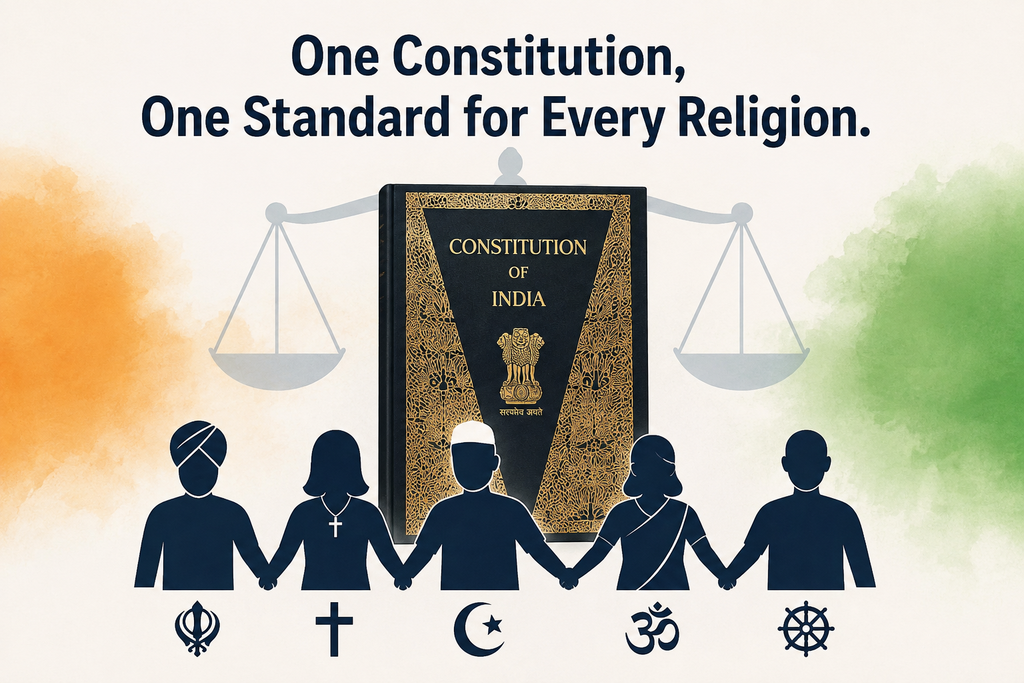
There is nothing inherently wrong with them. The Constitution protects the right of Hindus to explain and propagate their beliefs. But that same constitutional protection belongs equally to Christians distributing Bibles, Muslims explaining the Quran, Buddhists sharing the Dhamma, Sikhs promoting the teachings of the Gurus and atheists questioning religion itself.
If distributing a Bible is treated as evidence of attempted conversion while distributing the Bhagavad Gita is regarded as cultural service, the law is not being applied equally. If a Christian testimony about healing, dignity or personal transformation is called “inducement”, what should the State call religious discourses promising divine blessings, prosperity, relief from suffering or spiritual liberation? The issue is not whether Hindu religious outreach should also be controlled. It should not. The constitutional demand is that every religion must receive equal freedom and face the same lawful limitations.
Article 25 of the Constitution guarantees all persons—not only members of the majority—the freedom of conscience and the right freely to profess, practise and propagate religion. These rights are subject to public order, morality, health and other fundamental rights. Therefore, the State may intervene when there is credible evidence of coercion, fraud, violence or exploitation. But it should investigate the alleged criminal act, not place an entire religious community under permanent suspicion.
The language of “allurement” or “inducement” can become particularly dangerous when applied loosely. Christians consider education, healthcare, care for the poor and service to marginalised communities part of their faith. A school, hospital or food programme does not automatically become a conversion enterprise merely because it is operated by Christians. If a person experiences dignity through such service and later freely chooses that faith, the State must distinguish voluntary conviction from material coercion.
A.J. Philip rightly reminds us that conversion is not foreign to Indian history. Dr B.R. Ambedkar embraced Buddhism at Deekshabhoomi in Nagpur with thousands of followers. His decision was a rejection of caste oppression and an assertion of human dignity. Would we today require Ambedkar to notify a district official, explain his motives and prove that nobody had influenced him? A constitutional democracy cannot celebrate his conversion while criminalising the spiritual choices of ordinary Dalits, Adivasis, labourers or women.
Prior-notification requirements are also troubling. Faith is among the most intimate areas of human life. Requiring an adult to inform the administration before changing religion risks converting a fundamental right into a government-regulated privilege. It may expose vulnerable individuals to family pressure, community intimidation and political interference. The State should not become an intermediary between a person and his or her conscience.
The law also risks shifting the burden of proof. Once an accusation is made, a pastor, priest or ordinary believer may be forced to prove that another adult acted voluntarily. Even if acquitted later, the accused may endure arrest, imprisonment, legal expenses, social stigma and disruption of family life. In such cases, the process itself becomes punishment.
India does not need a law that appears neutral on paper but functions selectively in practice. It needs legislation that clearly and narrowly punishes force, fraud, threats and exploitation, irrespective of the religions of the accused and the victim. Complaints should require credible evidence, investigations should be impartial, and malicious accusations should attract consequences. Peaceful prayer, preaching, charitable service and distribution of religious literature must not be criminalised.
The question is not why Hindu satsangs and religious-book campaigns are allowed. They should remain free. The real question is why Christians are denied the same presumption of constitutional legitimacy.
A confident democracy trusts its adult citizens to make spiritual choices. A confident religion does not require police protection from competing beliefs. Maharashtra must uphold one Constitution, one standard and equal freedom for every faith. The State’s role is to prevent coercion—not to control conscience.
Keywords: Religious Freedom, Article 25, Constitution of India, Freedom of Conscience, Religious Conversion, Anti-Conversion Laws, Maharashtra Freedom of Religion Act, Equality Before Law, Religious Minorities, Secularism in India, Spiritual choices,
