
By Mathew Mattam
At an international gathering in New York, RSS chief Mohan Bhagwat recently spoke of “one world, one humanity,” respect for diversity and the need to protect the identity of others. These are admirable principles. Yet, at almost the same moment in Maharashtra, some Christian churches began asking worshippers to sign declarations confirming that they were attending prayers voluntarily. The forms were introduced as protection against allegations of unlawful religious conversion and possible police action.
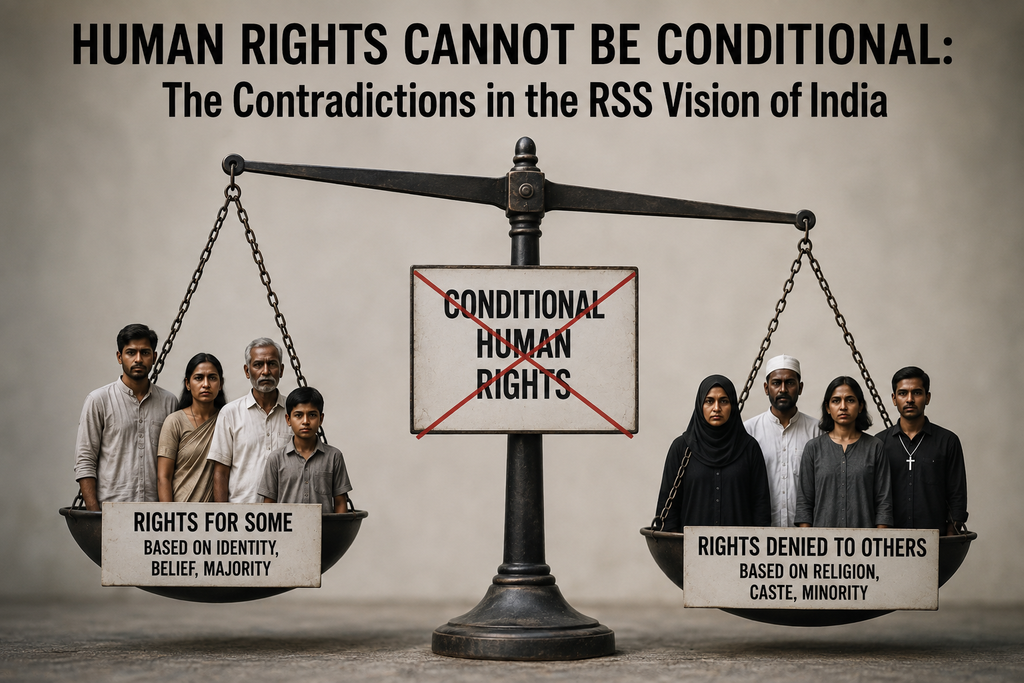
This contrast captures the central contradiction in the RSS approach to human rights: universalism in language, but conditionality in practice.
Churches asking people to prove in writing that they have come voluntarily to pray is not normal religious freedom. It is evidence of fear. The Maharashtra law does not formally require every Christian to obtain permission merely to attend worship. Nevertheless, when religious communities feel compelled to document participation, install cameras and gather declarations to defend themselves against accusations, freedom of religion has already been weakened. A constitutional right is being exercised under suspicion.
India must confront a simple question: if citizens must prove that their prayers are voluntary, how free is their faith?
India helped create the universal human-rights tradition
India is not an outsider to the global human-rights movement. It was among the 48 countries that voted for the Universal Declaration of Human Rights on 10 December 1948. Indian delegate Hansa Mehta played a historic role in changing the draft wording from “all men” to “all human beings,” helping make the Declaration genuinely universal. The United Nations records India’s contribution as an important part of the UDHR’s history.
The Constitution of India reflects many of the same principles: equality before the law, freedom of speech and association, protection of life and liberty, freedom of conscience, and the right to profess, practise and propagate religion.
India ratified the International Covenant on Civil and Political Rights and the International Covenant on Economic, Social and Cultural Rights in 1979. Parliament later enacted the Protection of Human Rights Act, 1993, establishing the National Human Rights Commission. The year 1993 did not mark India’s acceptance of the UDHR; rather, it created additional domestic machinery for protecting rights relating to life, liberty, equality and human dignity.
Yet institutions and declarations are meaningful only when they protect citizens who dissent from the dominant political, cultural or religious position.
The RSS idea of rights begins with a contradiction
The RSS frequently presents human rights as values already contained in Indian civilisation. It invokes Vasudhaiva Kutumbakam—the world is one family—along with seva, social harmony, duty and cultural unity. Its organisations have undertaken relief work, education, health programmes and initiatives among disadvantaged communities. These contributions should be acknowledged.
The problem lies not in speaking about duties or Indian philosophical traditions. Rights and responsibilities can strengthen each other. The contradiction emerges when duties to the nation, society or an officially preferred culture are placed above the freedom and dignity of the individual.
The UDHR protects every person—not only the culturally acceptable person, the politically loyal person or the member of the religious majority. A Muslim does not have to prove cultural assimilation to deserve equality. A Christian does not have to demonstrate that prayer has no connection with conversion. An Adivasi does not have to accept someone else’s definition of their religious identity. A journalist does not have to support the government to qualify as patriotic. A civil-society organisation does not surrender its freedom of association merely because it receives lawful international funding.
Human rights begin precisely where majoritarian approval ends.
Freedom of religion includes the freedom to change belief
RSS-linked arguments generally claim to support religious freedom while opposing “forced conversion.” Preventing conversion through violence, fraud or coercion is legitimate. No human-rights framework protects forced conversion.
However, several state laws go much further. They impose prior-notice or permission procedures, permit official inquiries into personal decisions, apply broad concepts such as “allurement” or “undue influence,” and sometimes shift the burden of proof onto the accused.
UN special rapporteurs reported that state anti-conversion laws had imposed undue limitations on freedom of religion and contributed to vigilante attacks, arbitrary arrests and harassment of religious minorities. They noted provisions requiring individuals or those conducting ceremonies to notify or obtain permission from district authorities. They also documented prayer meetings being interrupted by groups alleging conversion.
Maharashtra’s 2026 legislation deepens this concern by requiring advance notice of intended conversions and placing significant evidentiary responsibilities on those accused of facilitating them. Supporters describe the law as protection against coercion. Critics argue that vague definitions and intrusive procedures can criminalise voluntary belief and interfaith relationships.
A religion is not free if leaving it requires state scrutiny. Conscience belongs to the individual, not to the family, community, religious organisation or district administration.
“One family” cannot mean one identity
The RSS concept of cultural nationalism often claims that all Indians belong to a common civilisational family. But a family can be inclusive only when its members are equal. If minorities are accepted mainly on the condition that they acknowledge a Hindu cultural framework, equality becomes assimilation.
This is the difference between constitutional citizenship and cultural majoritarianism.
The Constitution does not divide Indians into cultural hosts and tolerated guests. Muslims, Christians, Sikhs, Buddhists, Jains, Hindus, atheists and people of every indigenous tradition possess equal citizenship. Their rights do not arise from the generosity of the majority. They arise from human dignity and constitutional guarantees.
The contradiction becomes sharper when leaders speak of social harmony but remain silent when hate speech, mob intimidation or collective punishment targets minorities. A research project cited by Reuters documented 1,165 instances of anti-minority hate speech in 2024, an increase of 74 per cent over the previous year. The BJP rejected the organisation’s analysis as biased and maintains that government welfare policies benefit all communities. Nevertheless, the documented scale of the problem demands investigation and accountability, not dismissal.
Service is not a substitute for equality
RSS supporters frequently cite service projects among Dalits, Adivasis and poor communities as evidence of commitment to human dignity. Service has real value, but charity and relief cannot substitute for rights.
A person may receive education, food or medical assistance and still experience discrimination, exclusion or political powerlessness. Human rights require more than helping disadvantaged communities; they require dismantling the structures that keep them disadvantaged.
“Social harmony” can become a way of avoiding difficult questions about caste power. Genuine equality requires the freedom of Dalits and Adivasis to organise, challenge dominant practices, reinterpret their histories and make independent religious and political choices. Harmony without justice can simply preserve hierarchy.
Dissent is not disloyalty
A second major contradiction appears in the treatment of dissent. The RSS celebrates discipline, national unity and collective purpose. But democracy depends equally on disagreement, investigation and criticism.
Rights organisations have documented the use of counterterrorism provisions, financial investigations, foreign-funding regulations and other legal mechanisms against activists and civil-society organisations. Human Rights Watch reported that the authorities used the Foreign Contribution Regulation Act, security laws and financial investigations against independent groups, while also blocking websites that documented hate speech and attacks on minorities.
The government argues that these measures enforce financial accountability, national security and public order. Such aims can be legitimate. But restrictions on fundamental freedoms must be lawful, necessary, proportionate and open to independent judicial scrutiny. When enforcement repeatedly falls more heavily on critics, minorities and rights organisations, the pattern creates a chilling effect even before a court determines guilt.
India still has courageous journalists, independent digital platforms, active courts, opposition parties and a vibrant civil society. It would therefore be inaccurate to say that independent media and freedom of association have been “totally denied.” However Reporters Without Borders placed India 157th among 180 countries in its 2026 World Press Freedom Index and highlighted the misuse of national-security and ordinary criminal laws against journalism.
A government may disagree with journalists. The RSS may strongly oppose activists, academics or NGOs. But disagreement does not make them anti-national. In a democracy, criticism is not an attack on the nation; it is one of the ways citizens defend it.
Institutions must protect rights, not political narratives
The Protection of Human Rights Act created the NHRC to protect life, liberty, equality and dignity. But a commission is credible only when it is independent, pluralistic, accessible and willing to confront the most powerful institutions of the state.
Human-rights bodies cannot become ceremonial institutions that speak forcefully about isolated crimes while avoiding politically sensitive patterns. Nor can investigative agencies be seen as instruments for disciplining opposition figures, journalists or organisations that challenge the ruling establishment.
The government has repeatedly rejected international criticism, including reports on religious freedom, as biased, politically motivated or insufficiently sensitive to India’s social realities. It has also correctly pointed out that Western countries have their own serious records of racism, religious hatred and human-rights violations.
Human rights are not foreign interference merely because international institutions raise uncomfortable questions. India voluntarily accepted international obligations and helped shape the universal framework itself.
The real test of Vasudhaiva Kutumbakam
The RSS does not need to abandon Indian philosophy to embrace universal human rights. It must instead accept the most demanding implication of Vasudhaiva Kutumbakam: every member of the human family has equal dignity, including the person who rejects the majority’s religion, ideology or understanding of the nation.
If the RSS genuinely believes that the world is one family, it must defend a Muslim facing hate speech, a Christian prayer meeting interrupted by vigilantes, an Adivasi asserting an independent faith, a journalist investigating those in power, an NGO questioning government policy and a citizen protesting peacefully.
Bhagwat’s cultural vision of “unity in diversity” deserves scrutiny because no inherited civilisation can define citizenship in a modern democracy. When one cultural tradition becomes the foundation of national unity, minorities may be accepted only on terms set by the majority. India’s Constitution offers a stronger basis: equal citizenship, religious freedom, individual dignity and state neutrality. Constitutional pluralism does not reject India’s civilizational heritage; it prevents any single interpretation of that heritage from dominating others. India belongs equally to every citizen, regardless of faith, caste, language or culture. Therefore, constitutional morality, not cultural conformity, must remain the foundation of unity.
Keywords: Human Dignity, Equal Citizenship, Human Rights, Constitutional Pluralism, Religious Freedom, Dalit Rights, Vasudhaiva Kutumbakam, Freedom of Expression, Anti-Conversion Laws, Justice, Freedom of Expression, Constitutional Morality, RSS Vision of India
