By Impactlens Correspondent
The world is passing through a period of profound instability. Wars and geopolitical rivalries are taking civilian lives, displacing communities and weakening international cooperation. Climate change is destroying livelihoods, while rising debt prevents developing countries from investing adequately in health, education, employment and social protection. Artificial intelligence and digital technologies are advancing rapidly, but their benefits remain concentrated among powerful corporations and wealthy societies. At the same time, workers, farmers, women, Indigenous communities, minorities and informal-sector producers continue to bear the cost of an economic system over which they exercise little control.
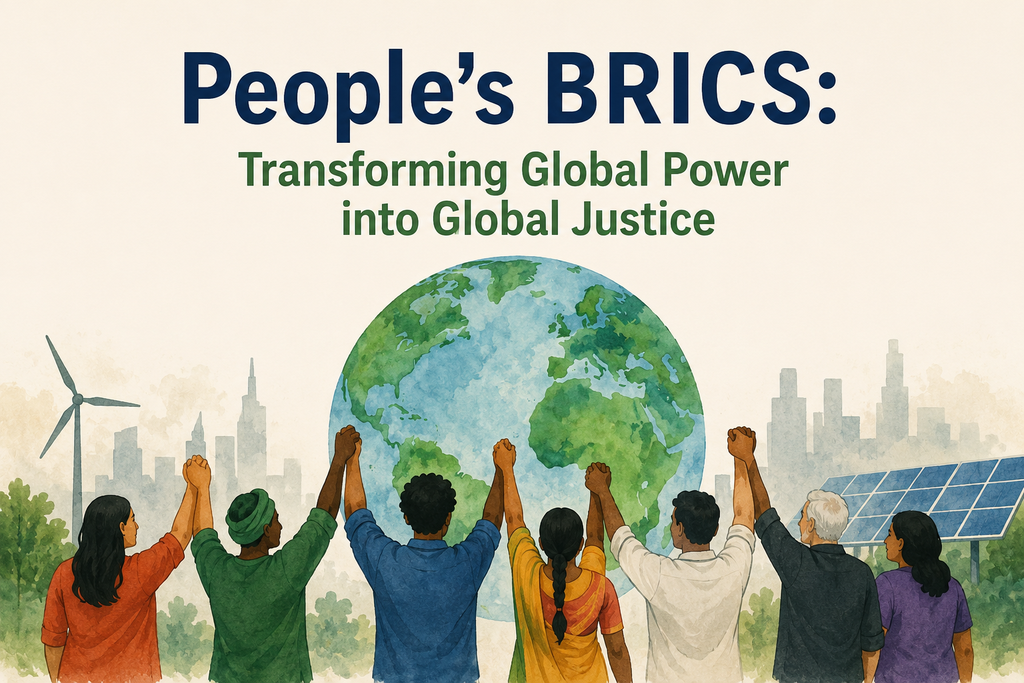
It was against this global background that more than 200 representatives of people’s movements, trade unions, farmers’ organisations, political groups, student movements and civil society organisations met in New Delhi on 21–22 August for the People’s BRICS Summit—formally called the Public Dialogue Forum on Global South Cooperation and Alternatives.
The meeting carried an important message: changing the countries that dominate the world is not enough; we must change the structures and values through which global power is exercised.
BRICS at a Historic Crossroads
BRICS began as a grouping of Brazil, Russia, India, China and South Africa. It has since expanded into an eleven-member coalition representing major emerging economies across Asia, Africa, Latin America and the Middle East. Together, its members account for approximately 49.5 per cent of the world’s population, 40 per cent of global GDP and 26 per cent of global trade. This gives BRICS considerable influence over the future of international cooperation.
BRICS emerged partly from dissatisfaction with a global order dominated by Western countries and institutions. Developing nations have long been underrepresented in the governance of the International Monetary Fund, World Bank, global trading system and other influential institutions. Decisions that affect billions of people are frequently made without their meaningful participation.
BRICS can help correct this imbalance. It can strengthen the voice of the Global South, expand South–South cooperation and promote a more representative multilateral system. The New Development Bank is one concrete achievement. It has approved financing of approximately US$42.9 billion for 139 projects and has sought to increase lending in local currencies, reducing some of the risks associated with dependence on dominant international currencies.
However, the real test of BRICS is not how successfully it competes with the West. The test is whether it creates a more democratic, peaceful, environmentally responsible and people-centred world order.
Replacing one concentration of power with another will not produce justice. Multipolarity has meaning only when it improves the lives of ordinary people.
The Unfulfilled Promise
The People’s BRICS Summit rightly warned that the transformative promise of BRICS remains substantially unfulfilled. Although member countries speak about equality, sovereignty and cooperation, many continue to follow development models based on corporate concentration, privatisation, financialisation and the intensive extraction of natural resources.
These models frequently displace communities, weaken labour protections and destroy forests, water systems and traditional livelihoods. Economic growth may increase national wealth without ensuring its fair distribution. A country can challenge Western dominance internationally while tolerating inequality, discrimination and political exclusion domestically.
The global debt crisis demonstrates why an alternative is urgently needed. Developing countries face higher borrowing costs while possessing less fiscal space to respond to poverty, unemployment and climate disasters. Around 3.4 billion people now live in countries that spend more on interest payments than on either health or education.
BRICS must therefore move beyond declarations and adopt measurable, time-bound commitments. Cooperation cannot be judged only by trade volumes, infrastructure projects, diplomatic influence or the sovereignty secured for governments and capital. It must be judged by the dignity, security and freedom it delivers to workers, farmers, women, Dalits, Adivasis, minorities, migrants and historically excluded communities.
A People-Centred Agenda
People’s BRICS provides a necessary democratic bridge between high-level diplomacy and everyday life. Its workshops on trade, agriculture, labour, inequality, natural resources, climate, finance, gender, artificial intelligence and democracy demonstrate how interconnected today’s crises have become.
A genuinely people-centred BRICS should pursue six priorities.
First, it must make inequality reduction an explicit and measurable objective. Universal social protection, affordable healthcare, pensions, unemployment assistance, living wages and income security should become central elements of BRICS cooperation.
Second, BRICS must protect food sovereignty. Farmers require accessible institutional credit, fair prices, universal crop insurance, climate-resilient agriculture and freedom from exploitative markets. Agricultural cooperation should strengthen small producers rather than promote corporate control over land, seeds, water and food systems.
Third, trade and investment must support employment, local industry and ecological protection. Developing countries need the policy space to regulate capital, protect strategic sectors and build domestic productive capacity. Trade cannot be called successful when exports grow but workers remain insecure and communities lose control over natural resources.
Fourth, BRICS must advance a just energy transition. The move away from fossil fuels is essential, but poor communities and workers cannot be forced to pay the price. Renewable-energy projects must be publicly accountable, environmentally sound and shaped by affected communities.
Fifth, BRICS needs democratic digital cooperation. Data, digital identities and artificial intelligence must be governed in the public interest. Technology should expand access to education, healthcare, employment and public services—not create surveillance, exclusion or new forms of corporate monopoly. No person should lose citizenship rights, welfare benefits or political participation because of digital barriers.
Sixth, women must have equal representation and decision-making power at every level. Gender equality cannot remain a separate programme; it must shape finance, trade, labour, technology, climate action and political governance.
Peace Must Be the Foundation
BRICS cannot build a fair economic order while remaining divided or inconsistent on war, occupation and human suffering. It must defend international law universally and oppose unlawful military intervention, collective punishment, ethnic cleansing, terrorism and attacks on civilians—regardless of who commits them.
The solidarity expressed by People’s BRICS with Palestinians reflects the urgent demand for justice, protection of civilian life and a durable political settlement. The same moral principles must apply to every conflict. Peace cannot be selective, and human rights cannot depend on geopolitical alignment.
BRICS countries should use their collective influence to strengthen diplomacy, conflict prevention, humanitarian assistance and peaceful resolution. A coalition representing nearly half of humanity carries a special responsibility to prevent the world from becoming further militarised and fragmented.
From Consultation to Participation
Civil society engagement must not be confined to the weeks before an official summit. Permanent mechanisms are needed through which workers, farmers, women, young people, marginalised communities, universities and social movements can influence BRICS priorities and monitor their implementation.
The BRICS Civil Forum and People’s BRICS should therefore be institutionally recognised, independently supported and connected to ministerial and leaders’ processes. Their recommendations should receive formal responses, while progress should be reviewed through public social, environmental and human-rights indicators.
People’s BRICS is not an opponent of BRICS. It is its democratic conscience. It reminds political leaders that the Global South is not merely a collection of governments or expanding markets. It is made up of people carrying histories of colonialism, exploitation, resistance and hope.
BRICS now has the scale to influence the world. People’s BRICS can help give it direction. Together, they can demonstrate that an alternative world order is possible—not simply a multipolar world divided among powerful states, but an equal world in which every person can live with dignity, peace, justice and harmony.

This Post Has One Comment
Peoples BRICS is good initiative. We appreciate the idea. We have to find a Common Programme to buildup BRICs, so that Dollar or EURO can’t suppress the Developing worlds Economy, Social & Cultural freedom.