
By Suryakant Chavan, Watershed Expert
For many years, Mr. Pandurang Kailas Gorad, a farmer from Diksal village in Sangola Block of Solapur District, faced many difficulties because of water shortage. His family depended on farming and dairy farming for their livelihood. He owned three dairy cows, which have been the main source of income for his family. Every summer, there was very little water. Poor rainfall, delayed monsoons, and frequent electricity cuts made it difficult to irrigate fodder crops. As such there was not enough green fodder for the animals and milk production often decreased.
Even during these difficult times, Mr. Pandurang never lost his hope. In drought years, he bought green fodder from nearby villages to feed his dairy animals. He used the available water very carefully and continued all his daily work, including cutting and carrying fodder, watering crops and animals, milking the cows, cleaning the cattle shed and taking care of the dairy farm. He also grew maize during the rainy season and prepared fodder so that his animals would have nutritious fodder during the dry months when fresh green fodder was not available.
Still, there was water scarcity issues. Every year, the family faced water scarcity for about four months, especially during summer. Because of limited water, fodder crops could be irrigated only 5 to 6 times in one crop cycle, which affected both the quantity and quality of fodder, which ultimately reduced milk production and less profit in dairy farming.
A major change came through the Comprehensive Village Development Programme implemented by CYDA with financial support from SBI Mutual Fund. Under the programme, a lined farm pond with a storage capacity of 14 lakhs litres was constructed on Mr.Pandurang’s farm. The pond stores water from a nearby nala connected to the canal system during the monsoon, providing a reliable source of water for irrigation throughout the year.
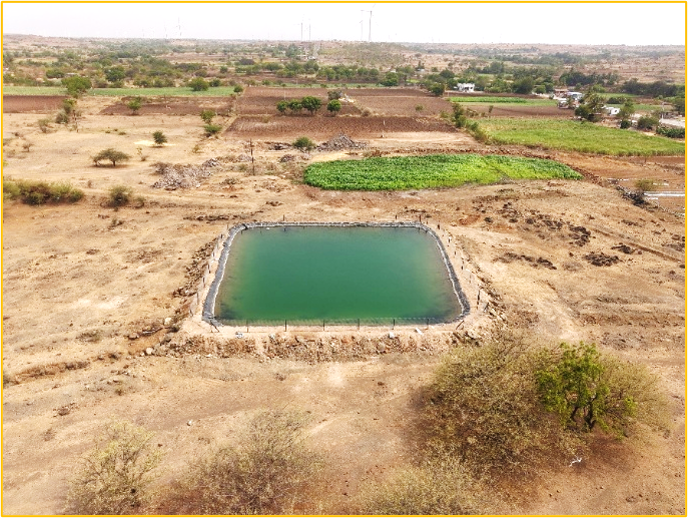
Pandurang’s farm had a suitable location with a nearby water source, appropriate land for construction and based on his financial condition and landholding size, he was supported with a farm pond. He also showed his commitment by contributing Rs.90,000/- towards the construction of the farm pond. The project also introduced a gravity-based siphon irrigation system. Since the farm pond is at a higher level than the field, water flows naturally through pipelines without using electricity or pumps. This allows irrigation even during power cuts, reduces irrigation costs, and makes better use of the stored water.
Now that the water is available, he is able to grow:
- One acre of fodder jowar and produces nearly 80 metric tonnes of green fodder every year.
- He is now able to provide timely irrigation to his fodder crops even during dry spells, improving crop health and ensuring a dependable fodder supply for his livestock.
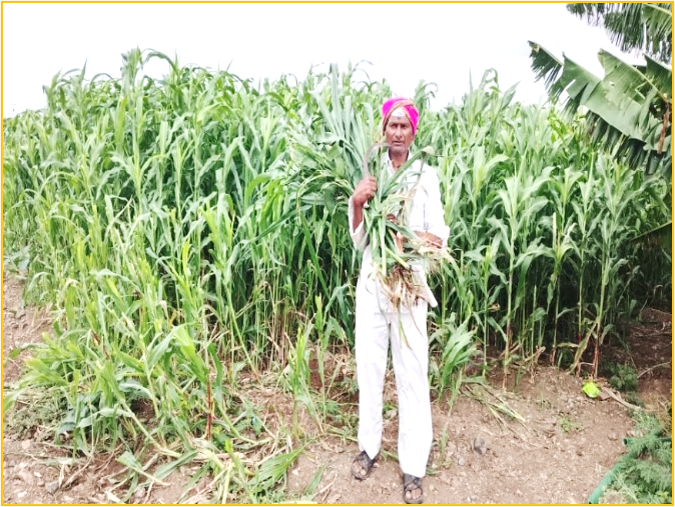
This has improved both the quality and quantity of fodder, ensuring that his dairy animals receive nutritious feed throughout the year. Because of better quality green fodder
- The health of the dairy animals has improved, leading to higher milk production.
- His average monthly milk production increased from 1000 to 1050 litres to around 1,200 litres.
- Dairy business earns an average monthly income of Rs.23,000/-, with a net monthly profit of approximately Rs.11,000/-.
- More stable income and reduced their dependence on uncertain rainfall.
The success has also encouraged many other farmers in Diksal village. They have seen the benefits of the farm pond, including reliable irrigation, better fodder production, healthier dairy animals and improved farm productivity. His experience shows that proper water management can help farmers continue agriculture and dairy farming successfully, even in drought prone areas. Mr.Pandurang is committed to maintaining the farm pond by regularly checking the HDPE lining, repairing it when needed, strengthening the pond bunds, removing silt whenever required and keeping the pond filled with water to increase its life and efficiency.
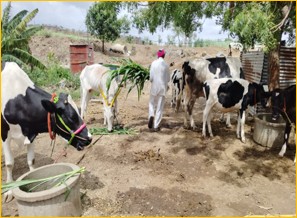
Today he feels very proud, that a simple farm pond has become a lifeline for his family. It has improved water security, increased dairy income, strengthened his livelihood and inspired other farmers in the village to adopt sustainable farming practices.
“The farm pond has completely changed my farming. Even when there is no rain and electricity supply is irregular, I can irrigate my fodder crop using the stored water and siphon technique. My 3 dairy cows receive green fodder year-round, and milk production continues without interruption. The farm pond has become my family’s biggest source of security and a reliable means of livelihood.”
