
ImpactLens Correspondent
World Lake Day — 27 August. Every day, we use water from lakes, rivers and groundwater for drinking, farming, livelihoods and ecosystems. Yet, we rarely stop to think about where this water comes from or what happens when these sources begin to disappear.
World Lake Day, observed on 27 August, is a reminder to do exactly that. The United Nations General Assembly designated 27 August as World Lake Day in December 2024. The day aims to raise awareness about the importance of lakes and promote their protection, restoration and sustainable management. Lakes are among the planet’s most important freshwater ecosystems. They provide water, support biodiversity, regulate local climates, sustain agriculture and fisheries, and contribute to the livelihoods of millions of people. Lakes contain around 90 per cent of the world’s unfrozen surface freshwater. (UNEP – UN Environment Programme). But while we depend on lakes, are we doing enough to protect them?
A Global Crisis Beneath the Surface
There are more than 100 million lakes across the world. Yet many are no longer as healthy, clean or full as they once were. Climate change, pollution, over-abstraction, land-use change and other human pressures are rapidly altering lake ecosystems. UNEP describes many lakes as being a shadow of what they were only a few decades ago. (UNEP – UN Environment Programme)
One of the biggest threats is pollution. Untreated sewage, industrial waste, plastic and agricultural runoff carry nutrients and contaminants into lakes. Fertilisers rich in nitrogen and phosphorus can trigger excessive growth of algae and aquatic plants. As this organic matter decomposes, it consumes oxygen in the water. Oxygen levels then fall, threatening fish and other aquatic life. This process, known as eutrophication, can turn a healthy lake into a degraded ecosystem. Lakes such as Hussain Sagar in Hyderabad and Dal Lake in Srinagar illustrate the pressures faced by urban and heavily used water bodies.
Climate change is making the situation more difficult. The World Meteorological Organization’s State of Global Water Resources 2024 report found that nearly all of the 75 major lakes assessed had above- or much-above-normal water temperatures in July 2024. Warmer water can increase evaporation and contribute to water-quality problems, placing additional pressure on freshwater ecosystems. (World Meteorological Organization)
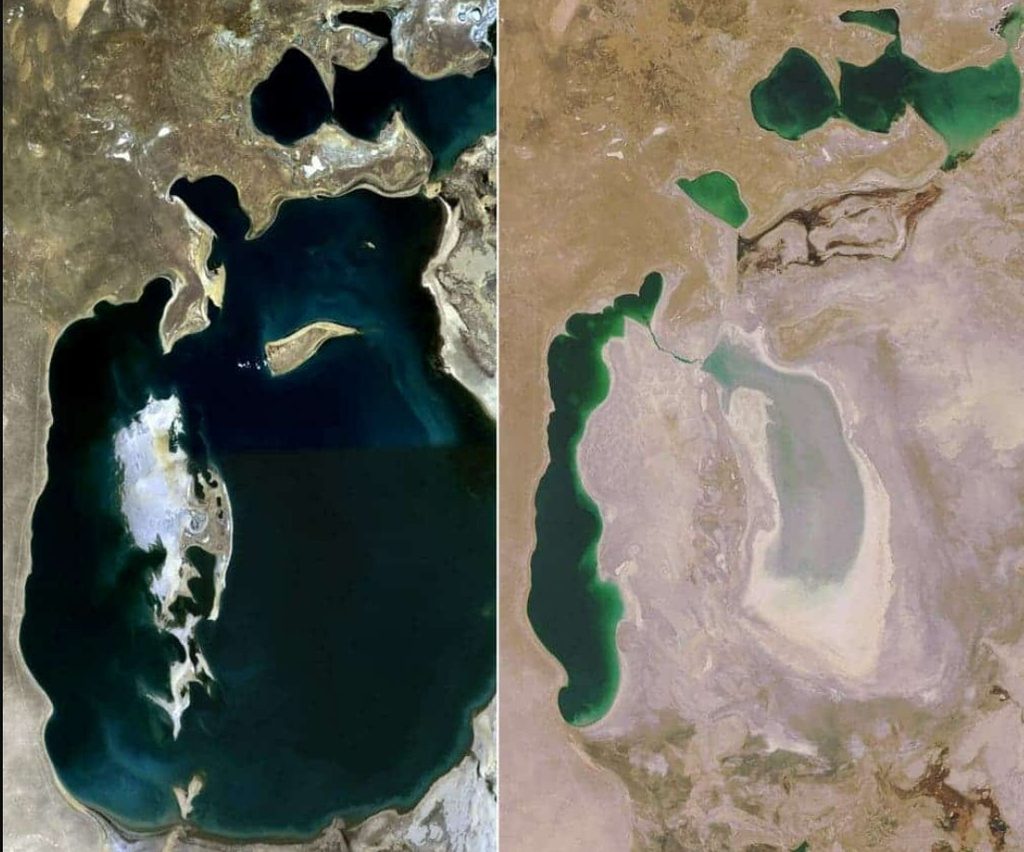
Source: Wikipedia
The problem is not limited to water quality. Lakes are also shrinking. The Aral Sea is one of the most dramatic examples. Once one of the world’s largest inland water bodies, it shrank drastically after the rivers that fed it were diverted on a massive scale for irrigation. Its decline demonstrates how excessive water extraction can transform an entire ecosystem.
UNEP has also reported widespread changes in lake water quality. Its assessments show that many large lakes are becoming increasingly turbid, while others are experiencing rising levels of organic matter. (UNEP – UN Environment Programme) This is more than an environmental problem. If lakes disappear or become polluted, communities lose water sources, livelihoods, biodiversity, flood protection and other ecosystem services.
India Is Facing the Same Challenge
India’s lakes are under growing pressure from pollution, encroachment, excessive water extraction, changing land use, waste dumping and climate variability. A recent audit by the Comptroller and Auditor General of India (CAG) presents a concerning picture in Jammu and Kashmir. Of the 697 lakes recorded in 1967, 315 had disappeared, while 203 had experienced a reduction in water area. Together, 518 lakes had either disappeared or shrunk. (Comptroller and Auditor General of India). The loss of lakes also has consequences beyond water availability. Lakes act as natural flood buffers. Their degradation can reduce the landscape’s ability to absorb and store excess water, increasing vulnerability to floods. The CAG has highlighted this connection in its assessment of lakes in Jammu and Kashmir. From Dal Lake in Kashmir to urban lakes across Indian cities, the story is increasingly familiar: water bodies are being squeezed between development and ecological needs.
According to India Today, between 1992 and 2020, more than 30 major Indian lakes have recorded a drying trend. 16 of these lakes are in southern India, including well-known reservoirs like Mettur, Krishnarajasagar, and Nagarjuna Sagar.
What Can Governments and Communities Do?
Governments have a central role because lake protection requires planning, regulation, investment and enforcement. India already has important policy mechanisms. The National Plan for Conservation of Aquatic Ecosystems (NPCA) supports integrated conservation and management of wetlands, including activities such as pollution abatement, catchment management, biodiversity conservation and restoration. It also emphasises the need for scientific assessment, monitoring and integrated planning. (MoEFCC). The Wetlands (Conservation and Management) Rules, 2017 provide a regulatory framework for notified wetlands and seek to restrict activities that can damage their ecological character.
People living around lakes are often the first to notice changes in water levels, pollution, encroachment or the disappearance of fish and birds. Their knowledge and participation can therefore become an important part of lake protection.
Communities can help by preventing waste dumping, reducing plastic use, participating in lake clean-up and restoration activities, reporting encroachments and pollution, and monitoring the condition of local water bodies. Schools and colleges can involve young people in lake mapping, biodiversity surveys, water-quality awareness and clean-up campaigns. Farmers can adopt practices that reduce agricultural runoff. Resident groups can work with local authorities to monitor sewage discharge and protect natural drainage channels.
The global experience shows that restoring a damaged lake is often much harder and more expensive than protecting a healthy one. UNEP has called for stronger integrated water-resource management, basin-level approaches that involve local communities and other stakeholders, and better data and monitoring to identify problems before they become crises. This requires a change in how we think about development. Protecting a lake today is about protecting biodiversity, livelihoods, climate resilience and the future of the communities that depend on them.
