
By ImpactLens Correspondent
India’s labour laws are meant not merely to regulate workplaces but to correct the unequal bargaining relationship between employers and workers. The recent nine-judge Constitution Bench judgment of the Supreme Court on the meaning of “industry” must therefore be examined through one central question: does it preserve meaningful access to justice for workers, or does it narrow the doors through which they can seek protection?
The judgment revisits Bangalore Water Supply and Sewerage Board v. A. Rajappa, the landmark 1978 decision led by Justice V. R. Krishna Iyer. For nearly five decades, that ruling provided an expansive and worker-oriented understanding of “industry” under Section 2(j) of the Industrial Disputes Act, 1947.
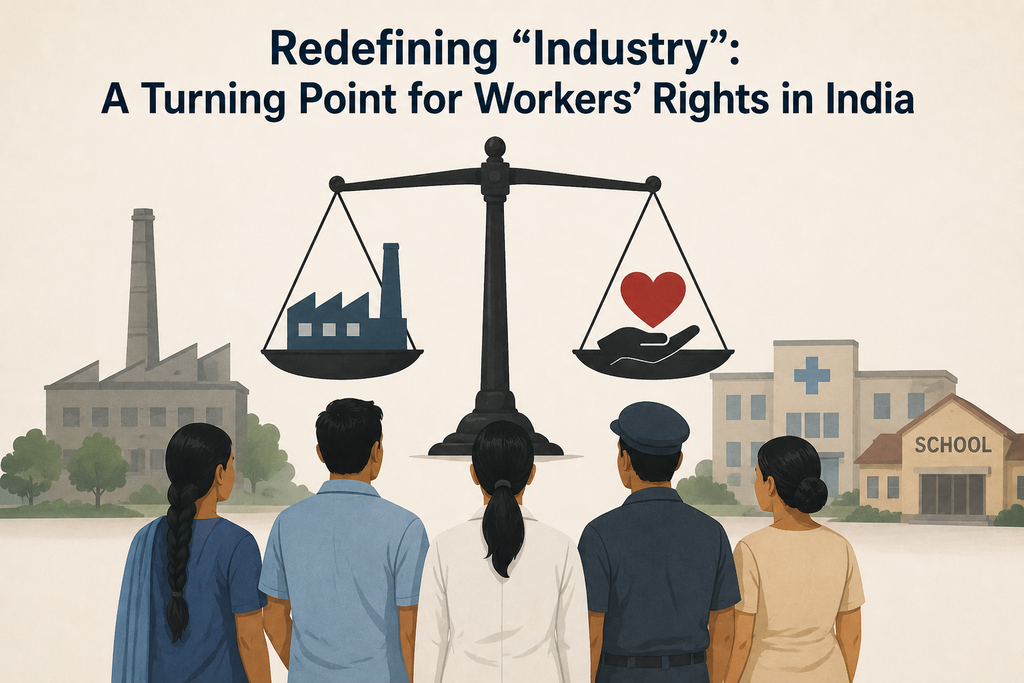
The new judgment, delivered amid India’s transition to the Industrial Relations Code, 2020, is legally complex and fractured. It does not simply overrule the 1978 decision for all purposes. Pending proceedings under the repealed Industrial Disputes Act will continue to be decided according to the Bangalore Water Supply test. However, the new Industrial Relations Code must be interpreted independently, according to its own language and exclusions. This distinction is crucial to understanding the judgment’s consequences. Supreme Court judgment, 20 August 2026
Why the Definition Matters
The word “industry” may appear technical, but it determines whether millions of workers can access industrial-dispute mechanisms. If an establishment is classified as an industry, its eligible workers can seek remedies concerning dismissal, retrenchment, wages, working conditions, unfair labour practices and other employment disputes through conciliation and industrial tribunals.
If the establishment falls outside that definition, workers may have to depend on individual contracts, establishment-specific laws or ordinary civil remedies. These alternatives can be slower, more expensive and less accessible, particularly for low-paid workers who lack legal knowledge, financial resources and collective bargaining power.
The definition therefore determines not merely the nature of an institution but the enforceability of the rights of those working within it.
The Industrial Disputes Act, 1947 was enacted to prevent and settle conflicts between workers and employers. It created mechanisms such as works committees, conciliation officers, labour courts and industrial tribunals. Its purpose was to promote industrial peace while protecting workers against arbitrary dismissal, retrenchment, lockouts and unfair labour practices.
Justice Krishna Iyer’s 1978 judgment interpreted this welfare legislation broadly. It introduced the famous “triple test.” An activity would qualify as an industry when there was:
- systematic activity;
- cooperation between employer and employee; and
- the production or distribution of goods or services intended to satisfy human needs.
Profit was not essential. Nor did the charitable or public-service character of an institution automatically remove it from the law. The focus was on the organised activity and the employment relationship, rather than the label or stated mission of the employer.
This approach brought hospitals, educational institutions, research bodies, charitable organisations and several government welfare activities within the potential scope of labour-law protection. It recognised a simple reality: a nurse employed by a charitable hospital, a sanitation worker engaged by a public authority and a non-teaching employee working in an educational institution are still workers. Their need for fair wages, due process and protection against arbitrary termination does not disappear because their employer is non-profit or performs a social function.
What Has Now Changed?
The Supreme Court’s latest judgment contains five separate opinions and sharply differing views. Chief Justice Surya Kant’s opinion called for a “calibration” of the earlier test. According to this approach, an activity should possess a discernible commercial character comparable to trade or business before it is treated as an industry. Profit-making would still not be essential, but activities entirely disconnected from economic enterprise could be excluded.
Justices B. V. Nagarathna, Dipankar Datta and Joymalya Bagchi defended the broader 1978 interpretation. They stressed the welfare purpose of labour legislation and warned against introducing a commercial-character requirement that could deny protection to employees simply because they work in hospitals, schools or charitable institutions.
Justice Nagarathna’s warning deserves serious public attention. A definition followed for almost half a century had created a degree of legal certainty. Narrowing or unsettling it during a major transition in labour regulation could generate fresh litigation and disturb industrial peace instead of strengthening it.
Yet the practical result of the judgment is more nuanced than some initial reports suggested. The Court did not retrospectively impose a new, narrower test on old cases. Pending proceedings under Section 2(j) of the Industrial Disputes Act will remain governed by Bangalore Water Supply. At the same time, the Court declined to carry that judicial interpretation automatically into the Industrial Relations Code.
The Code, in force from 21 November 2025, defines industry broadly as a systematic activity carried on through cooperation between an employer and workers for producing, supplying or distributing goods or services. Capital investment and profit motive are irrelevant. However, it expressly excludes institutions wholly or substantially engaged in charitable, social or philanthropic services, domestic services, core sovereign government functions and other activities that the Central Government may notify. Industrial Relations Code, 2020
The real contraction of protection, therefore, comes significantly from the wording chosen by Parliament. The Court has made clear that this new definition must stand on its own rather than be expanded automatically through the 1978 precedent.
The Workers Who May Be Left Behind
This shift raises a fundamental question: why should the nature of the employer’s mission determine the level of protection available to an employee?
Large hospitals, universities, charitable institutions and social-service organisations may operate without formally distributing profits, yet they can employ thousands of people, manage substantial budgets and function through professional hierarchies similar to those of commercial enterprises. Workers in these institutions can face the same problems found elsewhere—low wages, contractual insecurity, arbitrary dismissal, excessive workloads, discrimination and resistance to unionisation.
A charitable purpose does not guarantee charitable employment practices.
India’s development sector also increasingly operates through public-private partnerships, CSR funding, outsourcing, contractual employment and project-based appointments. A worker may perform the same duties under similar supervision but receive different legal protection depending on whether the employer is a company, a public institution or a charitable organisation. Such unevenness conflicts with the principle that labour protection should respond to the reality of the employment relationship.
The effects may be particularly severe for women, sanitation workers, hospital support staff, security personnel, drivers, community mobilisers and contractual workers. These workers often occupy the lowest levels of institutional hierarchies and possess the least individual bargaining power.
Exclusion from the definition of industry does not mean that every labour right disappears. Wage, social-security, workplace-safety, contractual and sector-specific protections may still apply. Nevertheless, losing access to industrial-dispute machinery can make enforcement considerably harder. A right without an affordable and accessible remedy can quickly become a right only on paper.
Reform Must Balance Efficiency with Justice
India needs modern labour laws. Employers require clarity, faster dispute resolution and freedom from contradictory interpretations. Institutions genuinely performing sovereign functions also require appropriate exemptions. But modernisation cannot become a polite expression for weakening workers’ remedies.
The purpose of labour reform should be to reduce unnecessary complexity while expanding security, dignity and formalisation. It should not create a situation in which institutional classifications become tools for avoiding accountability.
The Union and state governments must now ensure that workers excluded from the definition of industry are not left without effective remedies. This requires clear rules, accessible grievance mechanisms, time-bound adjudication and protection against retaliation. Large hospitals, educational bodies and charitable institutions should be required to establish credible internal grievance and appeal systems, recognise lawful worker representation and publicly disclose employment standards.
Parliament should also review whether a blanket exclusion for charitable, social and philanthropic institutions is justified. A better approach would examine the scale of operations, nature of employment, organisational structure and actual activity of an institution. Small voluntary initiatives cannot reasonably be treated in exactly the same way as large, professionally managed institutions employing hundreds or thousands of workers.
The judgment should therefore initiate a national conversation, not end one. India must decide whether labour protection follows the identity of the employer or the vulnerability of the worker.
Justice Krishna Iyer’s jurisprudence placed human dignity at the centre of industrial law. As India moves into a new labour-code era, that constitutional commitment must not be lost. Economic growth and institutional freedom are important, but neither can be built sustainably on insecure labour.
The true test of a labour law is not how conveniently it defines an establishment. It is whether the person who cleans its floors, handles its records, cares for its patients, supports its students or delivers its services can obtain justice when treated unfairly. India’s new framework will be judged by that standard.
