
By Mathew Mattam
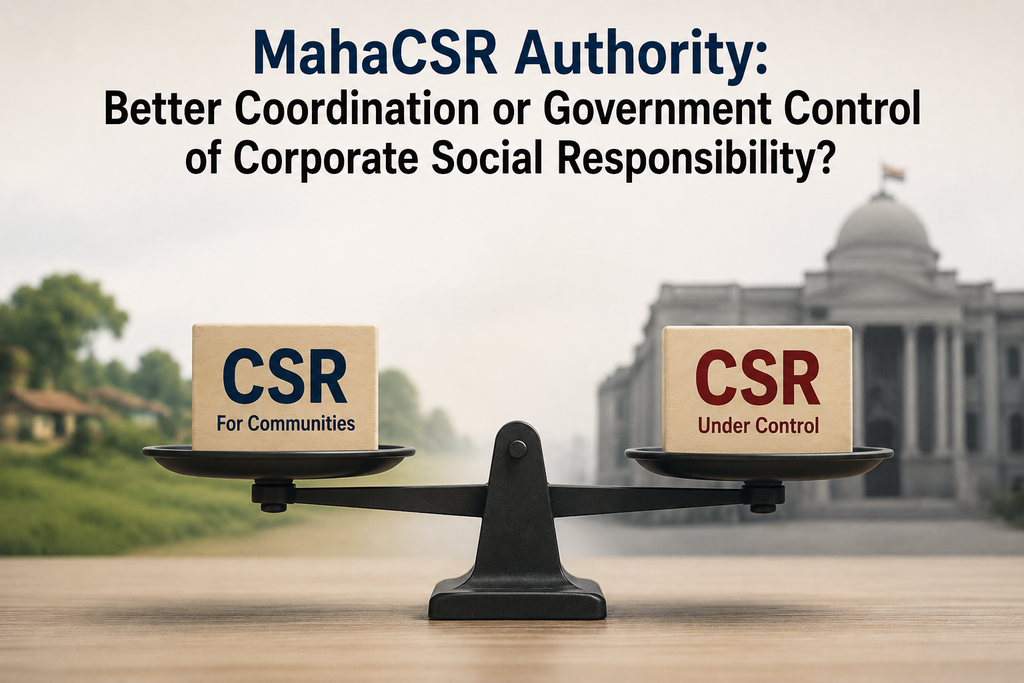
The Maharashtra Government’s proposal to establish a “MahaCSR Authority” deserves serious public discussion. Corporate Social Responsibility funds are meant to support communities, address development gaps and encourage companies to accept responsibility for their social and environmental impact. Any mechanism that improves transparency, geographical equity and measurable impact should be welcomed. However, if the proposed authority centralises decisions, adds political control or converts CSR into an alternative source of government finance, it could undermine the very purpose of the law.
On 21 August 2026, Chief Minister Devendra Fadnavis directed officials to prepare a proposal for a dedicated authority to coordinate, monitor and ensure the proper utilisation of CSR funds in Maharashtra. The proposed body would be chaired by the Chief Minister, with senior officials and industry representatives on its Governing Council. A Chief Executive Officer would serve as member-secretary and lead its Executive Council. It would create a project bank aligned with government priorities, assist companies in selecting projects and implementing organisations, and encourage maintenance of assets created through CSR funding. A “Diaspora Connect” mechanism has also been suggested. ThePrint’s report on the proposal
The intentions appear reasonable. Maharashtra attracts more CSR investment than any other state, but much of it remains concentrated in Mumbai, Pune, Thane, Nagpur and industrial areas. Meanwhile, tribal districts, drought-prone regions, remote villages and communities without influential intermediaries struggle to attract corporate attention. Projects are sometimes duplicated in well-connected locations, while equally urgent needs elsewhere remain invisible. A credible database of district-level needs could therefore improve the distribution and effectiveness of CSR expenditure.
The problem begins with the word “authority.” Will MahaCSR merely facilitate CSR, or will it regulate, approve and control it?
CSR is already governed by central law
Section 135 of the Companies Act, 2013 applies to companies meeting prescribed financial thresholds: a net worth of ₹500 crore or more, turnover of ₹1,000 crore or more, or net profit of ₹5 crore or more during the immediately preceding financial year. Such companies must ordinarily spend at least two per cent of their average net profits from the preceding three financial years on activities permitted under Schedule VII. Section 135 of the Companies Act
The existing system is not unregulated. A company’s CSR team examines community needs and proposals submitted by civil-society organisations. Senior management reviews the programme, its risks and its alignment with corporate policy. The CSR Committee recommends expenditure, while the company’s Board approves the policy and remains accountable for implementation and utilisation of funds.
Eligible implementing organisations must register with the Ministry of Corporate Affairs. Companies must disclose their CSR activities, expenditure and unspent amounts. Larger projects may require independent impact assessments. Statutory auditors examine financial compliance, and corporate employees frequently visit projects, volunteer with communities and monitor results.
Most importantly, the Ministry of Corporate Affairs describes CSR as a “Board-driven process.” Its guidance states that the government has no direct role in approving or implementing a company’s CSR projects. Compliance is monitored through corporate disclosures on the MCA21 system, audits and action under the Companies Act. The national government has also established a National CSR Exchange Portal through which companies and implementing organisations can identify projects and partners.
Therefore, Maharashtra should not create a parallel layer that duplicates central regulation. Corporate law falls primarily within the Union framework. A state can identify needs, facilitate partnerships, provide information and monitor projects undertaken with its departments. It should not impose an additional compulsory approval process, dictate every company’s CSR allocation or require funds to pass through a government-controlled institution.
The danger of turning CSR into government funding
CSR is public-purpose money, but it is not government revenue. It should complement—not replace—budgetary responsibilities.
If government departments begin listing unfunded schemes and expect companies to finance them, CSR may gradually become an off-budget instrument. Companies may feel pressured to select politically preferred projects instead of responding to communities, independent research or their own social-impact priorities. Smaller and less-connected civil-society organisations may be pushed aside by large agencies with easier access to officials.
There is also a risk that companies will be encouraged to finance visible infrastructure rather than less visible but transformative work such as community mobilisation, gender justice, youth leadership, mental health, disability inclusion, grassroots entrepreneurship and institutional capacity building. Buildings are easier to inaugurate; social change requires time, trust and professional engagement.
Government departments should not become both project proposers and regulators. Such an arrangement creates a clear conflict of interest.
Who will govern the authority?
Before establishing MahaCSR, the government must publish a detailed concept paper for public consultation. Several questions require answers:
- Will companies be legally or administratively compelled to route funds through the authority?
- Who will appoint the CEO and members of the Executive Council?
- What qualifications, experience and fixed tenure will the leadership have?
- Will civil-society organisations, community representatives, independent CSR professionals and experts from underserved regions have meaningful representation?
- Will project selection criteria, decisions, budgets, administrative costs and impact reports be publicly available?
- Will there be an independent grievance and appeal mechanism?
- How will political recommendations and conflicts of interest be prevented?
Since the present proposal refers to a CEO rather than a commissioner, the final structure remains unsettled. A transparent selection panel would be preferable to appointment by a single political executive. The selection process should include independent experts and representation beyond the ruling establishment. Judicial participation may not be necessary, but independence, public scrutiny, fixed tenure, conflict-of-interest disclosures and legislative oversight are essential.
Will the model spread across India?
It could—but Maharashtra is not entering entirely new territory. Gujarat already has a government-backed Gujarat CSR Authority that connects companies, government institutions and civil-society organisations. Madhya Pradesh has developed a CSR portal, while Bihar and other states have introduced CSR policies and coordination platforms.
If Maharashtra demonstrates that a state-level platform can reduce geographical inequality, improve project quality and strengthen transparency without controlling corporate decisions, other states may follow. But if it becomes a gatekeeper for CSR funds, resistance from companies and civil society is inevitable, and its legal powers may be questioned.
The best model is therefore not a controlling authority but an independent CSR Facilitation and Transparency Council. It should map unmet needs, publish district-level data, verify information, connect credible partners, promote neglected regions, encourage collaboration and disclose results. Companies must retain their statutory responsibility to select, approve and monitor projects.
Maharashtra does not need another layer of permission. It needs better information, fairer access and stronger accountability. CSR must ultimately reach the places where people matter—not merely the projects in which an authority is interested.

This Post Has 2 Comments
Very well said, Mathew. I fully agree with your views.
India already has a comprehensive statutory framework for CSR under the Companies Act, 2013, with the Ministry of Corporate Affairs (MCA) responsible for regulating and monitoring CSR compliance and disclosures. Companies are required to report their CSR activities through prescribed statutory reporting mechanisms.
In this context, I believe the Government of Maharashtra should primarily play the role of a **facilitator and enabler**, rather than creating another layer of authority to monitor CSR funding.
The State can add significant value by identifying underserved regions and critical development needs, creating a credible project pipeline, facilitating partnerships between corporates and credible implementing organisations, and helping CSR resources reach areas that may otherwise remain underserved.
This would, in my view, strengthen the impact of CSR while complementing, rather than duplicating, the existing national CSR framework.Very well said, Mathew. I fully agree with your views.
India already has a comprehensive statutory framework for CSR under the Companies Act, 2013, with the Ministry of Corporate Affairs (MCA) responsible for regulating and monitoring CSR compliance and disclosures. Companies are required to report their CSR activities through prescribed statutory reporting mechanisms.
In this context, I believe the Government of Maharashtra should primarily play the role of a **facilitator and enabler**, rather than creating another layer of authority to monitor CSR funding.
The State can add significant value by identifying underserved regions and critical development needs, creating a credible project pipeline, facilitating partnerships between corporates and credible implementing organisations, and helping CSR resources reach areas that may otherwise remain underserved.
This would, in my view, strengthen the impact of CSR while complementing, rather than duplicating, the existing national CSR framework.
Nice