

ImpactLens Correspondent
When Ajit Rajagopal travelled from India to Cotonou, Benin, for the World Social Forum, he carried the hopes of a young peacebuilder seeking to understand how communities across the world confront conflict, inequality and injustice through dialogue and nonviolence.
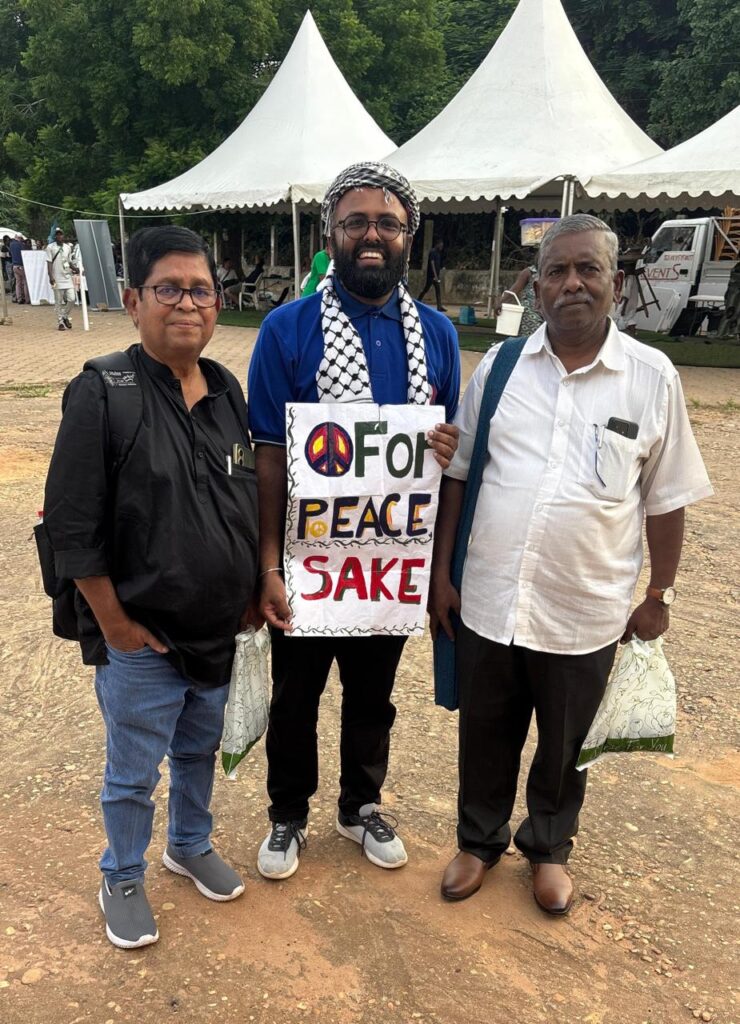
Ajit participated in PEACE 2026 at the World Social Forum from 4 to 8 August 2026 as a member of the Peace Builders Forum India delegation. The journey offered him a rare opportunity to move beyond the Indian experience and helped him enter a global space where activists, educators, traditional leaders, women, young people and grassroots organisations shared their experiences of building peace.
The Indian delegation included Gandhian P. V. Rajagopal, Shri Anil Hebbar, Indira Das Gupta Cherukuni, Ms. Priya Kadka, Dr. Ravichandran, Dr. Mani and Ajit Rajgopal. They were joined by Dr. Jill Carr-Harris, Aneesh Kumar, Jenmajay Singh, Vishwan Cherukuni and representatives of Peace Builders Forum India.
PEACE 2026 was a collaborative initiative organised by institutions and movements working for peace, nonviolence, social justice and inclusive development. Rethinking African Security, Home for Humanity, Ekta Parishad, Mahatma Gandhi Canadian Foundation, International Land Coalition, Gandhigram Rural Institute and Peace Builders Forum India jointly facilitated a series of workshops and conversations during the Forum meetings.
For Ajit, each workshop became a new window into the meaning of peace. He discovered that peace is not merely the absence of armed conflict. It is also the presence of justice, dignity, equality, cooperation and respect for the environment. Peace must be built within families, schools, communities, economies and institutions.
One of the most meaningful lessons came from discussions on local cultural and traditional values. Participants explained how indigenous knowledge, community dialogue and respected local institutions can help resolve disputes before they become violent. Ajit recognised that peacebuilding becomes more effective when it respects the history, identity and wisdom of local communities.
The sessions on women’s leadership highlighted how women often sustain families and communities during conflict, yet remain excluded from formal peace processes. Their courage and everyday leadership demonstrated that lasting peace cannot be achieved without women’s full and equal participation.
Youth leadership was another powerful theme. Young people are frequently described only as victims of violence or as potential troublemakers. At PEACE 2026, however, they were recognised as leaders, organisers and agents of nonviolent social change. Ajit saw how education, mentorship and international solidarity could equip young people to challenge injustice without hatred.
The workshops on peace education encouraged participants to introduce values such as empathy, dialogue, cooperation and nonviolent conflict resolution into schools, universities and community programmes. Discussions on inclusive economic development further showed that poverty, exclusion and exploitation can undermine peace. A peaceful society must therefore create livelihoods that promote social justice, environmental sustainability and the common good.
Ajit returned from Cotonou not simply as a participant who had attended an international event, but as a young peacebuilder with a wider vision. He carried with him new relationships, practical insights and a deeper commitment to working with marginalised communities.
Ajit also represents the North East Institute of Social Sciences and Research (NEISSR) and its emphasis on experiential social work education.
Ajit’s journey reminds us that peacebuilding begins when people are willing to listen across differences, learn from one another and act with courage. The World Social Forum gave him a global platform, but his real work begins at home—transforming international learning into local action and inspiring other young people to become builders of a more peaceful, just and inclusive world.
