
By Kumra Parameshwar, Project Executive, Nirmal Telangana
For generations, farming has been the backbone of life in Shethpalli village of Pembi Mandal. Most families are small and marginal farmers who depend entirely on agriculture and agricultural labour for their livelihood, though farming was not easy. Farmers managed to grow crops during the Kharif season using rainwater, cultivating crops during the Rabi season was a major challenge because water could not be lifted from open wells and borewells regularly.
Although many farmers had access to groundwater sources, they did not have a proper and affordable system to use the available water. Due to frequent power cuts, low voltage and damaged power lines caused falling trees and as such the electric irrigation did not work properly. Farmers often hired diesel generators to pump water, for which they invested more money in purchasing fuel, transportation, motor rentals, electricity bills and repair costs. In addition, voltage fluctuations frequently damaged electric motors, and farmers again spent money on repairs and paying technicians. They also had to irrigate fields late at night or early in the morning whenever electricity became available, which ultimately affected both their health and daily lives.
Along with reduced agricultural productivity, farmers were also discouraged from cultivating a rabi crop. Out of the group’s 13.15 acres, only 2 acres were cultivated during the previous Rabi season (2024-2025). The remaining land remained unused due to the absence of dependable irrigation. As a result, farming families earned only seasonal incomes despite investing heavily in seeds, fertilizers, pesticides and labour.
To overcome these challenges, Mouli Water Sharing Group was formed in Shethpalli village with five small and marginal farming families under the concept of shared irrigation and collective farming. The group manages 13.15 acres of agricultural land, cultivating crops such as maize and jowar. Recognizing their need, CYDA and HDFC Bank Parivartan installed a solar-based irrigation system after Gram Sabha consultations, field verification and technical assessments.
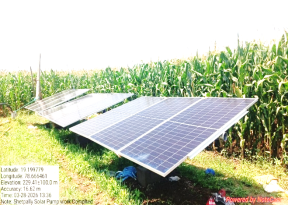
- Installation of 9 solar panels (575 Watts each)
- 5 HP solar motor, installation materials, transportation
- Complete technical support.
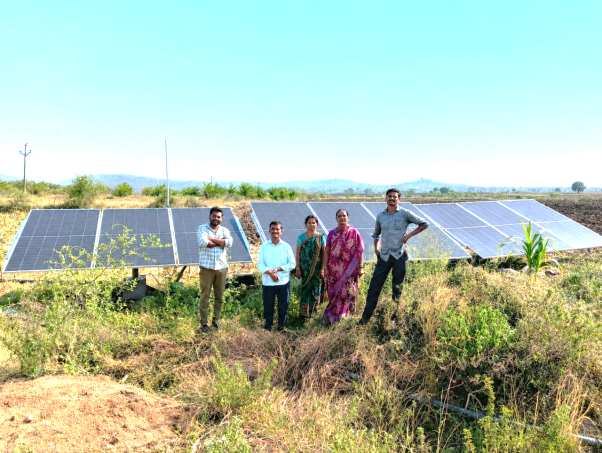
The solar irrigation system now provides reliable irrigation for nearly 5 acres of farmland shared by all five beneficiary families.
Thereafter, the farmers are no longer dependent on unreliable electricity or expensive diesel generators. Regular irrigation has improved crop health; especially during dry spells, crop productivity has increased by to 2–3 quintals per acre compared to the earlier average yield of 10 quintals per acre. On the other hand, farmers have regained the confidence to cultivate crops during the Rabi season.
| Impact of Solar Irrigation on Agricultural Productivity and Farmer Income – Based on Rabi season: 2024-25 to 2025-26 | ||||
| Particulars | Before Solar Irrigation (2024-25) | After Solar Irrigation (2025-26) | ||
| Crops | Maize | Jowar | Maize | Jowar |
| No of Farmers | 2 | 2 | 4 | 4 |
| Rabi Cultivated Area, Acers | 1 | 1 | 4 | 2 |
| Rabi Production, Quintal’s | 20 | 8 | 100 | 24 |
| Cost per Quintal (in Rupees) | 1900 | 3000 | 1900 | 3000 |
| Rabi Income, Rs. | 38000 | 24000 | 1,90,000 | 72,000 |
| Total Amount, Rs. | 62,000 | 2,62,000 | ||
The intervention has also reduced recurring farming expenses. Farmers no longer worry about electricity bills, diesel costs, motor rentals, transportation expenses or frequent motor repairs. Solar energy has made irrigation reliable, affordable, and easy to operate while requiring very little maintenance.
Women actively coordinate the distribution of irrigation water, prepare irrigation schedules, resolve issues through discussion and ensure fair sharing among all members. Their collective leadership strengthened cooperation and demonstrated the power of community-led resource management.
Today, the success of the Mouli Water Sharing Group extends beyond the five beneficiary families. Seeing the visible improvements in crop production and income, other farmers in the village have started exploring similar solar irrigation models. The intervention has promoted collective water management, improved livelihoods, encouraged sustainable agriculture and inspired the next generation of young farmers to adopt climate-friendly technologies.
Farmer’s Quote “Earlier, frequent power cuts created major difficulties for irrigation, and sometimes electricity was unavailable for two to three days. Because of this, crop cultivation became very difficult. After receiving the solar irrigation unit, we are able to irrigate our crops regularly without depending on electricity. The water-sharing concept is very useful because even farmers with less water access can now irrigate their fields properly. Our crop yields and income have improved, and we are very happy with this support.”
