
By Mathew Mattam
The right to vote is the foundation of every democracy. It is not merely an administrative privilege but a constitutional right available to every eligible Indian citizen who meets the legal requirements under Article 326 of the Constitution and the Representation of the People Act, 1950. It is therefore understandable that the Election Commission of India (ECI) periodically updates electoral rolls to remove duplicate, deceased, or ineligible entries and ensure that every eligible citizen can vote. The current Special Intensive Revision (SIR) of electoral rolls has become one of the most debated electoral exercises in recent years because it has raised difficult questions about documentation, citizenship, migration, and voter inclusion.
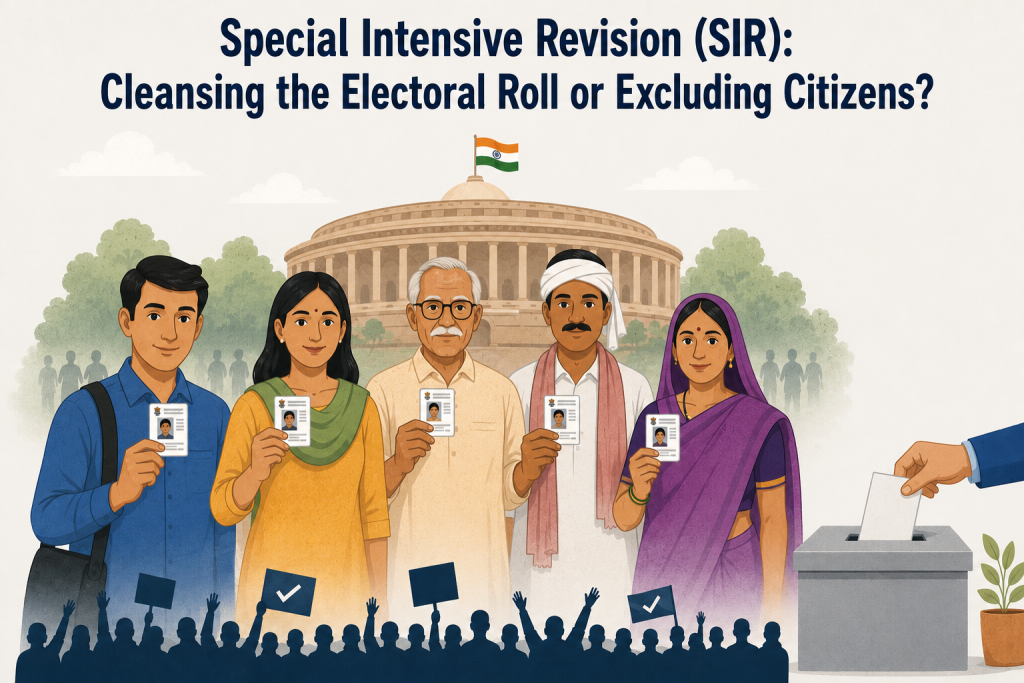
What is the Special Intensive Revision?
According to the Election Commission, the purpose of the SIR is to prepare an accurate electoral roll by identifying duplicate entries, deleting names of deceased or permanently shifted voters, enrolling newly eligible citizens, and ensuring that only eligible Indian citizens remain on the voter list. The Commission has explained that such an exercise became necessary because the last intensive revision in Bihar was conducted in 2003 and the State has experienced rapid urbanisation, migration, demographic change, and concerns about duplicate and ineligible entries.
The major features of the SIR include:
- House-to-house visits by Booth Level Officers (BLOs).
- Distribution and collection of Enumeration Forms.
- Verification of existing voter records.
- Removal of duplicate, deceased, and migrated voters.
- Collection of supporting documents where required.
- Preparation of revised electoral rolls.
On paper, these objectives are entirely reasonable. Every democracy requires an accurate voter list. The challenge arises when implementation creates uncertainty among genuine voters.
Why has the SIR become controversial?
The controversy does not lie in updating electoral rolls. It lies in the manner in which eligibility is being verified and the practical difficulties faced by millions of citizens.
Under the initial Bihar guidelines, electors whose names did not appear in the 2003 electoral roll were asked to furnish supporting government documents to establish their eligibility. This led to concerns because many citizens who have voted for years suddenly found themselves being asked to produce documentation linked to events that occurred more than two decades earlier.
Legal experts, civil society organisations, and political leaders questioned whether this shifted too much of the burden onto citizens, particularly those from poorer or more mobile backgrounds. Several petitions challenging aspects of the SIR were filed before the Supreme Court.
My Personal Experience
I experienced this uncertainty firsthand. On 26 July, I visited my Booth Level Officer to complete the revision process. After checking the records, the officer informed me that my name could not be traced in the 2002/2003 electoral list and therefore marked my form as “NL” (Not Linked).
This immediately raised an obvious question in my mind. I came to Pune in June 1986 as a student. Since then, Maharashtra has been my home. I completed my postgraduate studies and M.Phil. at Pune University. I purchased my first house in 1996. I shifted to my present residence in 2007. I founded an organisation in 1999 and spent twenty-five years working across Maharashtra before stepping down in 2024. Since then, I have established three non-profit organisations and five private limited companies. Most importantly, I have voted regularly, including in the 2019, 2024 Lok Sabha, 2024 Maharashtra Assembly, and 2025 local elections. Yet because my name could not immediately be linked with the 2003 roll, uncertainty arose regarding my continued inclusion.
I was asked whether my father had voted here in 2002. My answer was simple. My father never lived in Maharashtra. He lived in Kerala and passed away in 1989. How could his electoral history possibly determine my eligibility to vote in Maharashtra?
Documentation versus Citizenship.
This debate goes beyond electoral rolls. It raises a deeper constitutional question: How do we establish citizenship?
Indian citizenship is governed primarily by the Citizenship Act, 1955, while electoral eligibility depends on citizenship, age, and ordinary residence in a constituency. Electoral registration officers verify eligibility for inclusion on voter rolls; they do not determine citizenship in the same way as authorities administering the Citizenship Act.
For many older Indians, documentation itself presents a challenge. Birth certificates were not universally issued in the 1950s, 1960s, or even later in many rural parts of India. Thousands left school before completing Class X. Many elderly citizens possess no formal educational certificates. Women who changed residences after marriage often have fragmented documentation. Migrant workers frequently move between States in search of employment. Dalits, Adivasis, and economically weaker sections historically had limited access to schooling and documentation. If documentary requirements become too rigid without accommodating these realities, there is a risk that genuine citizens may face practical barriers in proving their eligibility.
The Challenge of Internal Migration
India is a nation of internal migrants. Millions leave their native villages to study, work, or settle permanently in other States. Their constitutional rights travel with them.
Ordinary residence—not place of birth alone—is central to electoral registration under Indian law. Students, professionals, labourers, and entrepreneurs who have made another State their home are entitled to seek enrolment where they ordinarily reside, provided they meet the legal requirements.
Administrative processes should therefore take into account the realities of internal migration while maintaining the integrity of the electoral roll.
Public Concerns
Political scientist and activist Yogendra Yadav, one of the petitioners challenging aspects of the SIR before the Supreme Court, argued that large numbers of voters risked exclusion because of documentation-related issues and criticised what he described as an unprecedented burden on citizens to establish eligibility.
At the same time, the Election Commission has consistently maintained that the objective of the exercise is not to disenfranchise eligible citizens, but to produce accurate electoral rolls by removing duplicate, deceased, shifted, or otherwise ineligible entries while ensuring that all eligible voters are included. These two perspectives illustrate why the issue has generated such intense public debate.
The Way Forward
There should be broad agreement on one principle: India needs accurate electoral rolls. No democracy benefits from duplicate, deceased, or fraudulent entries. At the same time, no democracy should inadvertently exclude genuine citizens because they cannot easily produce documents dating back decades or because of administrative gaps.
A fair electoral revision should therefore be guided by four principles:
- Accuracy, by removing duplicate and ineligible entries.
- Inclusion, by ensuring every eligible citizen has a reasonable opportunity to remain registered.
- Transparency, through clear procedures, accessible information, and avenues for correction and appeal.
- Sensitivity, particularly towards senior citizens, migrants, economically weaker sections, and historically disadvantaged communities.
The success of any Special Intensive Revision should ultimately be measured not only by how many names are deleted, but by how effectively it protects the voting rights of every eligible Indian citizen while preserving the integrity of the electoral process. In a democracy, the goal of electoral revision should always be to strengthen public confidence—ensuring that every eligible citizen can vote and that every vote rests on an accurate and trustworthy electoral roll.

This Post Has One Comment
The same experience applies to my family as well. Although several generations of my family have lived in Pune and have faithfully voted in every election, none of their records could be traced in the voter list. It was a deeply frustrating and disappointing experience for them.