
By Soumyashree Mohanty, CYDA
The Constitution of India promises every citizen equality, dignity, and the right to live without discrimination. But do we truly experience that equality in our everyday lives?
For many people from marginalized communities, the answer is still No. Sometimes discrimination is direct and visible. At other times, it is subtle. It appears in everyday conversations, social practices, and the way people are treated because of their caste.
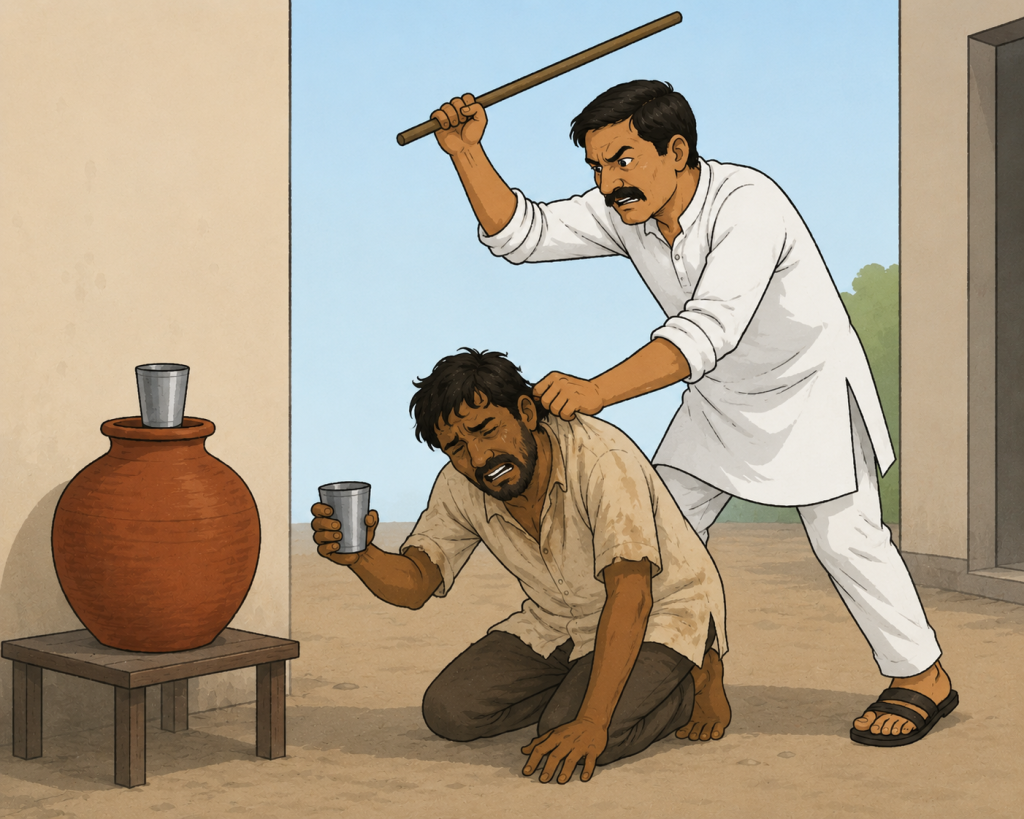
Recently, a Dalit labourer from Uttar Pradesh was allegedly assaulted after he asked for water at a clinic. He had gone there to buy medicine for a headache. When he touched the vessel placed outside the clinic, a nearby shopkeeper allegedly attacked him with a stick, saying that he had polluted it because of his caste. The man was also threatened with death. An FIR has been registered, but the larger question remains: why do such incidents continue to happen? Sadly, this is not an isolated case.
A 16-year-old Dalit boy in Kanpur was allegedly stripped, beaten, and abused with caste slurs after drinking water from a public hand pump. He was accused of polluting the water because of his caste. In Odisha, a Dalit woman working as an Anganwadi cook alleged that some parents refused to let their children eat the food she prepared because she belonged to a Scheduled Caste.
These incidents may appear to be isolated acts of violence. In reality, they reflect a much deeper social pattern. Water, food, and public spaces become sites where caste boundaries are enforced. Caste discrimination is often discussed only when a violent incident makes the news. Yet, for many people, it is experienced in ordinary moments like renting a house, applying for a job, entering a temple, sharing a meal, or even introducing themselves. These experiences show that caste is not merely an identity or a historical issue. It continues to shape access, opportunities, dignity, and everyday social relations.
Dr B. R. Ambedkar described caste as a system of graded inequality. According to him, caste does not simply divide society into different groups. It ranks people in a hierarchy, giving dignity, privilege, and power to some while denying them to others. Ideas of purity and pollution have historically been used to justify this unequal treatment. Although Article 17 of the Constitution abolished untouchability and the law guarantees equality, these beliefs continue to influence social behaviour in many places.
But why does caste continue despite decades of social reform, education, and legal protection?
Sociologist M. N. Srinivas argued that caste does not disappear; it adapts. It changes with time but continues to shape social relations. Today, caste may not always appear in the same form as it did decades ago, yet it continues to influence marriage, social networks, political identities, and everyday interactions. It often appears in everyday practices that seem ordinary but continue to reinforce social hierarchies.
Think about how often people ask, “What is your surname?” Sometimes it is simply a way of knowing someone’s full name. But in many social settings surnames also reveal caste. The question, therefore, can become a way of placing a person within a social hierarchy before knowing them as an individual. These interactions may seem harmless, yet they often influence how people are perceived and treated.
French sociologist Pierre Bourdieu helps us understand this through the idea of symbolic violence. He argued that inequality is sustained not only through physical force but also through everyday beliefs and practices that make unequal treatment appear natural. Over time, discrimination becomes so normalized that people begin to see it as tradition, culture, or simply “the way things are,” rather than as injustice.
It is equally important to acknowledge that India has made significant progress. Dalits today enjoy constitutional rights that were once denied to them. They can access education, participate in public life, vote, and seek legal protection against discrimination. Social reformers, constitutional safeguards, and people’s movements have challenged caste discrimination and brought about important changes.
Yet these recent incidents remind us that legal equality does not automatically become social equality. Caste continues to shape everyday experiences in both visible and invisible ways.
Perhaps the real challenge today is not whether caste exists. The evidence tells us that it does. The challenge is whether we are willing to recognize the subtle ways in which it operates and question the everyday practices that continue to keep social hierarchies alive. Equality cannot be achieved through laws alone. It also depends on changing the beliefs, attitudes, and everyday practices through which inequality is reproduced. Until that happens, constitutional equality will remain an aspiration for many rather than a reality.

This Post Has 2 Comments
Very true. Legislation alone does not change mindsets. Even today, we continue to witness not only caste-based discrimination but also gender-based discrimination.
The real need is a change in our mindset and behaviour.
Very well written, and thank you for highlighting this important issue.
Very well written. Such an important topic to talk about! Systemic change is the need of the hour!