
By Pramodini Naik, Assistant Director, CYDA
Artificial Intelligence (AI) is no longer a technology of the future—it is already transforming the present world of work. From banks using AI chatbots to factories using smart robots and schools using AI-based learning tools, the impact of AI is visible across every sector. The rise of Generative AI tools such as OpenAI’s ChatGPT, AI-powered automation, and machine learning systems has created both excitement and fear. While some experts believe AI will create millions of new jobs, others warn that it may replace many traditional occupations, especially low-skill and repetitive work.
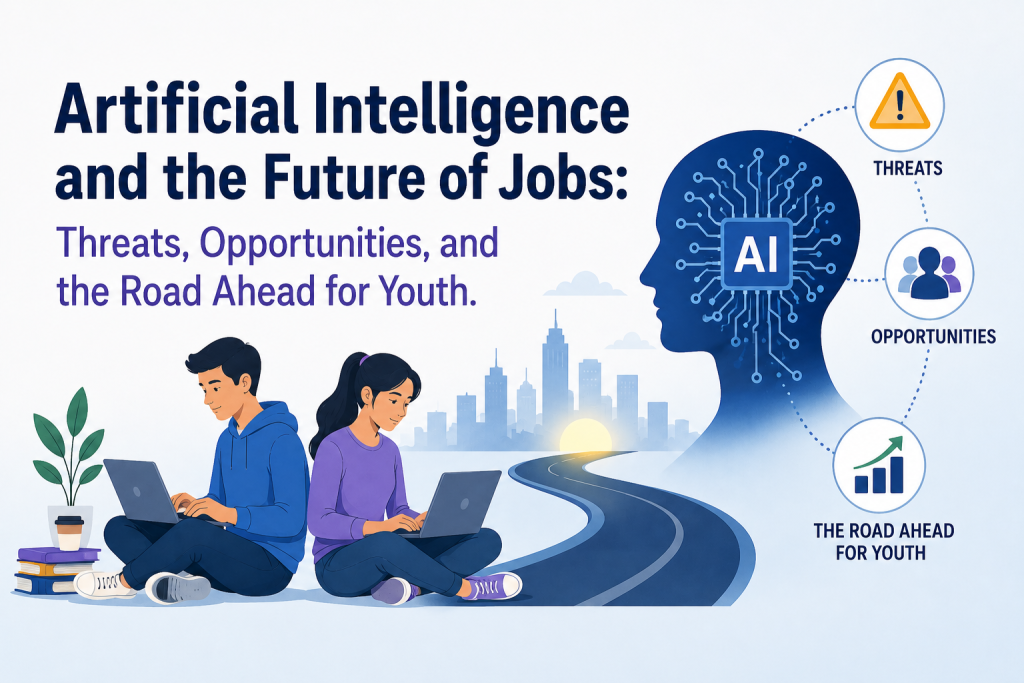
For marginalized and underprivileged youth, this transformation presents both a challenge and a historic opportunity. Those who gain the right skills can become part of the future workforce, while those without access to education, technology, and training may face deeper unemployment and inequality.
The Global Impact of AI on Employment
According to the International Labour Organization (ILO), AI is more likely to “augment” jobs rather than completely eliminate them. This means AI will change how people work instead of replacing all workers entirely. However, the impact will not be equal across all sectors and countries. A joint report by the ILO and the World Bank warns that developing countries may experience disruption before they experience economic benefits because of digital inequality and lack of workforce preparedness. The International Monetary Fund (IMF) estimates that AI could affect nearly 40% of jobs globally, while advanced economies may see impacts on nearly 60% of occupations.
At the same time, the World Economic Forum predicts that by 2030, AI and automation may displace around 92 million jobs but could also create nearly 170 million new roles, leading to a net increase in employment opportunities.
This shows that AI is not simply “destroying jobs”; rather, it is restructuring the labor market.
| Jobs Most at Risk from AI | New Jobs Being Created by AI | Opportunities for Underprivileged Youth |
| Data Entry Operators | AI Specialists | Remote freelance work |
| Tele callers & Customer Support | Data Analysts | Digital entrepreneurship |
| Cashiers & Retail Billing Staff | Cybersecurity Experts | Online learning opportunities |
| Manufacturing, Factory Workers | AI Trainers & Prompt Engineers | Work-from-home jobs |
| Basic Accounting, Clerical jobs | Digital Marketing Professionals | Access to global job markets |
| Routine IT Support Jobs | Robotics & Automation Technicians | Affordable skill development |
| Typists & Documentation Work | Content Creators & AI Reviewers | E-commerce and small business growth |
AI is especially replacing repetitive and rule-based jobs. Chatbots can answer customer queries, software can manage accounts, and machines can handle manufacturing tasks faster than humans. Low-skill and repetitive jobs are therefore at greater risk. However, AI cannot easily replace human creativity, empathy, communication, and critical thinking. Careers in healthcare, teaching, social work, counseling, design, and leadership will continue to require human involvement.
For underprivileged youth, AI can become a powerful tool for empowerment. A young person from a rural or low-income community can now access online learning, freelance work, and digital entrepreneurship through a smartphone and internet connection. AI tools are reducing barriers by making education and skill-building more accessible and affordable. Youth no longer need to migrate to big cities to earn opportunities; digital platforms now connect them directly to national and global markets.
However, the rise of AI also brings serious threats. The biggest challenge is the digital divide. Millions of youths still lack access to computers, smartphones, stable internet, and digital education. Without these basic resources, marginalized communities may be excluded from future employment opportunities. Another concern is the mismatch between education and industry needs. Many education systems still focus on memorization rather than practical skills, problem-solving, and digital literacy. As a result, many graduates remain unemployed despite having degrees.
Skills Youth Must Develop for the Future Job Market
To survive and grow in the future job market, youth must develop both digital and human skills. Basic computer literacy, AI awareness, communication skills, data handling, and digital marketing are becoming essential. At the same time, skills such as creativity, teamwork, leadership, emotional intelligence, and critical thinking will become even more valuable because these are difficult for machines to replace. Continuous learning and adaptability will be the most important qualities in the AI era.
Governments, NGOs, and educational institutions have a major responsibility in this transition. They must invest in digital infrastructure, affordable internet access, vocational education, AI literacy, career guidance and skill development programs for disadvantaged youth. NGOs working with adolescents and rural communities play a major role in promoting employability skills, digital education, and entrepreneurship development. Schools and colleges must redesign their curriculum to prepare students for emerging industries instead of outdated job roles.
Conclusion
Artificial Intelligence is neither a complete threat nor an entirely opportunity—it is a transformational force. Some jobs will disappear, many jobs will change, and new professions will emerge. The real challenge is whether society can prepare its youth for this transition.
For marginalized and underprivileged youth, the future depends on access: access to education, digital tools, training, mentorship, and opportunities. If inclusive policies and skill-building programs are implemented effectively, AI can become a tool for social mobility and economic empowerment rather than exclusion. The future workforce will not be defined only by technology, but by the ability of human beings to adapt, collaborate, think critically, and continue learning in an AI-driven world.
References
