
By Somnath Dabhade, Assistant Director CYDA
Water has always been the foundation of civilization. Every city, industry, village, and agricultural system depends upon a reliable supply of water for survival and growth. Pune, one of Maharashtra’s fastest-growing metropolitan regions, has long been considered fortunate because of its remarkable network of dams and reservoirs located in the Western Ghats. These water resources supported the city’s growth for decades while also serving agriculture and rural communities in surrounding areas.
Notably, Pune city holds the extraordinary distinction of being surrounded by one of the highest concentrations of dams and reservoirs in the world often cited as the region with the world’s largest density of dams around a single urban centre. This unique hydrological wealth has for centuries been both a blessing and a growing responsibility, as every drop stored within these structures must serve competing demands of a rapidly expanding metropolis and the farming heartland that surrounds it. Ironically, Pune is located in one of the most water-rich regions of Maharashtra. Few cities in India are surrounded by such a large concentration of major dams and reservoirs. The Pune region benefits from a network of reservoirs including Panshet, Varasgaon, Temghar, Khadakwasla, Mulshi, Pavana, Chaskaman, Andra, Kasarsai and several smaller water bodies. This unique geography has enabled Pune’s growth for decades while supporting agriculture, industries, and rural communities.
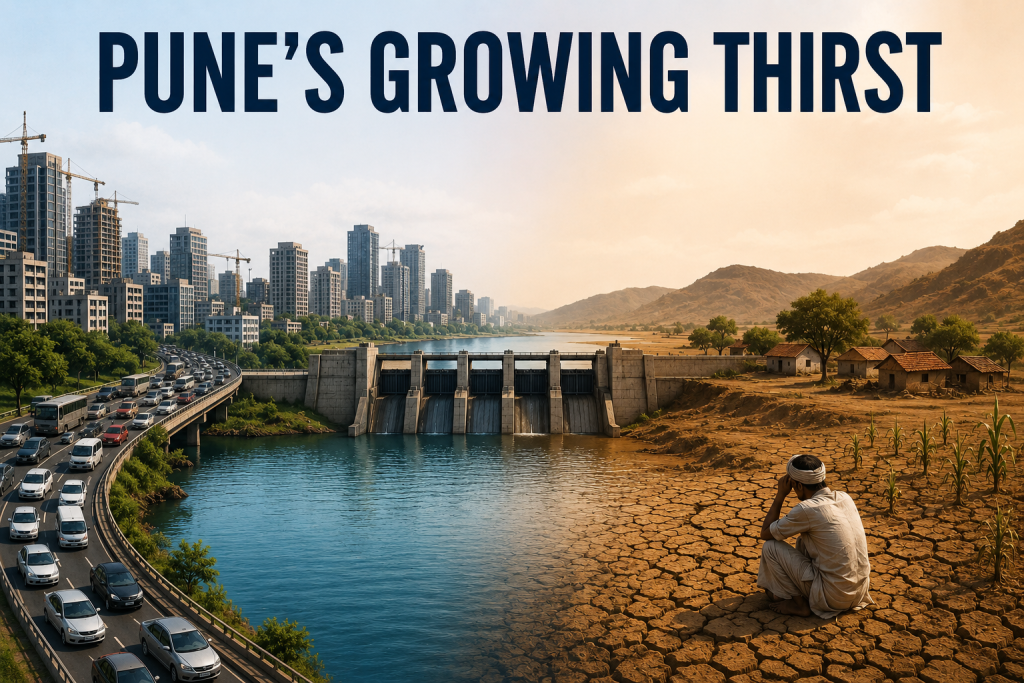
However, the existence of numerous dams does not automatically guarantee water security. The real challenge is whether the available water can continue to support a rapidly growing city while also sustaining agriculture, groundwater reserves, and environmental ecosystems.
Pune is uniquely positioned at the epicentre of India’s dam network a city encircled by the world’s largest density of dams. Yet paradoxically, it now faces its most serious water challenge in modern history.
However, Pune today stands at a critical crossroads. The city is experiencing unprecedented urbanisation, population growth, industrial expansion, and infrastructure development. New residential townships, IT parks, manufacturing zones, highways, educational institutions, hospitals, and commercial complexes are emerging at a pace never seen before. While this growth has transformed Pune into an economic powerhouse, it has also dramatically increased the demand for water.
The challenge facing Pune is no longer simply about providing drinking water to a growing population. It is about balancing the needs of urban development, industrial expansion, environmental sustainability, and agricultural livelihoods. The growing competition for water resources raises an urgent question: Can Pune continue to grow at its current pace without triggering a severe water crisis that will devastate agriculture and rural communities?
This article examines the increasing water demand in Pune, the role of major reservoirs, the impact of urbanisation and real estate development, the direct implications for agriculture and rural communities, and the urgent measures required to ensure long-term water security.
The warning signs are already visible. Seasonal water shortages, declining groundwater levels, increasing competition between urban and rural users, and changing climate patterns all suggest that Pune may face significant water stress in the coming decades if corrective measures are not taken.
Pune’s Water Wealth
Pune’s primary water supply comes from a network of reservoirs located in the Western Ghats.
Major Reservoirs Influencing Pune’s Water Security
| Reservoir | Storage Capacity (TMC) |
| Panshet Dam | 10.65 |
| Varasgaon Dam | 12.82 |
| Temghar Dam | 3.71 |
| Khadakwasla Dam | 1.97 |
| Mulshi Dam | 18.47 |
| Pavana Dam | 8.51 |
| Chaskaman Dam | 10.96 |
| Total Capacity | 67.09 |
The Khadakwasla system comprising Panshet, Varasgaon, Temghar, and Khadakwasla provides the backbone of Pune’s municipal water supply. Mulshi, Pavana, and Chaskaman contribute significantly to the broader regional water balance.
Together, these reservoirs represent one of Maharashtra’s largest concentrations of freshwater storage around a metropolitan region.
This abundance helped Pune become one of India’s most successful urban centers. However, increasing demand is gradually eroding the margin of safety these reservoirs once provided.
From a Small City to a Mega Metropolitan Region
A few decades ago, Pune was known as the “Pensioners’ Paradise.” It was admired for its educational institutions, military establishments, pleasant weather, and manageable population.
The economic reforms of the 1990s transformed Pune dramatically. The city emerged as a center for information technology, automobile manufacturing, engineering, pharmaceuticals, education, and services.
Today, the Pune Metropolitan Region is among India’s fastest-growing urban agglomerations.
The population has increased from less than three million people a few decades ago to more than seven million today. Experts estimate that Pune’s population could exceed ten million by 2047.
Every additional resident requires water for drinking, cooking, bathing, sanitation, and daily activities. Consequently, water demand has increased exponentially.
Pune currently consumes approximately 1,650–1,800 million liters of water every day. Future projections indicate that daily demand could exceed 2,500 million liters by 2047.
The Real Estate Revolution: A New Driver of Water Demand
One of the most significant reasons for rising water demand is the unprecedented growth of real estate projects.
Areas such as:
- Hinjawadi
- Wakad
- Baner
- Balewadi
- Kharadi
- Wagholi
- Hadapsar
- Ravet
- Tathawade
- Moshi
- Undri
- Pisoli
- Mahalunge
have transformed from villages and agricultural landscapes into dense urban centers.
Thousands of acres of farmland have been converted into residential townships, IT parks, warehouses, commercial complexes, and industrial estates.
Modern townships consume enormous quantities of water. Water is required not only for drinking and sanitation but also for:
- Landscaped gardens
- Clubhouses
- Swimming pools
- Recreational facilities
- Commercial establishments
- Cooling systems
- Maintenance operations
A single large residential township may consume more water in a day than several nearby villages combined.
As hundreds of such projects continue to emerge, Pune’s overall water demand is increasing at an unprecedented pace.
When Concrete Replaces Soil
Urbanization changes more than just the skyline. Agricultural land and open spaces naturally absorb rainwater, allowing it to infiltrate the soil and recharge groundwater reserves. When these lands are replaced by roads, buildings, parking areas, and concrete surfaces, natural groundwater recharge declines. As Pune expands, less rainwater enters the ground while more groundwater is extracted through borewells. This creates a dangerous imbalance. Many areas that once had shallow groundwater now require deeper borewells. The cost of accessing water continues to increase for both farmers and urban residents.
Agriculture: The Silent Loser in Pune’s Water Story
Perhaps the most overlooked consequence of Pune’s rapid growth is its impact on agriculture. When many of Pune’s major dams were planned and constructed, their primary objective was not solely urban drinking water supply. These projects were designed to support irrigation, agricultural development, rural livelihoods, and regional economic growth. At that time, Pune was a relatively small city. Agriculture formed the backbone of the local economy. Water stored in reservoirs was expected to improve irrigation coverage, increase crop productivity, and strengthen rural prosperity. Reservoirs such as Panshet, Varasgaon, Temghar, Mulshi, Pavana, and other dams were envisioned as engines of agricultural development. However, the priorities have changed dramatically. As Pune’s population expanded and urban demand increased, a growing share of reservoir storage began to be allocated for drinking water supply. Today, during years of water scarcity, urban drinking water understandably receives priority. Irrigation releases are often reduced, delayed, or restricted to preserve water for municipal consumption. This represents a fundamental shift in the purpose of these reservoirs.
The consequences for farmers are significant:
- Reduced irrigation availability.
- Increased dependence on groundwater.
- Higher cultivation costs.
- Greater uncertainty in crop planning.
- Increased vulnerability to drought.
- Reduced agricultural productivity.
The irony is striking. Pune is surrounded by one of India’s highest concentrations of major dams and reservoirs, yet farmers increasingly face uncertainty regarding water availability. Agriculture is gradually becoming the silent loser in the competition for water.
Groundwater: The Hidden Crisis
Groundwater has traditionally served as a buffer during periods of water scarcity. However, increasing extraction by residential societies, industries, commercial establishments, and agriculture is placing immense pressure on aquifers. At the same time, urbanization is reducing groundwater recharge. The result is a steady decline in groundwater levels across many parts of Pune district. Farmers often have no option but to invest in deeper borewells, increasing production costs and financial risks. Groundwater depletion is particularly concerning because aquifers require many years to recover.
Climate Change: The Great Multiplier
Climate change is expected to intensify Pune’s water challenges. The city’s reservoirs depend heavily on monsoon rainfall in the Western Ghats.
Scientists predict:
- More erratic rainfall patterns.
- Delayed monsoons.
- Longer dry spells.
- Increased temperatures.
- Higher evaporation losses.
- More extreme weather events.
Even when annual rainfall remains normal, intense rainfall events often lead to rapid runoff rather than groundwater recharge. This means that regions may experience floods during one season and water scarcity during another. For farmers, such unpredictability creates major challenges in crop planning and irrigation management.
Water Losses: The Invisible Waste
Before seeking additional water sources, Pune must address inefficiencies within its existing system. Large quantities of treated water are lost due to:
- Aging pipelines.
- Leakage.
- Illegal connections.
- Distribution inefficiencies.
Every liter lost through leakage represents water that has already been stored, treated, and transported at considerable expense. Reducing water losses may provide one of the most cost-effective solutions to Pune’s future water needs.
Future Risks
If current trends continue, Pune may face:
Increased Competition Between Cities and Farmers
Urban areas may increasingly require water that was historically used for agriculture.
Rising Water Costs
Both urban residents and farmers may face increasing water demand.
Groundwater Collapse
Continued over-extraction may lead to severe groundwater depletion.
Food Security Challenges
Reduced irrigation can affect agricultural productivity and regional food systems.
Environmental Damage
Rivers and natural ecosystems may suffer from excessive water withdrawals.
The Way Forward
Pune’s future water security depends on proactive action.
Mandatory Rainwater Harvesting
Every building, industry, institution, and housing society should harvest rainwater.
Wastewater Recycling
Treated wastewater should be reused for industries, landscaping, construction, and non-potable purposes.
Sustainable Urban Planning
Future projects should receive approval only after demonstrating long-term water sustainability.
Groundwater Recharge
Recharge wells, ponds, wetlands, and open spaces should be protected and expanded.
Water-Efficient Agriculture
Farmers should receive support for drip irrigation, micro-irrigation, and climate-smart agricultural practices.
Modernization of Water Infrastructure
Leak detection and pipeline upgrades can save millions of litres of water daily.
Public Participation
Citizens must recognize that water conservation is not merely desirable—it is essential.
Conclusion
Pune’s future prosperity depends on how wisely it manages its water resources today. The city enjoys a unique advantage, being surrounded by one of India’s largest concentrations of dams and reservoirs. Yet abundance should not be mistaken for security.
The most significant transformation in Pune’s water story is the changing purpose of its reservoirs. Many dams were originally constructed with irrigation and agricultural development as key objectives. Today, an increasing share of their storage is effectively reserved for the urban drinking water supply.
Population growth, real estate expansion, industrialization, groundwater depletion, and climate change are steadily increasing pressure on available water resources.
The challenge before Pune is not choosing between cities and farmers. The challenge is ensuring that both can thrive.
Future urban growth must be accompanied by strict water conservation, rainwater harvesting, wastewater recycling, groundwater recharge, and responsible planning. Otherwise, farmers may continue to bear the hidden cost of urbanization through reduced access to water that was once intended to support agricultural prosperity.
Water is not merely a resource. It is the foundation of agriculture, food security, economic growth, environmental sustainability, and human well-being. The decisions made today will determine whether Pune becomes a model of sustainable development or a warning of the consequences of ignoring nature’s limits.

This Post Has One Comment
Thanks, Somnath for writing on current burning issue of water scarcity which every citizen facing in the city. Your article clearly indicates that the gravity of the issue is going to increase in future as well. A political will is a major missing link here! Thanks!