
By Dr. Nitin Jadhav and Ms. Bhagyashree Panghanti, CYDA India
CYDA has been actively promoting Menstrual Health Management (MHM) through awareness campaigns, training programmes, and community outreach activities, particularly among adolescents and underserved communities. To better understand people’s knowledge, perceptions, and practices related to menstrual health, a study was conducted. The study aimed to identify gaps in awareness, reduce stigma around menstruation, and encourage informed and healthy menstrual hygiene practices.
This study goes beyond awareness messaging. It represents an effort to understand the real experiences, behaviors, and challenges women face in managing menstrual pain. By collecting data directly from communities across different regions, the study aims to contribute to more evidence-based interventions, ensuring that menstrual health initiatives address not only hygiene but also pain management, awareness gaps, and social barriers.
Scope, objectives and methodology
This study was conducted to understand how women experience menstrual pain, how they manage it, and what factors influence their decisions around treatment. The focus was not only on the medical aspect of pain, but also on awareness, behavior, and social influences.
The survey covered 156 women across seven states ( Maharashtra, Uttarakhand, Jammu and Kashmir, Chhattisgarh, Goa, Madhye Pradesh, Karanataka, Guajarat, Tamil Nadu. Punjab, Kearala, Anadhra Pradesh, Telangana, Odisha, Delhi, Jharkhand, Harayana) and multiple districts, including participants from urban, rural, and semi-urban areas. The objective was to capture a diverse picture of menstrual health experiences across different age groups, marital statuses, and socio-economic backgrounds.
A structured questionnaire was used to collect information on menstrual patterns, pain frequency and intensity, treatment practices, awareness about medicines, and socio-cultural factors such as family influence and communication barriers. The study follows a cross-sectional descriptive approach, using self-reported data to identify patterns and gaps in menstrual pain management.
A common experience that is regularly overlooked
Menstrual pain is one of the most widely experienced health conditions among women, yet it remains one of the least discussed and managed issues in everyday life. Findings from this study clearly show that while menstrual pain is extremely common, the way it is understood and treated reflects deeper gaps in awareness, behavior, and social attitudes.
The most striking finding is that 87.2 percent of women reported experiencing menstrual pain. This confirms that pain is not an exception but the norm. However, what makes this issue more significant is not just how many women experience pain, but how often they go through it. A large proportion of women reported that pain occurs every month or frequently across cycles. This means menstrual pain is not a one-time discomfort but a repeated monthly experience that becomes part of normal life.
Over time, this repeated exposure leads women to adjust their routines around pain. Instead of addressing it directly, they learn to live with it, often planning their daily activities with the expectation that pain will occur.
Across age groups and locations
The study mainly includes women in younger age groups, as well as both married and unmarried participants. This shows that menstrual pain affects women across different life stages.
For younger women, it affects education and early work life. For married women, it adds to household responsibilities. The inclusion of urban, rural, and semi-urban populations also shows that while access may differ, awareness and social attitudes remain important factors in all contexts.
Impact on daily functioning
The data shows that 81.4 percent of women experience disruption in their daily activities due to menstrual pain. This disruption may not always be severe, but it is consistent and widespread. It affects multiple areas of life.
For students, it may reduce concentration or lead to missed classes. For working women, it can result in lower productivity. For homemakers, it can make routine work more difficult. Because this happens regularly every month, even moderate disruption creates a continuous impact on overall efficiency and well-being.
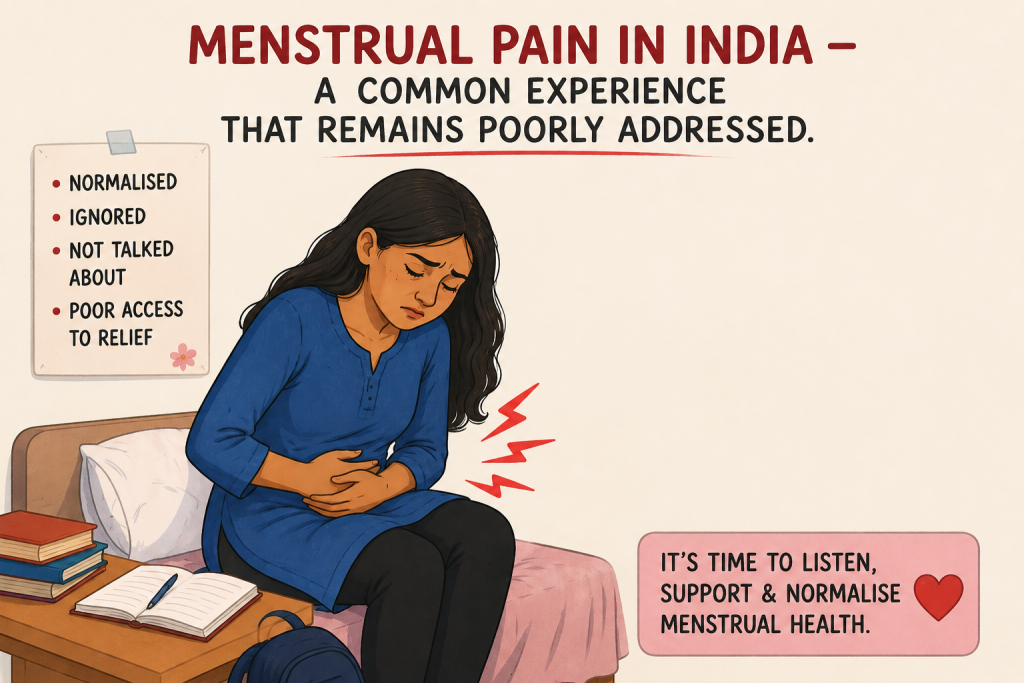
What is important here is that these effects are rarely reported or discussed as a health issue. Instead, they are normalized and accepted, which prevents them from being treated seriously.
The gap between pain and treatment
One of the most important insights from the study is the large gap between experiencing pain and taking treatment. Even though almost all women report pain, 57.7 percent do not take any medicine at all, and only a small proportion use medicines regularly. In addition, 71.2 percent of women have never consulted a doctor for menstrual pain.
This shows that menstrual pain is largely managed without medical attention. Women continue their daily lives while dealing with discomfort, often without seeking proper relief. This is not because the pain is mild. Many women report moderate to severe intensity. Yet, treatment remains low.
Awareness, not access, is the main barrier
At first, it may seem that a lack of access to medicines or healthcare is the main problem. However, the findings show that this is not entirely the case. More than half of the respondents reported that medicines are easily available.
This shifts the focus to awareness and perception. The study shows that 55.1 percent of women say they do not know enough about pain-relief medicines. At the same time, 66.7 percent have heard myths suggesting that medicines may cause harm or infertility.
These beliefs create hesitation. Women experience pain, but they are unsure about the safety of treatment. As a result, they choose to avoid medicines and continue with untreated pain. At the same time, the data shows that 76.2 percent of women would consider using medicines if they were assured of their safety. This indicates that the barrier is not resistance, but uncertainty.
Reliance on coping methods instead of treatment
Because many women avoid medicines, they turn to alternatives like heat therapy, rest, or home remedies. The study shows that 57.7 percent of respondents use hot water bags or similar methods.
These methods do provide some relief, especially in mild cases. However, they are often not sufficient for stronger pain. This suggests that women are relying on coping strategies rather than effective treatment. This behavior shows adaptation. Women find ways to manage pain without challenging the reasons behind avoiding treatment.
Silence and social influence
Another important finding is the lack of open communication around menstruation. About 50.6 percent of women report difficulty in discussing menstrual pain openly. When discussions are limited, correct information does not spread easily. Myths continue, and women hesitate to ask for help. This keeps menstrual pain a private issue, even though it affects a large number of people.
Family influence also plays a role. While many respondents reported some awareness among family members, including men, there are cases where women are discouraged from using medicines. This shows that decisions are influenced not only by individual knowledge but also by family beliefs and social norms.
Conclusion
The findings of this study show that menstrual pain is common, repeated, and impactful, yet it remains poorly addressed. The main issue is not just the presence of pain, but the lack of action taken to manage it effectively. The gap between pain and treatment is mainly driven by lack of awareness, myths, and social silence. Women are not avoiding treatment because they do not need it, but because they are unsure or discouraged. At the same time, the willingness to adopt treatment if provided with the correct information shows that the situation can be improved. Addressing menstrual health requires not only access to medicines but also better awareness, open communication, and supportive environments. Changing how menstrual pain is understood is essential. When women move from accepting pain to managing it, the impact of this condition can be significantly reduced — improving both their daily lives and overall well-being.
