
By ImpactLens Correspondent
India’s fuel policy is changing. The government is now allowing the use of higher ethanol blends such as E85, where fuel contains 85 percent ethanol and 15 percent petrol. At present, India is using E20 fuel, which contains 20 percent ethanol and 80 percent petrol. But why is India moving in this direction? Let us understand.
Why India is Promoting Ethanol
One of the major reasons is to reduce dependence on crude oil. India imports a large share of its fuel. By increasing ethanol blending, the country can reduce this dependence. Another reason is energy security. If ethanol is produced within the country, it can support a more self-reliant system. Ethanol is also seen as a cleaner fuel. Compared to petrol, it produces lower carbon emissions and supports environmental goals.
Progress of Ethanol Blending in India
India started the Ethanol Blending Programme in 2003. In the early years, progress was slow. By 2014, ethanol blending was only about 1.5 percent. After policy support and reforms, the pace increased. India achieved 10 percent blending by 2022. The rollout of 20 percent blending began in 2023 and expanded across the country by 2025. The target of E20, which was earlier set for 2030 was achieved much earlier.
The Hidden Cost: Water Use
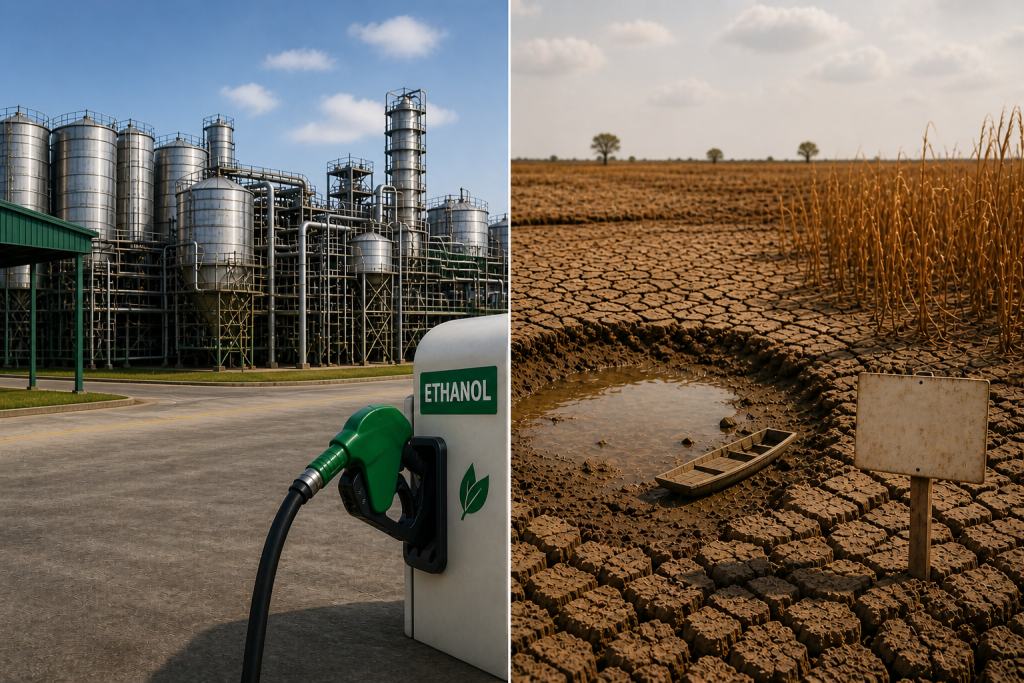
However, there is another side to this development that needs attention. Ethanol is mainly produced from crops like sugarcane, rice, and maize. These crops require a large amount of water. According to a report published in India Today, producing one litre of ethanol from rice requires around 10,000 litres of water. Most of this water is used during crop cultivation. Growing one kilogram of rice itself requires about 3,000 to 5,000 litres of water. Since around 2.5 to 3 kilograms of rice are needed to produce one litre of ethanol, the total water use becomes very high. The report further mentioned that in comparison, maize requires around 4,670 litres of water per litre of ethanol, and sugarcane requires around 3,630 litres. This shows that ethanol production, especially from rice, can put pressure on water resources.
This raises serious concerns for a country like India, where water scarcity is already a challenge. According to a NITI Aayog report, by 2030 about 40% of India’s population may face difficulties accessing drinking water. Irregular rainfall and falling groundwater levels are already creating stress in many regions. At the same time, the increased use of crops like rice and sugarcane for ethanol production can put pressure on water resources.
Impact on Food Security and PDS
Another important issue is related to food security. To support ethanol production, the government has proposed reducing the share of broken rice distributed through the Public Distribution System (PDS) from 25 percent to 10 percent. The saved quantity is planned to be diverted for ethanol production. This raises questions about the impact on low-income households that depend on subsidized food.
Wastewater Pollution from Ethanol Production
Ethanol mills produce a large amount of wastewater during the production process. This wastewater, known as vinasse, contains high levels of organic matter and chemicals. According to Om Prakash, Editor of Kisan Tak, “Ethanol mills also generate large volumes of wastewater (vinasse), which can pollute surface and groundwater if not treated properly.”
The government views ethanol blending as a strategic and environmentally beneficial solution. It helps reduce dependence on imported fuel and can lower emissions. However, experts have raised concerns. They point out that producing ethanol from water-intensive crops like rice and sugarcane may increase pressure on water resources. In many regions, water levels are already under stress. Expanding such crops for ethanol production could worsen the existing water crisis and affect long-term sustainability.
India’s move towards energy self-reliance is important, but it is equally necessary to consider these wider impacts. A balanced and careful approach is needed. Policies must ensure that ethanol production does not put excessive pressure on water resources or affect food distribution systems. A solution in one sector should not create new problems in another.Long-term planning should focus on sustainable practices, alternative raw materials, and efficient water use.
