
By ImpactLens Correspondent
India is building roads at an extraordinary pace. Expressways are shortening travel time, highways are becoming wider, vehicles are becoming faster, and personal mobility is expanding into towns and villages that only a generation ago depended largely on walking, cycling and public transport. Yet behind this story of infrastructure progress lies another India—one where a journey to work, school, a market or a hospital can end in death or lifelong disability.
The Road Safety in India: Status Report 2023, prepared by Geetam Tiwari, Rahul Goel and Kavi Bhalla of the Transportation Research & Injury Prevention Centre at IIT Delhi, challenges the way we normally understand road crashes. Road deaths are too often explained as the result of careless drivers, speeding motorcyclists or people refusing to follow traffic rules. The report asks us to look deeper: at how roads are designed, how mixed traffic is managed, how laws are enforced, how crashes are recorded, and whether our transport system is designed around vehicles or human beings.
The official numbers themselves are disturbing. The report notes that 153,972 people were killed in road crashes in 2021, equivalent to 11.3 deaths per 100,000 population. Road traffic crashes were the 13th-largest contributor to India’s overall health burden during 2009–2019, and among people aged 15–49 they were the sixth-largest contributor. These are people in the most economically productive years of life—workers, parents, entrepreneurs and young adults whose deaths affect entire families.
Even these numbers may significantly understate the tragedy. Independent estimates cited in the report suggest that road deaths could be substantially higher than government records indicate. The gap is even greater for injuries. Police data recorded 371,884 non-fatal road traffic injuries in 2021, but the report estimates that hospitalisation-level injuries may be undercounted several times over, while the total number of injuries could be underestimated by a factor of around twenty. Every unrecorded injury may mean lost wages, medical debt, disability and a family pushed into financial insecurity.
At the same time, India is experiencing a mobility revolution. Registered motorised two-wheelers reached about 243.5 million in 2020, compared with 43.7 million cars. Motorcycle and car ownership more than doubled between 2008 and 2017. Greater mobility can be a sign of economic progress, but vehicle ownership alone does not have to translate into more deaths. Other countries with much higher motorisation have achieved lower fatality rates. The critical question is whether road design, enforcement, safety standards and public institutions are keeping pace.
Those paying the greatest price are often those with the least protection. In districts studied in Chhattisgarh and Haryana, motorcyclists accounted for a very large share of road deaths. When pedestrians and cyclists are included, vulnerable road users represented around 87% of fatalities in the Chhattisgarh districts studied and about 79% in Haryana. A transport system cannot be called efficient if it moves cars faster while making walking, cycling or riding a motorcycle more dangerous.
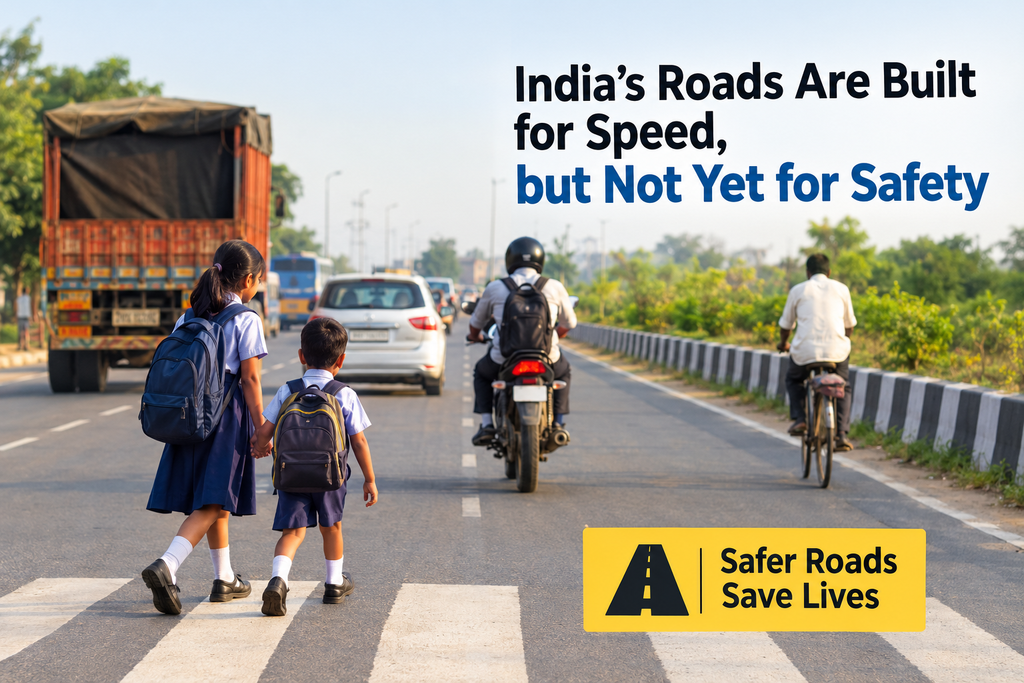
The highway findings are particularly alarming. National Highways and expressways represent only about 2% of India’s road network, yet account for roughly 36% of road fatalities. Around 68% of people killed on highways are pedestrians, cyclists and motorcyclists, while trucks and buses are involved in about 70% of fatal crashes in both rural and urban areas. These figures expose a fundamental contradiction: roads engineered for higher speeds continue to carry pedestrians, bicycles, motorcycles, tractors, buses, trucks and local traffic within the same environment.
Wider roads do not automatically mean safer roads. The report finds that head-on collisions still constitute 19% of crashes on some four-lane divided highways, pointing to wrong-way driving. Rear-end collisions also remain common. The solution cannot simply be another lane. Road design must acknowledge how people actually live and move. That means separating slow and fast traffic, constructing service roads, creating safe crossings, providing pedestrian and cycling infrastructure, improving lighting and traffic calming roads where highways pass through settlements.
Enforcement is equally important, but enforcement must be intelligent and consistent. The report notes that tougher penalties alone do not necessarily change behaviour. What matters is whether road users believe they will actually be caught. Education campaigns by themselves also have limited impact. Helmet and seat-belt laws save lives when they are consistently enforced. Seat belts and airbags together can reduce car-occupant fatalities by more than half.
Motorcycle safety deserves special attention because two-wheelers have become central to Indian mobility. Helmets must be worn not only by riders but by passengers, and they must be certified, correctly sized and properly fastened. Enforcement cannot stop at municipal boundaries. It must extend into small towns and rural roads. The report also identifies speed control as a major priority and highlights alcohol involvement as an important contributor to fatal crashes.
Road safety also begins before the engine starts. A simple pre-journey discipline can prevent breakdowns and crashes. The Five Fs provide a useful routine. Check Flats—tyres, tread, cuts, pressure, rims and wheel nuts. Check Fluids such as engine oil, coolant and brake fluid. Look for Fractures in windscreens, mirrors, lights or body panels. Remove Filth from windows, mirrors, number plates and lights. Finally, ensure Freedom around the vehicle: no child, pedestrian, animal or obstacle should be in its path. A few minutes of inspection can save a life.
Recent national figures underline how urgent the situation remains. MoRTH’s 2023 data recorded roughly 4.81 lakh crashes and about 1.73 lakh deaths. Overspeeding was associated with the largest share of fatalities, while wrong-side driving, drunken driving and mobile-phone use also caused thousands of deaths. Helmet non-use contributed to more than 54,000 deaths among two-wheeler users, and seat-belt non-use to over 16,000 deaths. These figures should not be read simply as evidence of individual irresponsibility. They also demand realistic work schedules, better driver training, safer road environments, maintained vehicles and stronger protection against fatigue.
One of the report’s most important warnings concerns data itself. Police investigations are largely structured around assigning legal responsibility, causing crashes to be attributed overwhelmingly to “human error.” This can obscure the role of poor road design, unsafe infrastructure, visibility, vehicle design and institutional failure. The authors therefore caution against using existing “cause of crash” tables uncritically for policymaking and call for major reform of India’s crash-data system. Bad data produces bad policy.
The report proposes a fundamentally different road-safety architecture: protected space for pedestrians and cyclists, service lanes for slow traffic, road-safety audits, traffic calming, better trauma and pre-hospital care, stronger helmet and seat-belt enforcement, and safer highway design. It also calls for a National Road Safety Board or Agency, a central system for professionally recording fatal crash data, publicly available anonymised datasets and multidisciplinary road-safety research centres.
India must therefore redefine what road development means. Progress cannot be measured only through kilometres constructed, travel time reduced or expressways inaugurated. It must also be measured by whether a child can cross a road safely, whether a cyclist can reach work alive, whether a two-wheeler passenger has meaningful protection, and whether a truck driver can rest without being forced into dangerously long hours.
Road crashes are routinely called “accidents,” as though they are random and unavoidable. They are not. Many deaths are preventable through better engineering, credible data, disciplined enforcement, safer vehicles, responsible driving and effective trauma care. India does not merely need faster roads.
Conclusion: India’s road-safety challenge is ultimately a test of how seriously we value human life. Infrastructure must serve people, not merely vehicles. When safety becomes as important as speed, and prevention as important as construction, India can transform mobility from a daily risk into a genuine instrument of development.
