
ImpactLens Correspondent
Maharashtra’s festivals and commemorative days are powerful expressions of faith, history, identity and collective joy. Dahi Handi celebrates courage, cooperation and teamwork. Ganeshotsav promotes devotion, creativity and community participation. Dussehra symbolises the victory of good over evil, while Diwali celebrates light, hope and renewal. Ambedkar Jayanti reminds us of equality, constitutional morality and social justice. Annabhau Sathe Jayanti honours the dignity, struggles and cultural contributions of working people.
None of these occasions requires unbearable noise to establish its importance.
Unfortunately, public celebrations are increasingly being measured by the height of speaker towers, the power of DJ systems and the number of hours for which neighbourhoods can be forced to endure amplified sound. What should unite communities is often converted into a competition of volume, money and political influence. Devotion is confused with decibels, public participation with public disturbance, and cultural pride with the ability to overpower everyone else.
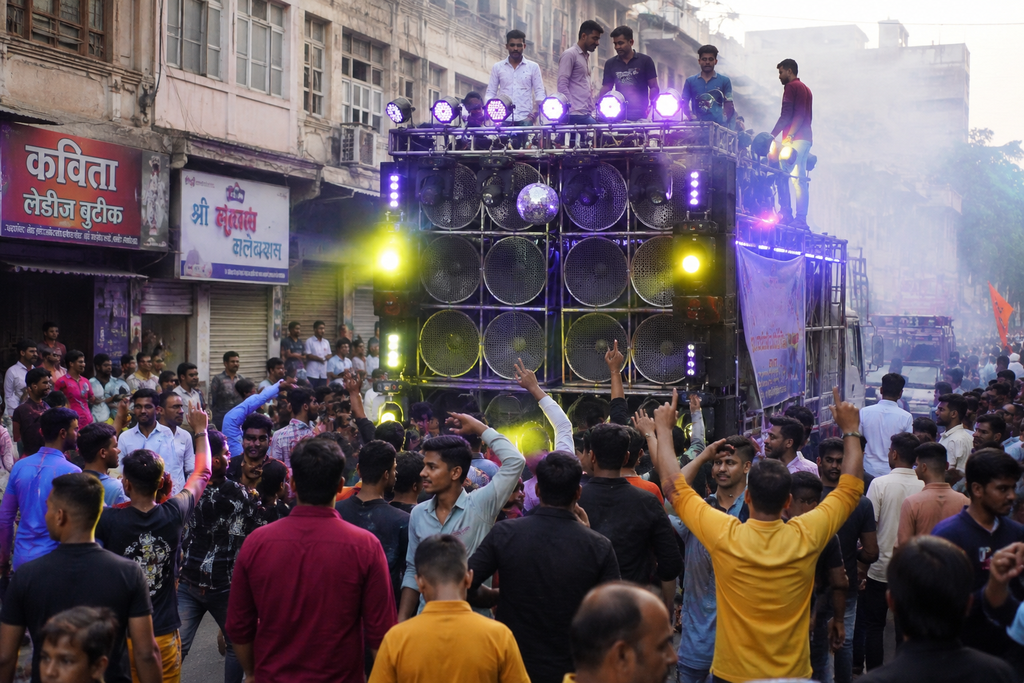
A recent controversy illustrates this worrying trend. After police intervened to stop DJs at certain locations, political leaders questioned why restrictions were being imposed and challenged the authorities to take similar action against Mumbai’s Dahi Handi celebrations. Some Ganesh mandals reportedly warned that they might boycott immersion processions if restrictions on speakers were imposed.
At the same time, other festival representatives appealed to mandals to promote Marathi culture, education, women’s safety, environmental responsibility, social harmony and healthy living. That is the direction Maharashtra should choose.
Selective enforcement is wrong—but defiance is not the answer.
Citizens and festival organisers are justified in demanding equal treatment. If noise restrictions apply to one festival celebration, they must also apply to every festival, political rallies, religious gatherings, weddings, processions and every other public event. Enforcement cannot depend on the religion, political affiliation, financial strength or influence of the organiser.
But inconsistency in enforcement cannot become an argument for removing enforcement altogether. If one person crosses a traffic signal without being caught, it does not give everyone else the right to violate traffic rules. The proper demand is equal enforcement—not universal lawlessness.
India’s Noise Pollution (Regulation and Control) Rules, 2000 regulate the use of loudspeakers and public-address systems and prescribe ambient noise standards for industrial, commercial, residential and silence zones. These rules are not attacks on religion or culture. They exist to protect the health, dignity and fundamental rights of every citizen.
Respect for law cannot be selective. A society cannot demand strict action against corruption, crime and traffic violations while treating noise regulations as optional. Obeying laws only when they are convenient is not constitutional citizenship. Respecting the law must become a value in itself.
Noise pollution is a public-health issue.
Excessive noise is often dismissed as a minor inconvenience that people should tolerate during festivals. It is not merely an inconvenience. It is a public-health concern.
The World Health Organization identifies excessive environmental noise as a risk associated with sleep disturbance, hearing impairment, hypertension, cardiovascular problems, cognitive effects and poorer performance at school and work. It can also contribute to annoyance, anxiety and changes in social behaviour. These effects are particularly serious for infants, senior citizens, pregnant women, hospital patients, students, people with disabilities and those living with heart conditions or mental-health difficulties. (WHO guidance on environmental noise)
A hospital patient does not recover faster because the noise comes from a religious procession. A student preparing for an examination does not lose the right to study because a political leader has inaugurated a DJ system. A senior citizen’s health does not become less important during a festival. Children, animals, workers on night shifts and families living beside procession routes also have rights. Freedom to celebrate cannot mean freedom to harm.
Political leaders must demonstrate courage, not encourage confrontation
Politicians have a special responsibility. Their words influence thousands of followers. When they challenge police officers for enforcing regulations or present legal restrictions as an insult to community pride, they weaken public institutions and encourage confrontation.
True leadership does not ask, “How loudly can we defy the authorities?” It asks, “How responsibly can we celebrate while protecting everyone?”
Political parties across the ideological spectrum must adopt a common position: laws should apply equally to every religion, caste, organisation, rally and public event. Leaders should publicly discourage the use of dangerously loud sound systems, refuse to inaugurate non-compliant events and support police officers who act impartially.
They should also avoid using young people as instruments in competitions over prestige. Festival committees often include energetic and committed youth. Their leadership can be directed towards blood-donation camps, career guidance, sports, environmental campaigns, support for vulnerable families, entrepreneurship exhibitions and cultural programmes. Political leadership should inspire such constructive participation.
Religious and community leaders cannot remain silent
Religious heads, trustees, mandal leaders and community organisers must remind people that devotion is measured by conduct, compassion and service—not by noise.
Ganeshotsav has a rich history of public education, cultural awakening and social organisation. Ambedkar Jayanti should deepen understanding of constitutional values. Annabhau Sathe Jayanti should stimulate discussion about labour, caste, inequality and dignity. Dahi Handi can promote teamwork and safe sporting practices. Diwali can encourage responsible consumption and environmental awareness.
These celebrations can feature traditional music, lezim, dhol-tasha within permissible limits, folk performances, theatre, poetry, lectures, book exhibitions, health camps and youth competitions. Technology can be used intelligently by placing smaller speakers strategically rather than building enormous sound walls. Sound limiters and real-time decibel displays can make compliance transparent.
A quieter festival need not be a weaker festival. It can be safer, more inclusive and more meaningful.
Administration must be fair, transparent and prepared
The police and civil administration must also earn public trust. Rules should be communicated well before festivals, not suddenly imposed during processions. Permission conditions, time restrictions, silence zones and penalties should be published clearly in Marathi and other local languages.
Enforcement teams should receive proper equipment and training. Decibel readings should be documented, and action should follow a graded and transparent process: warning, opportunity for immediate correction, seizure of equipment where necessary, and prosecution for repeated or deliberate violations.
Most importantly, the same standards must apply everywhere. Citizens lose faith when a small mandal is penalised while a politically connected event is ignored. Selective enforcement produces resentment and gives irresponsible leaders an opportunity to portray regulation as discrimination.
Celebration must strengthen civilisation.
A developed society is not defined only by highways, skyscrapers, digital payments or economic growth. It is defined by how people exercise freedom, respect neighbours, protect vulnerable citizens and obey laws even when enforcement is inconvenient.
Festivals should create happiness, not helplessness. They should strengthen relationships, not produce conflict between organisers, residents and police. They should celebrate faith without violating health, culture without coercion, and identity without excluding the rights of others.
Maharashtra has a proud tradition of saints, social reformers, writers and people’s movements. That legacy calls for celebrations rooted in wisdom, equality, compassion and self-discipline. The state should lead India in demonstrating that public enthusiasm and civic responsibility can coexist.
Let drums be played, songs be sung, processions be organised, and communities come together—but within reasonable limits and with respect for the law. The greatness of a festival is not measured by how far its speakers can be heard. It is measured by how deeply its values are lived.
