By Mathew Mattam
Every Indian has heard of the Taj Mahal. Every history lover dreams of visiting the Ellora Caves. Yet, hidden in the planned city of Chandigarh lies another masterpiece that deserves to stand alongside these iconic monuments—not because of royal patronage or ancient dynasties, but because it is the extraordinary creation of a single ordinary man with an extraordinary vision.
The Rock Garden of Chandigarh, created by Padma Shri Nek Chand Saini, is perhaps India’s greatest example of creativity, environmental sustainability, and human perseverance. Spread across 35 acres, built almost entirely from discarded waste materials, and attracting over 5,000 visitors every day, the Rock Garden is much more than a tourist destination—it is a monument to imagination.
Recently, I had the privilege of visiting the Rock Garden and meeting Anuj Saini, the son of Nek Chand, who continues to preserve and carry forward his father’s remarkable legacy. Walking through the garden was not merely sightseeing; it was an inspiring lesson on how one person’s dream can transform the world.
The Dream of an Ordinary Man
Nek Chand was born in 1924 in Shakargarh Tehsil, which is now in Pakistan. During the Partition of India in 1947, like millions of others, he was forced to leave his ancestral village and migrate to India. Eventually, he joined the Public Works Department as a road inspector in Chandigarh, the newly planned capital city designed by the legendary Swiss-French architect Le Corbusier.
During the late 1950s, while Chandigarh was rapidly expanding, construction activities generated enormous quantities of discarded materials—broken tiles, sanitary ware, electrical fittings, bicycle parts, glass bangles, stones, bottles, ceramic pieces, and industrial waste. Most people saw rubbish. Nek Chand saw possibilities.
After completing his government duties each day, he would spend another eight hours collecting discarded objects on his bicycle. Working secretly, often at night, he began creating sculptures in a hidden forest area near the Capitol Complex. His dream was simple yet profound—to build “a kingdom I had always dreamt about.”
For nearly eighteen years, he worked in complete secrecy, driven not by recognition or reward but by an inner calling. His story reminds us that true passion rarely seeks applause; it simply seeks expression.
When Waste Became Art
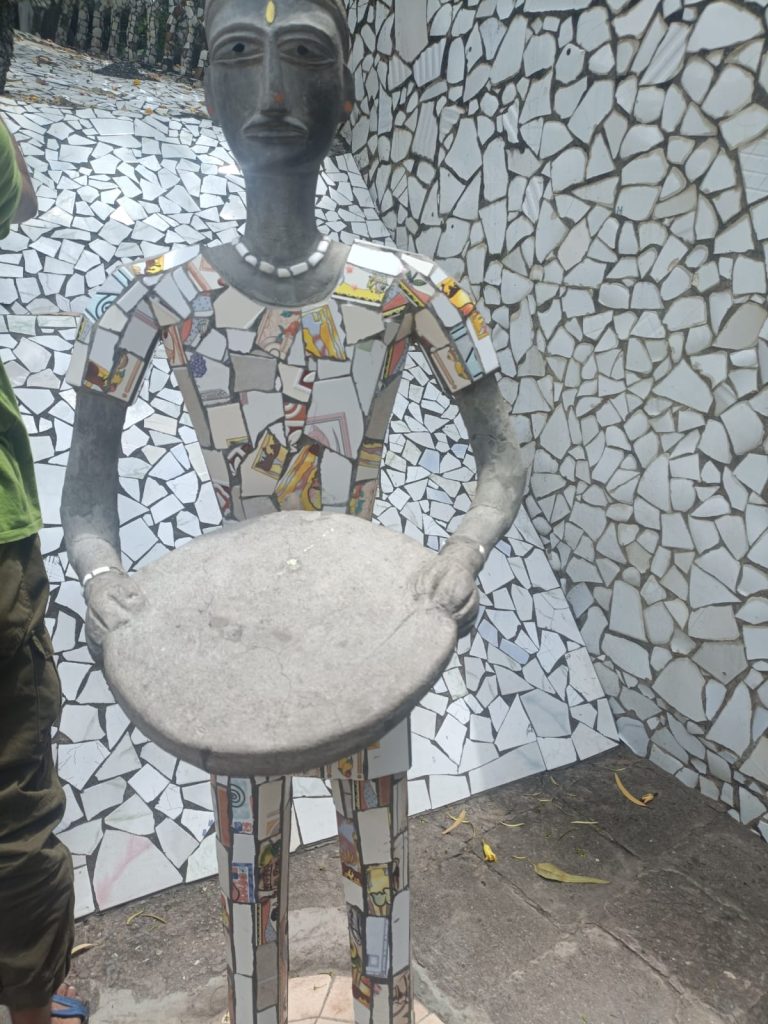
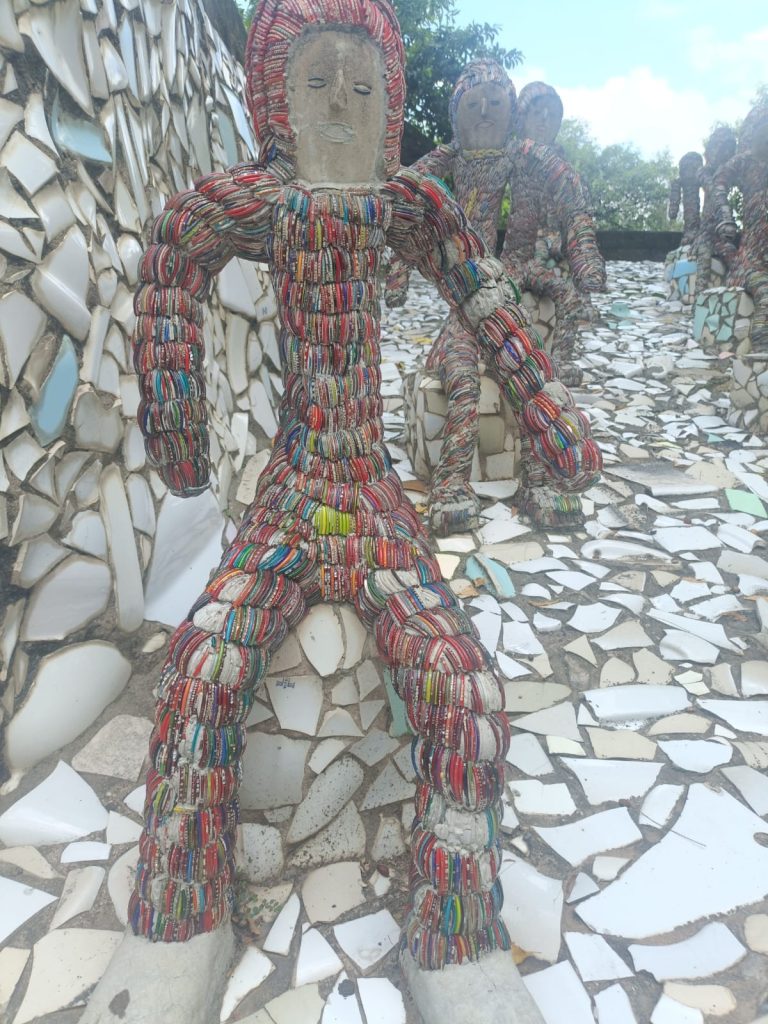
One of the greatest lessons the Rock Garden teaches is that nothing is truly waste. Every sculpture tells a story of transformation. Broken bangles become colourful mosaics. Old ceramic tiles become dancing women. Electrical sockets become decorative patterns. Bicycle frames become animals. Discarded bottles, porcelain, industrial scrap, stones, coal drums, and construction debris together create an entirely new artistic universe.
Long before “circular economy,” “recycling,” and “upcycling” became global buzzwords, Nek Chand was demonstrating how waste could become wealth and beauty. His philosophy was beautifully captured in his own words: “All waste material need not be thrown away; make it a thing of beauty.” Today, when cities across the world struggle with mountains of waste, Nek Chand’s vision appears decades ahead of its time.
A Kingdom Unlike Any Other
Walking through the Rock Garden is like entering another world. Narrow pathways suddenly open into magnificent courtyards. Waterfalls cascade over stone walls. Streams flow through artistic landscapes. Secret tunnels lead visitors into hidden chambers. Bridges connect different levels of the garden. Giant swings delight children while open plazas welcome families.
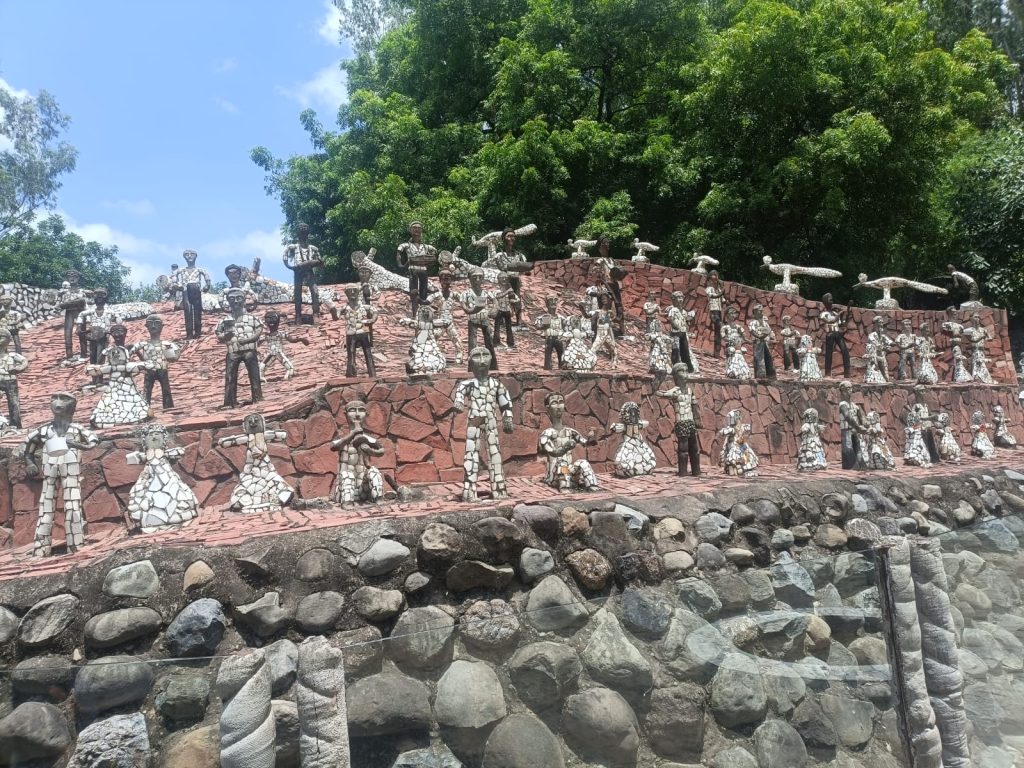
Thousands of sculptures silently narrate the story of India. There are villagers carrying pots, musicians playing instruments, dancers celebrating festivals, monks, warriors, kings, queens, animals, birds, elephants, camels, monkeys, peacocks, tigers, and countless human figures standing together as though celebrating India’s diversity.
Unlike museums where art is confined behind glass, here visitors walk through the artwork itself. Every turn surprises the imagination.
A Creation Saved by the People
Perhaps the most inspiring chapter in the Rock Garden’s history is how it survived. In the early 1970s, city authorities discovered the secret kingdom built illegally on government land. Many officials wanted it demolished. Fortunately, ordinary citizens thought differently.
The people of Chandigarh recognised the extraordinary beauty of Nek Chand’s creation. Public support grew rapidly. Instead of destroying the garden, the administration finally embraced it. In 1976, Nek Chand was officially appointed full-time to continue developing his dream. He was provided a salary, a truck, and a team of workers.
What began as an illegal secret project became one of India’s greatest cultural treasures. This story reminds us that when society values creativity, extraordinary things happen.
Equal to the Taj Mahal and Ellora
Many may wonder whether comparing the Rock Garden with the Taj Mahal or the Ellora Caves is justified. The comparison is not about architecture alone. The Taj Mahal represents eternal love. Ellora represents spiritual devotion and artistic excellence. The Rock Garden represents human imagination, environmental responsibility, and perseverance.
Each reflects the highest expression of human creativity in its own era. The Taj Mahal was built by an emperor with enormous resources. Ellora was created over centuries under royal patronage. The Rock Garden was built largely by one man, using discarded materials, after office hours, with no formal artistic training.
That makes it one of the greatest stories of creative determination in the world. It is no surprise that visitors, ambassadors, architects, artists, and scholars from across the globe have praised Nek Chand’s work. International exhibitions of his creations have travelled to Europe and North America, and the Government of India honoured him with the Padma Shri in 1984.
Meeting Anuj Saini
One of the highlights of our visit was meeting Anuj Saini, Nek Chand’s son. Growing up under the careful guidance of his father, Anuj learnt the unique art of transforming waste into beauty. Today, he continues that legacy by creating sculptures, training artists, and promoting the philosophy of sustainable creativity across India and internationally.
His work can be seen at prestigious locations, including Mumbai International Airport Terminal 2, and many institutions continue to seek his expertise in creating artistic installations from recycled materials. Speaking with Anuj was inspiring because it became clear that the Rock Garden is not merely a monument of the past—it is a living movement that continues to evolve.
As Nek Chand himself famously said: “The day this kingdom is completed will never come; every day there are so many new ideas.”
A Lesson for Every Indian
The Rock Garden is much more than a tourist attraction. It teaches resilience after displacement. It teaches environmental sustainability. It teaches creativity without expensive resources. It teaches that passion can overcome bureaucracy. Above all, it teaches that ordinary people can create extraordinary legacies. For students, it is a lesson in innovation. For architects, it is a masterclass in imagination. For environmentalists, it is a model of the circular economy. For artists, it is endless inspiration. For every citizen, it is proof that dreams built patiently can outlive generations.
A Destination Every Indian Must Visit
India possesses countless historical monuments, but very few places combine art, ecology, architecture, engineering, storytelling, and sustainability as beautifully as the Rock Garden. Whether you are travelling with family, children, students, photographers, architects, or nature lovers, this remarkable creation offers an unforgettable experience.
If the Taj Mahal represents India’s glorious past and Ellora showcases its ancient artistic genius, the Rock Garden of Chandigarh represents the creativity of modern India—an India where imagination transforms waste into wonder and where one individual’s vision becomes a national treasure.
The Rock Garden is not just a place to visit. It is a place to believe that creativity can change the world.