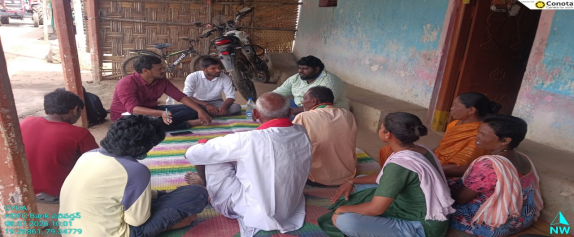
By Balaraja K T, Project Officer, YouthAid Foundation, Karnataka
At five o’clock every morning, before the rest of the household awakens, Lakshmi begins her day in a small village near Kalaburagi. She prepares breakfast, gets her children ready for school, and takes care of her elderly parents. Only after the morning chores are complete does she step into the small shed behind her home where sacks of millets, spices, and pulses await processing.
What started as preparing nutritious flour for neighbours has gradually evolved into a small food-processing enterprise. Today, her products are sold in local markets and supplied to nearby towns. Yet every packet she sells represents far more than income—it represents confidence earned, barriers crossed, and a quiet transformation taking place across Karnataka.
Lakshmi is not alone. Across Karnataka, thousands of women are making a similar journey—from unpaid household work to income generation, from self-help groups to formal enterprises, and from local markets to digital platforms. Their businesses may differ in scale and sector, but they share a common story of resilience, innovation, and determination.
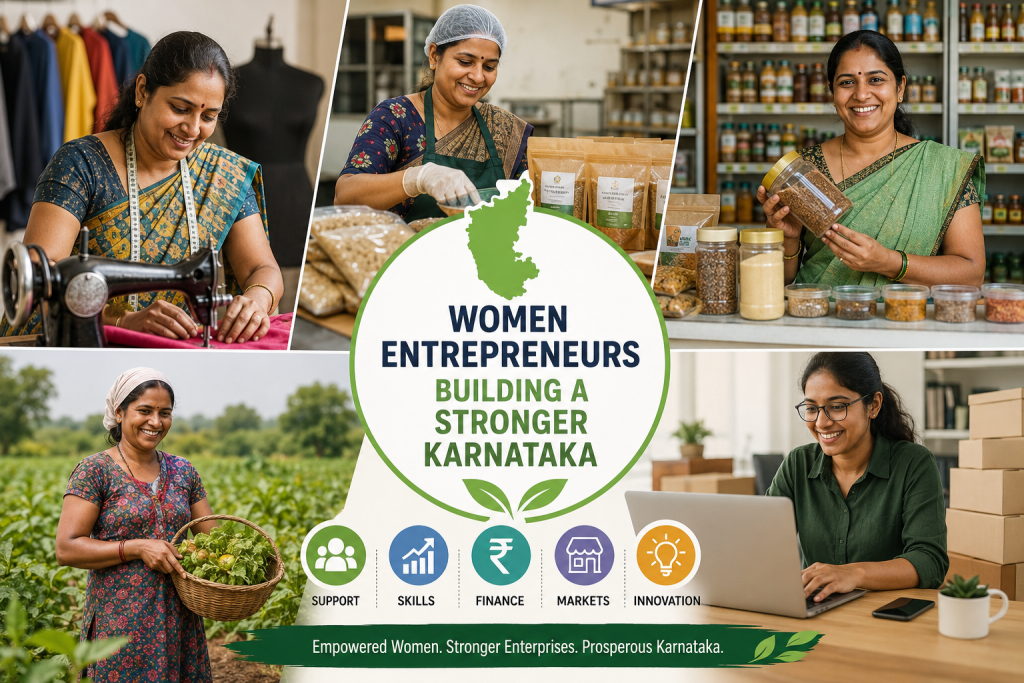
They manufacture garments in Belagavi, process spices in Shivamogga, produce jaggery in Mandya, run tourism ventures in Kodagu, weave handlooms in North Karnataka, operate healthcare services in Mysuru, manage retail businesses in Hubballi-Dharwad, create handicrafts in coastal districts, and launch technology startups from Bengaluru. Collectively, they are reshaping Karnataka’s entrepreneurial landscape—not through headline-grabbing investments, but through thousands of enterprises that generate livelihoods, strengthen communities, and contribute to inclusive economic growth.
Karnataka’s Entrepreneurial Advantage
Karnataka has long been recognised as one of India’s most entrepreneurial states. While Bengaluru has earned international recognition as the country’s startup capital, the state’s entrepreneurial strength extends well beyond the city.
Its robust industrial base, thriving MSME sector, agricultural diversity, educational institutions, and innovation ecosystem have created opportunities for enterprise across manufacturing, food processing, textiles, handicrafts, agriculture, healthcare, education, tourism, retail, and digital services.
The numbers reflect this momentum. More than 10 lakh Micro, Small and Medium Enterprises (MSMEs) are registered on the Government of India’s Udyam Registration Portal, placing Karnataka among India’s leading MSME states.
Equally significant is the strength of its grassroots institutions. Over five lakh Self-Help Groups (SHGs) operate across the state, connecting more than 60 lakh rural women through the Karnataka State Rural Livelihood Promotion Society (KSRLPS). These collectives have become much more than savings groups. They serve as the first platform where many women learn financial literacy, collective decision-making, bookkeeping, and enterprise management.
For countless rural women, entrepreneurship begins not with venture capital or incubation centres, but with a modest group loan, a family recipe, traditional skills, or a locally available resource.
From Survival to Enterprise
Women rarely begin businesses because they identify a market gap through sophisticated market research. More often, entrepreneurship emerges from necessity. A dairy farmer begins selling milk products to supplement household income. A tailor expands from stitching clothes for neighbours to supplying school uniforms. A craftswoman starts exhibiting products at district fairs. A graduate unable to secure formal employment launches an online design studio.
These enterprises are often rooted in home-based production, requiring women to balance business responsibilities alongside unpaid domestic work.
The transition from home production to a sustainable enterprise, however, is rarely easy. Many entrepreneurs quickly discover that producing quality goods is only one part of the journey. Registering a business, obtaining licences, accessing finance, understanding taxation, creating a brand, finding customers, managing digital payments, maintaining accounts, and navigating government procedures require an entirely different set of skills. For first-generation entrepreneurs, this learning curve can be overwhelming.
A Strong Ecosystem on Paper
Recognising the importance of women-led enterprises, Karnataka has developed one of India’s most comprehensive entrepreneurship support ecosystems.
Women entrepreneurs can access schemes such as the Udyogini Scheme, Prime Minister’s Employment Generation Programme (PMEGP), Stand-Up India, Pradhan Mantri MUDRA Yojana, Credit Guarantee Fund Trust for Micro and Small Enterprises (CGTMSE), Startup India Seed Fund Scheme, MSME Champions Scheme, National Rural Livelihood Mission (NRLM), and the Pradhan Mantri Formalisation of Micro Food Processing Enterprises (PMFME) programme.
State institutions including the Department of Industries and Commerce, Startup Karnataka, Karnataka Udyog Mitra, Karnataka State Women’s Development Corporation, Department of Women and Child Development, and KSRLPS provide entrepreneurship promotion, training, financial assistance, and livelihood support.
At the national level, organisations such as the Ministry of MSME, NSIC, KVIC, SIDBI, NABARD, Startup India, and NITI Aayog’s Women Entrepreneurship Platform provide additional financing, capacity building, technology support, and market development.
Commercial banks, financial corporations, entrepreneurship development institutes, innovation hubs, incubators, industry associations, and organisations such as AWAKE, SEWA, Deshpande Foundation, MYRADA, Youth Aid Foundation, YEFi, TiE Women, FICCI FLO, and several others contribute to a rich ecosystem of training, mentoring, networking, and enterprise development.
Taken together, Karnataka possesses one of the strongest institutional foundations for women entrepreneurship in the country. Yet, the reality experienced by many women tells a more complex story.
When Opportunity Does Not Reach the Last Mile
Although programmes exist, many aspiring entrepreneurs remain unaware of them. In rural and semi-urban districts, women often learn about schemes only through word of mouth. Information is fragmented across multiple departments, each with separate procedures, eligibility criteria, documentation requirements, and timelines.
For many first-generation entrepreneurs, accessing institutional finance remains one of the biggest hurdles. Despite dedicated credit programmes, collateral requirements, limited credit histories, procedural delays, and risk-averse lending practices frequently discourage applicants.
Even after securing finance, new challenges emerge. Entrepreneurs outside Bengaluru often have limited access to incubators, mentors, business consultants, design experts, or technology partners. Government support frequently focuses on helping women establish enterprises, but comparatively less attention is given to helping businesses scale.
Brand development, packaging, e-commerce, digital marketing, export readiness, participation in government procurement, and market expansion continue to remain significant gaps.
As businesses increasingly move online, digital capabilities have become essential rather than optional. Yet many women-led MSMEs still require practical training in digital tools, artificial intelligence, online marketing, and business management software to remain competitive.
The challenge is therefore not simply creating more entrepreneurs. It is enabling existing entrepreneurs to become sustainable business owners capable of generating employment and long-term economic value.
Beyond Finance: The Invisible Barriers
Not every challenge can be solved through subsidies or credit. Women’s entrepreneurship is shaped by social realities that often remain invisible in policy discussions.
Many women continue to shoulder the majority of unpaid care work within households. Business meetings are planned around school schedules. Production stops during family emergencies. Travel to training programmes requires permission, transport, and childcare arrangements.
Mobility constraints, limited family support, social expectations, and the absence of reliable childcare can influence business decisions just as much as access to finance.
These invisible barriers explain why many promising enterprises remain small despite their commercial potential.
Addressing them requires community support, flexible training models, local mentoring networks, and policies that recognise the lived realities of women entrepreneurs.
Measuring Success Differently
Karnataka continues to rank among India’s leading startup ecosystems. Yet nationally, only around one in five DPIIT-recognised startups has at least one woman director.
While women’s labour force participation has improved, a significant proportion remains concentrated in informal and low-income enterprises rather than growth-oriented businesses.
This raises an important question. Success should not be measured solely by the number of enterprises registered or loans sanctioned. It should also be measured by how many women-owned businesses survive beyond the first few years, expand into new markets, adopt technology, create employment, and become financially resilient.
The journey from entrepreneur to employer is where the real development impact lies.
The Road Ahead
Karnataka has already laid a strong policy foundation. The next phase must focus on ensuring that existing schemes become easier to access, better coordinated, and more responsive to the realities of women entrepreneurs.
Greater awareness at the village level, simplified procedures, stronger last-mile implementation, easier access to finance, sustained mentoring, digital and AI capacity building, improved market linkages, and better institutional coordination will be critical for enabling women-led enterprises to grow. Equally important is shifting the policy conversation beyond enterprise creation towards enterprise growth.
Women do not simply need help starting businesses; they need long-term support to build competitive enterprises capable of creating jobs, increasing incomes, and contributing to regional development.
Lakshmi’s journey from a small shed behind her home to supplying products across district markets is ultimately not just her story.
It reflects the aspirations of millions of women across Karnataka who possess the skills, determination, and entrepreneurial spirit to build successful enterprises if given the right opportunities.
When these women move from home to market, they transform far more than their own livelihoods. They strengthen local economies, create employment for other women, preserve traditional knowledge, encourage innovation, and contribute to a more inclusive model of economic growth.
Karnataka’s next chapter of development will not be written only in technology parks, industrial corridors, or startup incubators. It will also be written in village kitchens, small workshops, farm-based enterprises, neighbourhood retail stores, and women-led businesses that quietly but steadily reshape the state’s economy—one enterprise at a time.