By Dr. Kuldeep Singh Rajput
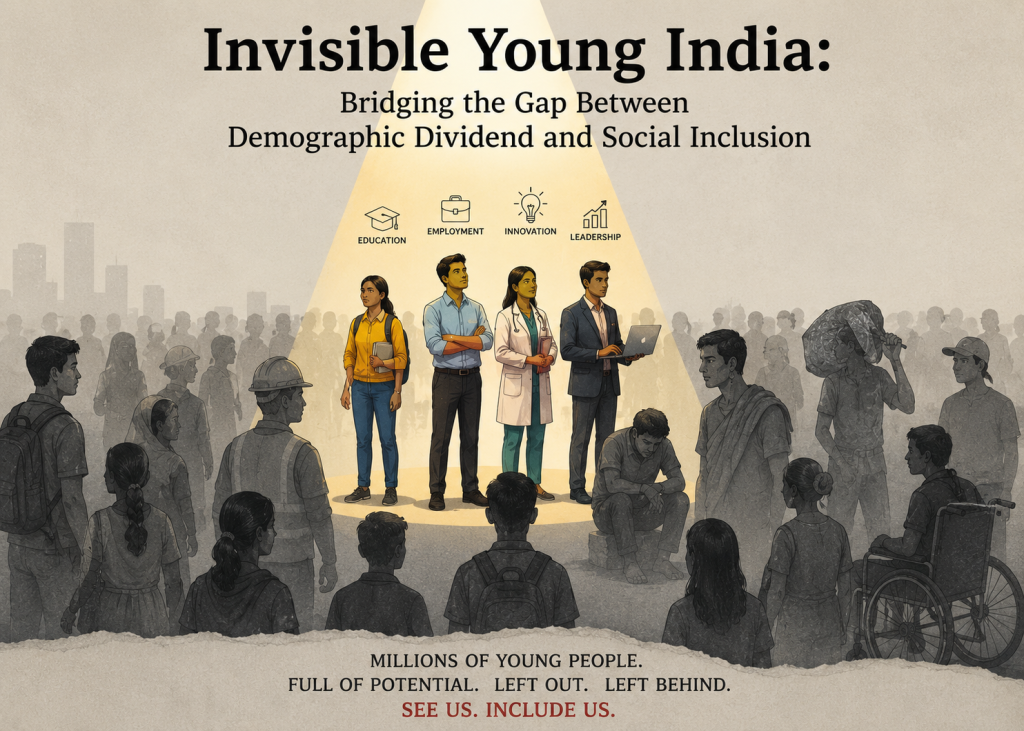
India is frequently celebrated as the world’s youngest nation. With one of the largest youth populations globally, the country possesses an unprecedented demographic advantage that has the potential to shape its economic, social, and political future. Young people are widely acknowledged as innovators, entrepreneurs, workers, citizens, and leaders capable of driving transformative change. Yet, beneath the optimism surrounding India’s demographic dividend lies another reality—millions of young people remain invisible to public policy, development planning, and institutional support.
The paradox of contemporary India is not that it lacks young people, but that it fails to recognise many of them.
Sociologist G. K. Karanth aptly observed that youth are both “products” of society and contributors to it. Young people are shaped by the social, cultural, and economic structures into which they are born, while simultaneously influencing those very structures through their participation, creativity, and aspirations. Their ability to contribute, however, depends significantly on whether society provides equitable opportunities for education, employment, health, participation, and dignity.
India’s demographic profile presents an extraordinary opportunity. According to the 2011 Census, nearly 27.5 percent of India’s population belonged to the 15–29 age group. Although demographic patterns have evolved since then, India continues to possess one of the world’s largest youth populations. This youthful workforce has been recognised as a critical driver of economic growth, innovation, entrepreneurship, and social transformation.
However, demographic dividend is not an automatic outcome of population size. It becomes meaningful only when young people are healthy, educated, skilled, socially included, and economically productive. Without these conditions, the demographic dividend can easily become a demographic liability.
Unfortunately, development discourse often focuses on the visible youth—students enrolled in schools and colleges, graduates preparing for competitive examinations, young professionals entering formal employment, or entrepreneurs participating in innovation ecosystems. Public schemes, educational reforms, digital initiatives, and skill development programmes are frequently designed around this relatively visible segment.
The invisible youth remain outside these conversations.
Invisible Young India comprises millions of adolescents and young adults who experience exclusion because of multiple and intersecting disadvantages. They include school dropouts, migrant workers, unemployed youth, young persons with disabilities, transgender persons, LGBTQ+ youth, tribal communities, Dalits, religious minorities, young women restricted by patriarchal norms, homeless youth, conflict-affected populations, and those engaged in informal or hazardous labour.
Many of these young people remain statistically underrepresented, institutionally underserved, and socially unheard.
Social exclusion extends far beyond poverty. It is produced through complex interactions of caste, class, gender, ethnicity, religion, language, geography, disability, migration status, and sexual identity. These disadvantages reinforce one another, limiting access to quality education, healthcare, employment opportunities, financial services, digital technologies, political participation, and social recognition.
Education illustrates this structural exclusion vividly. India has made remarkable progress in expanding elementary education through landmark policy initiatives and increasing enrolment at secondary and higher education levels. Nevertheless, educational inclusion remains uneven. Young people who discontinue education because of poverty, migration, family responsibilities, early marriage, discrimination, disability, or conflict often find themselves permanently disconnected from learning systems.
For many young people, earning becomes a necessity long before learning can become a choice.
Traditional educational models rarely accommodate young workers whose livelihoods depend on daily wages. Flexible learning pathways, bridge education, vocational mobility, recognition of prior learning, and community-based skill development remain insufficiently integrated into mainstream education policy.
The consequences extend into employment.
India’s labour market increasingly demands technical competencies, digital literacy, communication skills, adaptability, and continuous learning. Yet excluded youth frequently lack access not only to quality education but also to employability skills, career guidance, mentorship, internships, financial inclusion, and entrepreneurial ecosystems. As a result, they remain concentrated within insecure informal employment characterised by low wages, limited social protection, and restricted opportunities for upward mobility.
The Ministry of Youth Affairs and Sports, in its Action Plan on Promoting Social Inclusion of Excluded Youth Groups through Volunteering, highlighted that Dalit, Adivasi, and Muslim youth continue to experience disproportionate educational deprivation. Structural barriers, poor-quality schooling, inadequate academic support, and persistent discrimination contribute to high dropout rates and limited participation in higher education. These inequalities illustrate that exclusion is embedded within institutions rather than arising merely from individual circumstances.
The challenges have become even more complex in the digital era.
Digital technologies have expanded opportunities for education, employment, entrepreneurship, and civic participation. However, digital transformation has simultaneously widened existing inequalities. Young people without reliable internet connectivity, digital devices, language accessibility, or technological literacy risk further exclusion from emerging opportunities. The digital divide has become an extension of existing social inequalities.
Mental health represents another neglected dimension of invisibility.
Increasing academic competition, unemployment, migration, family instability, financial insecurity, discrimination, online harassment, and uncertain futures have contributed to rising psychological distress among young people. Yet access to affordable, youth-friendly mental health services remains limited, particularly for marginalised populations.
The invisible youth often experience exclusion not in isolation but across multiple dimensions simultaneously.
This reality calls for a shift from welfare-based approaches towards rights-based youth development.
Youth policies must recognise diversity rather than treating young people as a homogeneous category. Inclusive development requires targeted interventions for migrant youth, transgender communities, differently abled young people, informal workers, conflict-affected populations, tribal communities, and other historically excluded groups. Education systems must embrace flexibility. Skill development must respond to local livelihoods. Employment programmes should integrate entrepreneurship, social protection, digital inclusion, and financial literacy.
Equally important is recognising young people as partners rather than beneficiaries.
Across India, numerous civil society organisations have demonstrated innovative approaches to engaging excluded youth through community learning centres, leadership programmes, entrepreneurship incubation, livelihood promotion, mental health support, digital education, and civic participation. Organisations such as CYDA have shown that community-based interventions combining education, life skills, employability, entrepreneurship, health awareness, and youth leadership can successfully reconnect marginalised young people with mainstream development processes.
These experiences offer important lessons for public policy.
Building an inclusive India requires stronger collaboration between government institutions, educational systems, civil society organisations, private enterprises, local communities, and young people themselves. Investment in youth should not be measured solely by enrolment figures or employment statistics but by the extent to which every young person experiences dignity, opportunity, participation, and hope.
India’s demographic dividend will ultimately be judged not by the success of its most privileged youth but by its ability to ensure that those currently invisible also become visible participants in national development.
The question before policymakers is therefore not whether India has enough young people to build the future.
The real question is whether every young Indian—irrespective of caste, gender, geography, disability, identity, or economic background—will be given an equal opportunity to participate in building it.
Only when the invisible become visible will India’s demographic dividend truly become a dividend for all.
References
- Karanth, G. K. (1981). Rural Youth: A Study of a Karnataka Village. New Delhi: Concept Publishing Company.
- Office of the Registrar General & Census Commissioner, India. Census of India 2011.
- Ministry of Youth Affairs and Sports. (2017). Action Plan on Promoting Social Inclusion of Excluded Youth Groups through Volunteering.
- Swadesh Singh. (2016). “Empowering Rural Youth: Challenges and Opportunities.” Kurukshetra: A Journal on Rural Development.
- United Nations Population Fund>. State of World Population (various editions).
- International Labour Organization. Reports on Youth Employment and School-to-Work Transition.
Dr. Kuldeepsingh Rajput is a Development Practitioner and leads RUBAL FOUNDATION, a non-profit working with migrants and unorganised sector workers.
www.drkuldeepsingh.in
www.rubalfoundation.org