
Mathew Mattam
The prolonged ethnic violence in Manipur has emerged as one of the most painful humanitarian and social crises in contemporary India. What began as a conflict between communities has gradually evolved into a deeper crisis of trust, coexistence, and shared citizenship. The violence has resulted not only in the loss of human lives and destruction of property but has also weakened the social fabric that historically connected the diverse ethnic, cultural, and religious communities of the state. Amidst this suffering, a growing number of religious leaders, peacebuilders, human rights defenders, and civil society organizations have consistently appealed for an end to violence and a return to dialogue, reconciliation, and peace.
The various appeals issued by the Interfaith Forum Manipur over the past two years reflect a profound concern for the future of the state. Representing Hindu, Sanamahi, Christian, Muslim, Jain, Buddhist, and Tingkao Ragwang faith traditions, the Forum has repeatedly emphasized that violence degrades human dignity and threatens the future of generations yet to come. Their statements remind society that the continuing cycle of killings, intimidation, displacement, and hatred is not merely a political or ethnic issue; it is fundamentally a moral and humanitarian crisis. Thousands of women, children, elderly persons, and innocent civilians continue to suffer in relief camps and conflict-affected areas, bearing the consequences of decisions over which they have little control.
A central theme emerging from these appeals is the recognition that peace is inseparable from the welfare of children. The Interfaith Forum has consistently argued that threats against peacebuilders and human rights defenders are, in effect, threats against the present and future generations of Manipur. Children who should be growing up in secure and nurturing environments are instead witnessing fear, insecurity, and division. The normalization of violence risks transmitting hatred across generations and creating a society where conflict becomes an accepted means of resolving differences. Such a future would undermine the aspirations of every parent who desires safety, education, dignity, and opportunity for their children.
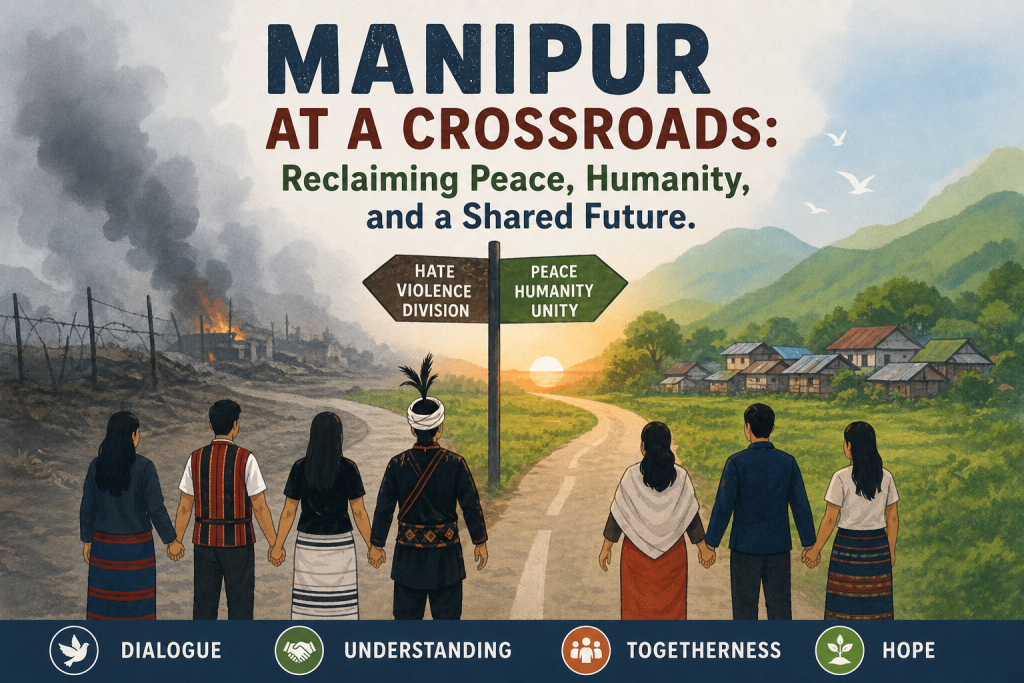
The significance of these appeals lies in their insistence that peace is not simply the absence of violence but the active cultivation of humane relationships between communities. The Forum has repeatedly called upon community leaders, religious institutions, and citizens to reject intimidation, demonization, and retaliatory violence. It argues that genuine leadership requires the courage to protect neighbors, respect human dignity, and seek common solutions even amidst profound disagreements. This vision of leadership places the welfare of future generations above immediate political or communal interests.
The tragic killings of pastors and civilians in June 2026, condemned by the Churachandpur District Christians Goodwill Council, further highlighted the devastating human consequences of prolonged conflict. The Council’s statement described these deaths as violations of human dignity, justice, and peace, while appealing for restraint, forgiveness, and reconciliation. Such interventions from faith-based institutions demonstrate that despite differences in religious traditions, there exists a shared moral consensus that violence cannot provide lasting solutions to social and political disputes. The Council’s appeal reflects a broader understanding that every life lost leaves behind grieving families, fractured communities, and deeper wounds that future generations must struggle to heal.
The current crisis also raises important questions about the nature of identity and belonging in Manipur. Historically, the state has evolved as a meeting place of multiple ethnic groups, cultures, languages, and religions. The hills and valleys have been interconnected through trade, migration, social relationships, and shared histories. While diversity has always characterized Manipur, coexistence has traditionally enabled communities to navigate differences without resorting to sustained violence. The present conflict threatens this historical legacy by promoting narratives of separation and mutual exclusion. If such narratives continue unchecked, they risk transforming temporary divisions into permanent social realities.
The repeated calls for dialogue and reconciliation are therefore not merely appeals for an immediate ceasefire but efforts to preserve the pluralistic foundations of Manipuri society. The Interfaith Forum has warned against the growing acceptance of geographical separation and social fragmentation as solutions to conflict. Such approaches may provide temporary relief from tensions, but they fail to address the underlying challenges of coexistence in a multi-ethnic and multi-religious society. Sustainable peace can emerge only through renewed engagement, trust-building, and institutional mechanisms that enable communities to address grievances through nonviolent means.
An important contribution of the peace initiatives emerging from Manipur is their emphasis on long-term peacebuilding. The proposal to establish a World Peace Center in Manipur and create youth peacebuilding fellowships reflects an understanding that peace requires investment in future generations. Young people must be equipped with the knowledge, skills, and values necessary to manage conflicts constructively, engage in dialogue, and promote social cohesion. Such initiatives recognize that peacebuilding is not an event but a continuous process that requires education, leadership development, and community participation.
Equally significant is the recognition that peace must be linked with development and social progress. Communities that remain trapped in cycles of poverty, unemployment, insecurity, and exclusion are more vulnerable to manipulation by divisive forces. Economic cooperation, entrepreneurship, educational opportunities, environmental protection, and community development initiatives can create shared interests that transcend ethnic boundaries. When communities work together to improve livelihoods and build prosperity, peace becomes both a moral aspiration and a practical necessity.
The future of Manipur will depend largely on the choices made by its citizens, leaders, and institutions in the coming years. Continuing along the path of violence will deepen social divisions and leave future generations burdened by inherited grievances. Alternatively, embracing dialogue, reconciliation, and peaceful coexistence can transform the present crisis into an opportunity for renewal. Religious leaders, civil society organizations, educational institutions, women’s groups, youth organizations, and community elders all have critical roles to play in this transformation.
The appeals emerging from different faith traditions and community organizations ultimately converge on a simple yet powerful truth: every community desires peace, security, and dignity for its children. No parent wishes to leave behind a legacy of hatred and violence. The greatest gift that the present generation can offer the next is a Manipur where diversity is respected, conflicts are resolved peacefully, and every citizen can live without fear. Such a vision requires courage, compassion, and collective commitment, but it remains both achievable and necessary. The future of Manipur depends not on who wins a conflict, but on whether its people can rediscover their shared humanity and rebuild a society founded on justice, reconciliation, and lasting peace. (Based on the IFM Souvenir III)

This Post Has 2 Comments
Very well articulated article! Completely agree with the spectrum of issues discussed, but the critical question is ‘who will take initiative?’
Yet another voice to the voiceless from Mr Mathew. Thanks is not enough. Future is more helpful when Mathew articulate the central arguments and amplifies the marginalized voice – peace by peaceful means
Salute
Deben Bachaspatimayum
Convener, IFM