
Mathew Mattam
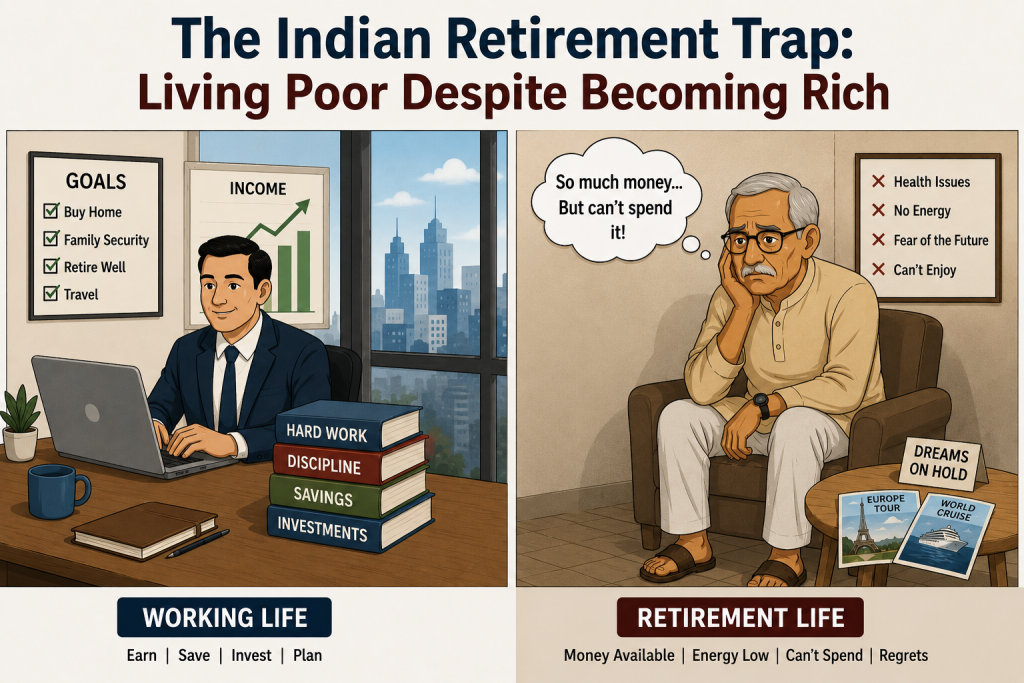
For nearly forty years, Raghavan did everything that Indian society expected of a responsible man. He woke up before sunrise, travelled long hours to work, paid every EMI on time, educated his children, built a house, looked after ageing parents, attended every family function, and quietly sacrificed every personal dream. Vacations were postponed. Hobbies disappeared. Health took a back seat. “After retirement,” he would often tell himself, “I will finally live.”
At sixty-five, he retired with dignity. He owned a debt-free home in Pune. His savings exceeded ₹3 crore. His pension arrived every month without fail. His children were well settled abroad. Financially, he had won the race. Yet every afternoon in the scorching month of June, his wife would ask, “Shall I switch on the air conditioner?” “No,” he would reply. “The electricity bill will become too high.” Instead, he sat sweating under a ceiling fan.
This is not the story of one man. It is the story of millions of Indian retirees. They spend a lifetime creating wealth, only to discover they have forgotten how to enjoy it.
Retirement Was Supposed to Be Freedom
For most Indians, retirement is imagined as the reward after decades of hard work—a time to travel, read, learn music, spend time with grandchildren, volunteer, rediscover friendships, and simply enjoy life. Yet for many, retirement becomes an invisible prison.
The office disappears. The daily routine vanishes. The phone stops ringing. People who once sought their advice no longer call.
The identity that took forty years to build disappears almost overnight. Many retirees soon discover that they planned financially for retirement but never emotionally. The result is boredom, loneliness, anxiety, and sometimes depression.
The Mind Never Retires from Saving
Financial security does not automatically create emotional security. One of the biggest retirement challenges is what financial experts now describe as “Switch Failure.” Imagine driving a car for forty years using only the brake pedal. One day someone tells you to enjoy driving by pressing the accelerator. Your foot hesitates. That is exactly what happens to many retirees.
Their minds have operated in SAVE MODE for four decades. Every unnecessary purchase was avoided. Every luxury was postponed. Every rupee was carefully invested. But when retirement finally arrives, the mind refuses to switch into SPEND MODE.
The wealth exists. The permission does not. Many elderly couples continue living as though they are still struggling financially.
They refuse to buy comfortable furniture. They avoid domestic help. They postpone medical procedures. They refuse air-conditioning during summer. They travel in uncomfortable sleeper coaches despite painful knees. Not because they cannot afford comfort. Because they no longer know how.
Living Like Custodians Instead of Owners
Indian culture teaches sacrifice. Parents proudly say, “Everything we earn is for our children.” It is a beautiful value. But somewhere along the journey, sacrifice becomes permanent. Even after children become financially independent, many parents continue denying themselves life’s simple pleasures because they believe every rupee must eventually be inherited.
Ironically, most successful children do not need that inheritance. What they truly want is something far more valuable. Healthy parents. Happy parents. Parents who travel. Parents who laugh. Parents who enjoy the life they worked so hard to build.
The greatest inheritance is not money. It is the peace of seeing parents living well.
When Retirement Becomes an Identity Crisis
Work gives us more than income. It gives purpose. Titles. Recognition. Colleagues. Achievements. Suddenly retirement removes all of them.
Many people have introduced themselves for decades by saying, “I am an engineer.” “I am a banker.” “I am a government officer.” “I am a professor.”
After retirement, they struggle to answer a simple question: “Who am I now?” Without purpose, even wealth begins to feel meaningless.
Research and community experiences consistently show that retirees who actively build new routines—morning walks, volunteering, learning, mentoring, gardening, reading groups, travel clubs, or community service—report significantly greater life satisfaction than those who simply stop working.
Retirement should not be an empty vacation. It should become a second career in living.
The Fear That Never Leaves
Another invisible trap is fear. “What if I live to be 100?” “What if medical expenses increase?” “What if inflation destroys my savings?”
These are valid concerns. But fear without balance slowly steals the present. Many retirees spend twenty healthy years worrying about problems that never arrive. Meanwhile, the years they could have enjoyed quietly disappear.
The Hidden Cost
Across India, stories of elderly people struggling emotionally are becoming increasingly visible. Property disputes. Isolation. Financial stress. Family conflicts. Mental health challenges. Some tragedies make newspaper headlines. Most remain hidden inside silent homes. The issue is rarely only money. Often it is the absence of purpose, belonging, emotional connection, and permission to live fully.
Flipping the Switch
Retirement requires a different financial plan—but even more importantly, a different psychological plan. Every retiree should create two mental accounts. The first is for security. Healthcare. Emergency expenses. Essential living. Once that is adequately protected, the second account should become sacred. The Happiness Fund. Money meant only for experiences. Travel. Learning. Music lessons. A comfortable chair. Better healthcare. A family holiday. Good food. A weekend getaway. Buying books. Supporting a social cause. Money stored forever loses its purpose. Money used wisely creates memories.
Industrialist Ratan Tata once reflected that wealth, possessions, and business success brought only temporary satisfaction. His deepest happiness came when he personally distributed wheelchairs to disabled children and witnessed their joy.
The Real Measure of Wealth
Many retirees face a tragic end as they struggle with loneliness, isolation, declining health, property disputes, and inheritance conflicts. Despite financial security, the absence of purpose and social connections can lead to depression and despair. Their stories remind us that emotional well-being and meaningful relationships are as important as retirement savings.
Real wealth is not measured by the balance left in the bank after death. It is measured by the life experienced before it. India has taught generations how to earn. It has taught them how to save. Perhaps the next lesson is learning how to enjoy. Because retirement is not the end of productivity. It is the beginning of freedom.
After spending forty years working for employers, serving the nation, raising children, caring for parents, and fulfilling responsibilities, there comes a time to finally live for oneself. One need not spend entire life building wealth only to become the richest patient in the hospital or the wealthiest person with unfulfilled dreams. The greatest retirement plan is not leaving behind the largest inheritance. It is leaving behind the memory of a life fully lived.

This Post Has 4 Comments
Excellent. Live while alive. While care for others, practice compassion and care for self. Don’t forget self.
Good article. Congratulations Mathew. I think these people have never shared anything with poor and deserving during their employment.
Well thought, written piece…this is what the society needs
Good article, it make us to think about how to live life in present happily.