Mathew Mattam
Green Youth Movement Pune Endorses Maharashtra’s Ban on Newspaper-Wrapped Food. Recently, while travelling in Manipur, I visited a small restaurant for breakfast. Fresh puris were served to customers wrapped in old newspapers. I politely refused to accept them. To my surprise, everyone around me continued eating without hesitation. The same practice is common in Maharashtra. Jalebi, poha, samosa, kachori, pakoda, vada pav, and numerous street foods are routinely wrapped in newspapers or served on recycled printed paper.
For generations, this practice has been accepted as normal. Today, however, science and public health experts tell us a different story: newspaper-wrapped food is unsafe and potentially harmful.
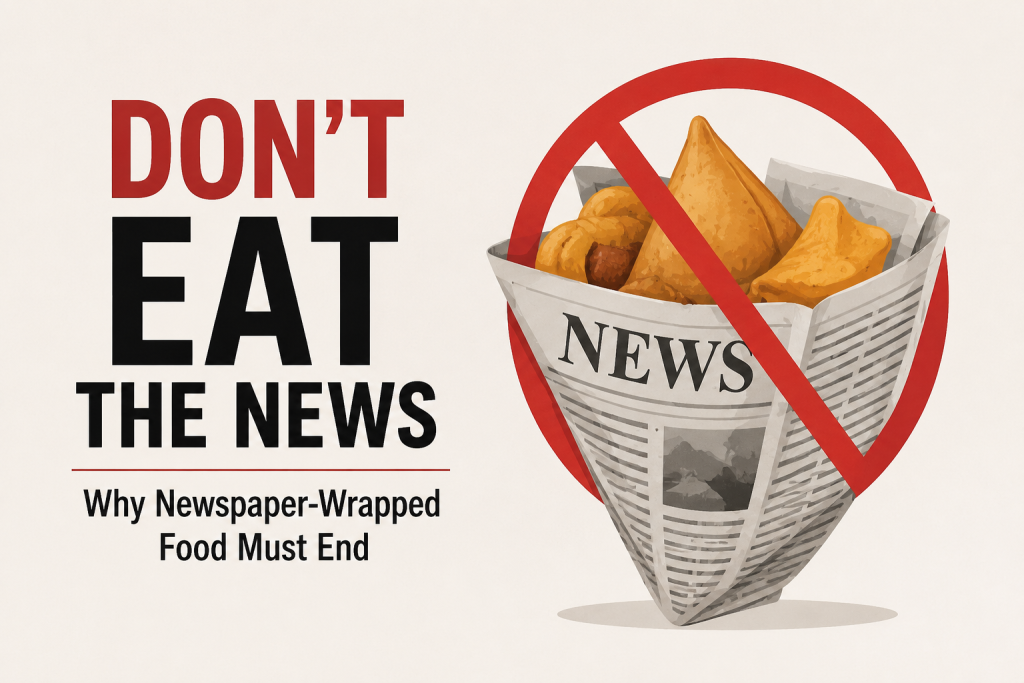
Recognizing this serious health concern, the Maharashtra Food and Drug Administration (FDA), in coordination with the Food Safety and Standards Authority of India (FSSAI), has strictly prohibited the use of newspapers and recycled printed paper for serving, storing, or wrapping food. The Green Youth Movement Pune strongly endorses this decision and calls upon citizens, vendors, and institutions to support this important public health initiative.
The Hidden Poison in the Newspaper
Many people assume that newspapers are harmless because they are made from paper. Unfortunately, newspapers contain printing inks that are not designed for food contact. These inks may contain: Heavy metals, Mineral oils, Chemical pigments, Dyes and solvents, Preservatives and additives.
When hot, oily, or moist food items such as samosas, pakoras, puris, jalebis, or vada pav come into contact with newspaper, these chemicals can migrate into the food. The heat and oil accelerate this transfer.
The result is that consumers may unknowingly ingest toxic substances along with their food.
Long-Term Health Risks
Medical experts warn that continuous exposure to these contaminants may lead to: Digestive disorders, Hormonal disturbances, Liver and kidney damage, Weakening of the immune system, Developmental problems in children, Increased risk of certain cancers.
The risks are particularly severe for: children, pregnant women, elderly people, individuals with weak immunity, and people suffering from chronic illnesses.
Even food prepared under hygienic conditions becomes unsafe when wrapped in contaminated materials.
Recycled Paper Is Not Safe Either
Many vendors believe that recycled paper is environmentally friendly and therefore safe. Unfortunately, recycled printed paper often contains: Dust and dirt, Bacterial contamination, Chemical residues, Metallic particles, Industrial contaminants.
These materials pass through multiple handling processes before being reused. Their direct contact with food creates additional health hazards.
Tradition Should Not Become a Threat
Newspaper wrapping became common because it was inexpensive and easily available. Street vendors, tea stalls, and small eateries used discarded newspapers to reduce costs.
Many Indians grew up eating newspaper-wrapped snacks. During periods of economic hardship, even families in other countries used newspapers to wrap food.
However, traditions must evolve when scientific evidence demonstrates harm. Just as we moved away from unsafe drinking water, lead paints, and smoking in public spaces, we must now move away from newspaper-wrapped food.
Maharashtra Takes a Bold Step
The Maharashtra FDA has begun inspections across the state. Restaurants, street vendors, cloud kitchens, and food businesses are now required to use approved food-grade packaging materials.
Violations may attract penalties under the Food Safety and Standards Act. This move represents more than regulation. It represents a commitment to public health, consumer safety, and modern food practices.
What Are the Alternatives?
Fortunately, safe alternatives are widely available: they are Food-grade paper, Butter paper, Biodegradable wrappers, Banana leaves, Areca leaf plates, Food-safe containers, Certified packaging materials. These options protect consumers while also supporting environmental sustainability.
Green Youth Movement Pune: A Public Awareness Campaign
The Green Youth Movement Pune believes that every citizen has the right to safe food.
The movement is launching awareness campaigns across educational institutions, communities, youth groups, and marketplaces with the following messages:
- Do not accept food wrapped in newspapers.
- Encourage vendors to use safe alternatives.
- Educate families about health risks.
- Promote sustainable and food-safe packaging.
- Report repeated violations to local authorities.
Young people can become ambassadors for safer food practices in their communities.
A Small Change That Can Save Lives
The issue may appear minor. After all, it is only a newspaper.
But every day, thousands of people consume snacks wrapped in printed paper. The health effects accumulate slowly and silently. No newspaper headline is worth eating. No article deserves to dissolve into a hot samosa. No ink should become part of our breakfast.
As consumers, we possess the power to change this practice. The next time a vendor offers food wrapped in newspaper, politely refuse it. Ask for safer packaging. Encourage others to do the same.
The Green Youth Movement Pune stands with Maharashtra’s food safety initiative and calls upon citizens to embrace a simple but powerful message:
“Read the newspaper. Don’t eat it.” Because safe food is not merely a matter of hygiene—it is a matter of health, dignity, and the future of our communities.