
By Bhumiputra Wagh
This is a serious subject—one that deserves careful thought and practical action. Across the world, companies work to expand their businesses and economies. Every business depends on energy in one form or another: diesel, petrol, coal, natural gas, solar power, wind energy, biomass, and other resources. While using these resources, industries inevitably generate carbon emissions. Since these resources belong to the nation and are part of our shared natural wealth, governments have introduced regulations requiring companies to compensate for their environmental impact through carbon credits.
A carbon credit system is based on a simple principle: if an organization releases carbon dioxide into the atmosphere, it should also contribute to activities that remove or offset that carbon. Tree plantation and forest conservation are among the most effective ways to achieve this because trees absorb carbon dioxide and release oxygen. The amount of carbon emitted and the amount of carbon absorbed can be scientifically measured and verified.
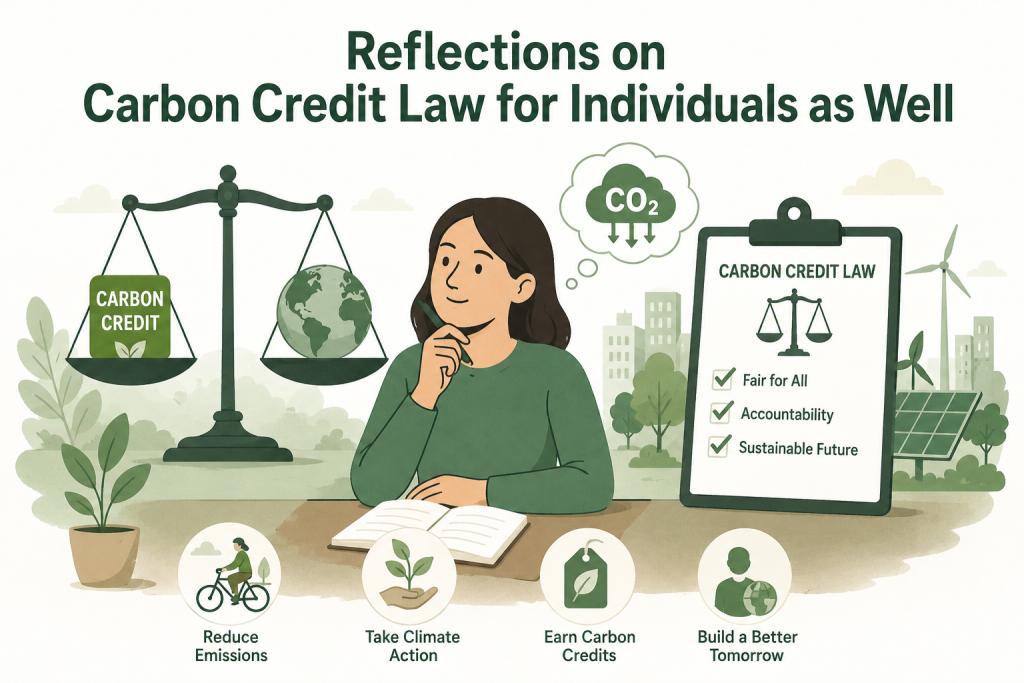
This principle raises an important question: Should environmental responsibility be limited only to companies?
Every human being consumes natural resources throughout life. We use fuel for cooking, transportation, housing, manufacturing, agriculture, and countless daily activities. Wood, metals, electricity, petroleum products, and other resources support our existence from birth to death. Even our final rites often require significant amounts of fuel or energy.
If we calculate the total natural resources consumed by an average person over a lifetime of seventy to eighty years, the figure is enormous. While the exact numbers may vary, there is no doubt that each individual leaves an environmental footprint. Therefore, just as industries are expected to compensate for their impact, individuals should also be encouraged to contribute to environmental restoration.
For generations, we have benefited from trees planted by our ancestors. Unfortunately, many of those trees have been cut down without adequate replacement. Forests are shrinking, groundwater levels are declining, and environmental degradation is increasing. The question we must ask ourselves is: What kind of planet will we leave behind for our children and grandchildren?
Governments regularly organize tree-planting campaigns, and millions of saplings are planted every year. However, a large number of these saplings fail to survive because proper care and maintenance are often lacking. Planting trees is important, but ensuring their survival is even more important.
Looking ahead, environmental challenges may become increasingly severe. Climate change, pollution, water scarcity, and declining green cover could threaten future generations. The COVID-19 pandemic reminded us of the value of clean air, health, and environmental resilience. These lessons should not be forgotten.
Therefore, it may be worthwhile for policymakers to consider a system of environmental responsibility for individuals. Such a system could encourage every adult citizen to contribute to tree plantation, forest conservation, or environmental restoration projects. Those unable to plant and maintain trees themselves could contribute financially to verified conservation programs managed transparently by public institutions or community organizations.
The objective would not be to burden citizens but to create a culture of environmental accountability. If every individual contributes, even in a small way, the collective impact could be transformative. Millions of trees could survive and grow, groundwater could improve, biodiversity could be protected, and future generations could inherit a healthier environment.
Today, this idea may seem ambitious. Yet every major social change begins with a new idea. If society and government work together to promote environmental responsibility at both institutional and individual levels, we can build a greener, healthier, and more sustainable future.
May this thought become a stepping stone toward a new era of environmental stewardship and national progress.
