Mazhar Hussain, Chief Executive, COVA, Hyderabad.
Peace Series 8
What if schools taught students not only how to solve mathematical equations but also how to solve the problems around them?
What if young people learned not only about history and science but also about empathy, social responsibility, and community leadership?
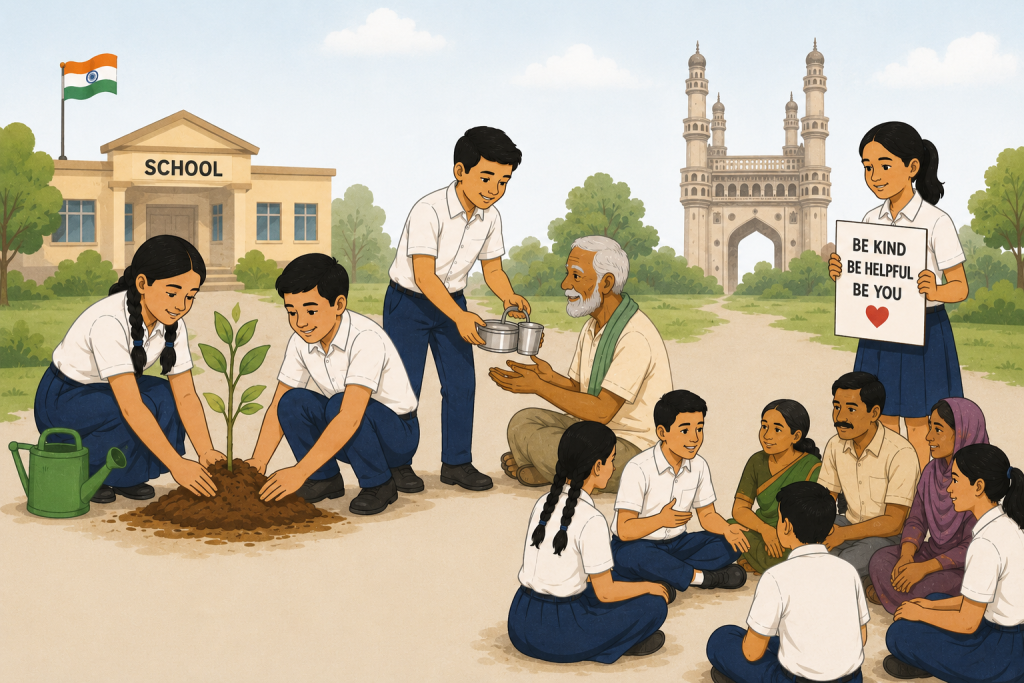
In Telangana, an innovative educational initiative is attempting to answer these questions. Led by the COVA Peace Network in collaboration with the School Education Department, Government of Telangana, the Compassionate Citizenship Program (CCP) is redefining what it means to educate young people for the future.
The program begins with a simple belief: education should create not only professionals but also compassionate human beings.
The Missing Dimension in Education
India’s education system has produced millions of doctors, engineers, scientists, administrators, and entrepreneurs. Academic achievement remains a central focus of schools, and rightly so. However, while students are equipped to compete in examinations and careers, they often receive limited opportunities to understand the social realities around them.
Many young people grow up without direct exposure to the struggles faced by marginalized communities, environmental challenges, public health concerns, or issues of social justice. As a result, society increasingly witnesses indifference towards the suffering of others, weakening social cohesion and contributing to intolerance, hatred, and violence.
Recognizing this gap, COVA Peace Network designed the Compassionate Citizenship Program to take students beyond classrooms and textbooks. The objective is not merely to teach about society but to immerse students in understanding social issues and inspire them to become active contributors to positive change.
Learning Through Real-Life Experiences
The program engages students from Classes 7 to 9 and introduces them to social issues through a combination of lectures, fieldwork, research, advocacy, and community engagement.
Instead of learning exclusively through books, students investigate real-world challenges affecting their communities. They interact with citizens, conduct interviews, organize discussions, observe local conditions, and document their findings using scientific methods.
Students learn how to identify a problem, gather evidence, analyse information, engage with stakeholders, and propose practical solutions.
The approach combines the principles of social science research with civic responsibility, transforming young learners into investigators, problem-solvers, and change-makers.
A Successful Pilot that Inspired Expansion
The Compassionate Citizenship Program was initially implemented as a pilot project during 2022-23 in 120 schools across four districts of Telangana.
The results exceeded expectations.
Teachers observed increased confidence among students, stronger analytical abilities, greater social awareness, and improved communication skills. Students who previously had little exposure to community issues began discussing solutions to problems such as sanitation, environmental degradation, public services, discrimination, and community welfare.
Encouraged by the program’s impact, the School Education Department entered into a partnership with COVA to scale the initiative dramatically.
Today, the program is being expanded to approximately 3,000 schools across Telangana, making it one of the largest school-based citizenship and social engagement programs in the country.
Turning Students into Researchers
One of the most innovative aspects of the program is the Project Work component.
Students are trained in basic social science methodologies including:
- Questionnaire development
- Interviews and focus group discussions
- Transect walks and observation techniques
- Data collection and analysis
- Report writing and documentation
Working individually or in groups, students investigate issues affecting their local communities. They collect evidence, analyse causes, identify stakeholders, and suggest practical recommendations.
This process teaches critical thinking, scientific inquiry, and problem-solving skills while simultaneously nurturing empathy and social awareness.
Rather than viewing social issues as distant problems, students begin to understand how these challenges affect real people in their own communities.
From Awareness to Action
The Compassionate Citizenship Program goes beyond awareness creation.
Its ultimate goal is what COVA describes as Responsible Activism.
Students are encouraged not only to study problems but also to become part of the solution.
After completing their research, they prepare representations to elected representatives and government officials. They learn how governance systems function and how citizens can engage constructively with authorities.
Students organize awareness campaigns, poster exhibitions, rallies, presentations, and community dialogues. Some create short videos and social media messages to spread awareness. Others participate in local improvement initiatives addressing environmental and social concerns.
Through these experiences, young people discover that positive change does not always require large resources. It often begins with informed citizens taking small but meaningful actions.
Building Future Leaders
The program requires approximately 40 hours of engagement during an academic year.
Activities include expert lectures, field visits, advocacy interactions, internet-based research, report writing, and project exhibitions.
Importantly, the program has been designed to fit within existing school schedules. Many activities are conducted during bagless days and through structured after-school engagements, ensuring that academic learning remains unaffected.
Teachers receive specialized training to mentor students throughout the process. Volunteers from the National Service Scheme (NSS) also support implementation by delivering lectures and accompanying students during field studies.
This collaborative model creates an ecosystem where schools, communities, government departments, civil society organizations, and young people work together.
Creating Change Champions
The vision behind the Compassionate Citizenship Program extends far beyond individual schools.
COVA believes that today’s students are tomorrow’s leaders, policymakers, professionals, entrepreneurs, and citizens. If they develop compassion, empathy, and civic responsibility early in life, they will carry these values into every sphere of society.
Whether a student becomes a doctor, engineer, teacher, bureaucrat, scientist, or entrepreneur, the program seeks to ensure that professional success is accompanied by social consciousness.
At a time when societies across the world are grappling with polarization, environmental crises, and social fragmentation, initiatives such as the Compassionate Citizenship Program offer a powerful alternative.
They remind us that education is not merely about preparing children for jobs. It is about preparing them for life.
By helping students understand social realities, engage with communities, and take responsibility for change, Telangana’s Compassionate Citizenship Program is nurturing a generation of compassionate citizens—young people who will not only build successful careers but also contribute to building a more just, peaceful, and inclusive society.